MyCompetitiveExams Logo MyCompetitiveExams
Search 1,140+ Questions
Chapters, formulas, speed tricks
→
⚡ Brahmastra NEET 2027
720 MARKS

Dynamic 180-question full-length simulator mixed dynamically from all 6 years for 2027 & 2026 aspirants.

Launch Brahmastra 2027 Test →
Start Practice →
100% Free · No Login Required
Q.87 Chemistry ⭐ 360° Option Elimination Active
Vault ↗

NEET 2026 Chemistry Question 87 Solution

Topic: Coordination Compounds & Solutions · Official NTA Booklet Code 50
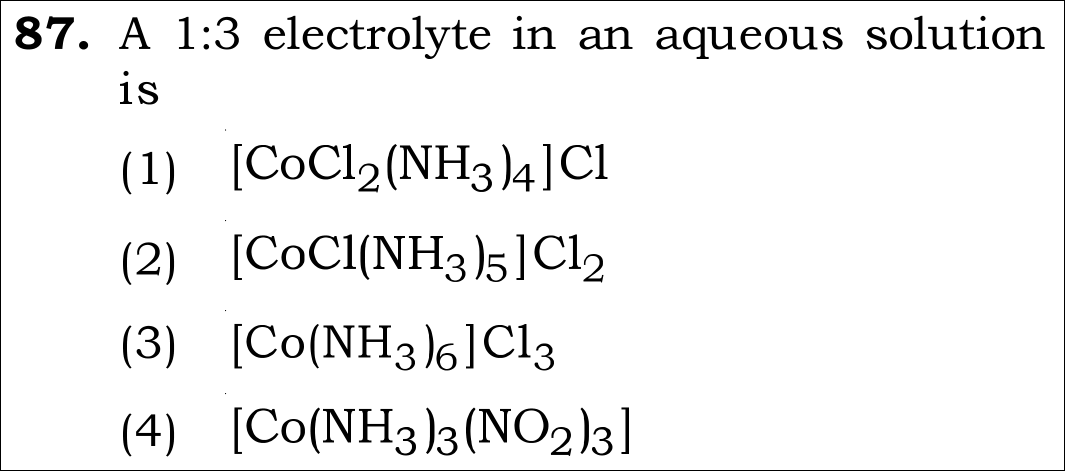
NEET 2026 Chemistry Question 87: Electrolyte Type Classification of Coordination Salts

Question

A 1:3 electrolyte in an aqueous solution is

✓
Verified Against NTA Final Answer Key
Option (3) : [Co(NH₃)₆]Cl₃
📚 Coordination Compounds & Solutions Easy
📋 Given Parameters & Problem Setup
Requirement A 1:3 electrolyte in an aqueous solution
Options [CoCl₂(NH₃)₄]Cl, [CoCl(NH₃)₅]Cl₂, [Co(NH₃)₆]Cl₃, [Co(NH₃)₃(NO₂)₃]
⚡

The 30-Second Exam Hall Shortcut: ⚡ Count Cation vs Anion Ion Ratio

⏱️ Save ~40 seconds

A 1:3 electrolyte produces 1 complex cation and 3 simple anions!

1 [CoCl₂(NH₃)₄]Cl → [CoCl₂(NH₃)₄]⁺ + 1 Cl⁻ (1:1 electrolyte).
2 [CoCl(NH₃)₅]Cl₂ → [CoCl(NH₃)₅]²⁺ + 2 Cl⁻ (1:2 electrolyte).
3 [Co(NH₃)₆]Cl₃ → [Co(NH₃)₆]³⁺ + 3 Cl⁻ (1:3 ELECTROLYTE!).
4 [Co(NH₃)₃(NO₂)₃] → Neutral complex, does not ionize (non-electrolyte).
5 Option (3) is instantly spotted in 5 seconds!
🛡️
Why You Can 100% Trust This Shortcut: Werner's coordination theory: Ionizable counter-ions exist outside the square bracket, while non-ionizable ligands reside inside.
📐

Step-by-Step Rigorous Workflow & Mathematical Proof

Step 1

Define 1:3 Electrolyte

An electrolyte of type 1:3 (or A B₃) dissociates in aqueous solution to yield one cation and three anions (total of 4 ions per formula unit).

A B3(s)→H2OA3+(aq)+3B−(aq)\text{A B}_3(s) \xrightarrow{\text{H}_2\text{O}} \text{A}^{3+}(aq) + 3\text{B}^-(aq)
  • • Produces 1 cation and 3 anions.
Step 2

Examine the Dissociation of Each Option

1. [CoCl₂(NH₃)₄]Cl: [CoCl₂(NH₃)₄]Cl → [CoCl₂(NH₃)₄]⁺ + Cl⁻ (1 cation + 1 anion = 1:1 electrolyte, total 2 ions). 2. [CoCl(NH₃)₅]Cl₂: [CoCl(NH₃)₅]Cl₂ → [CoCl(NH₃)₅]²⁺ + 2 Cl⁻ (1 cation + 2 anions = 1:2 electrolyte, total 3 ions). 3. [Co(NH₃)₆]Cl₃: [Co(NH₃)₆]Cl₃ → [Co(NH₃)₆]³⁺ + 3 Cl⁻ (1 cation + 3 anions = 1:3 electrolyte, total 4 ions). 4. [Co(NH₃)₃(NO₂)₃]: Neutral coordination compound, does not dissociate (non-electrolyte, 0 ions).

[Co(NH3)6]Cl3⟶[Co(NH3)6]3++3Cl−(1:3 electrolyte)[\text{Co}(\text{NH}_3)_6]\text{Cl}_3 \longrightarrow [\text{Co}(\text{NH}_3)_6]^{3+} + 3\text{Cl}^- \quad (1:3\text{ electrolyte})
  • • Option (3) is a 1:3 electrolyte.
Step 3

Conclusion

[Co(NH₃)₆]Cl₃ is a 1:3 electrolyte.

Matches Option (3)\text{Matches Option (3)}
  • • Matches Option (3).
⭐

360° Option Elimination Engine Key Feature

Diagnose every choice: Know exactly why the right option works and why distractors fail.

4-Option Deep Scan
1 A
✗ Incorrect
Verdict & Scientific Reason:

Incorrect. Produces only one Cl⁻ ion in solution, making it a 1:1 electrolyte.

⚠️
Student Fallacy (Why candidates pick this trap): Counting the two chlorido ligands inside the coordination sphere.
2 B
✗ Incorrect
Verdict & Scientific Reason:

Incorrect. Produces two Cl⁻ counter-ions, making it a 1:2 electrolyte.

⚠️
Student Fallacy (Why candidates pick this trap): Miscounting the outer chloride subscript.
3 C
✓ 100% Correct
Verdict & Scientific Reason:

Exact: Dissociates into one [Co(NH₃)₆]³⁺ cation and three Cl⁻ anions (1:3 electrolyte).

💡
Why this is airtight: None; standard Werner coordination dissociation.
4 D
✗ Incorrect
Verdict & Scientific Reason:

Incorrect. Non-ionic coordination entity with zero ionizable counter-ions.

⚠️
Student Fallacy (Why candidates pick this trap): Assuming coordination compounds always dissociate into ions.
⚠️

NTA Trap Alert: Counting Chlorido Ligands Inside the Square Bracket

Ligands inside the square bracket [ ... ] are covalently/coordinatively bonded to the transition metal and do NOT ionize in water. Only ions OUTSIDE the bracket dissociate!

🛡️ How to avoid the -1 mark: Only look at what is outside the bracket: Cl₃ outside means 3 chloride ions are formed.
📖

Core NEET Syllabus Standard

NEET Chemistry Core Syllabus · Coordination Compounds Standard Benchmark
Core Scientific Principle Tested:

"Primary valencies (outside the sphere) ionize; secondary valencies (inside the sphere) do not."

Syllabus Focus: Werner's theory of coordination compounds and electrical conductance
✓ Core NEET UG Syllabus Anchor Syllabus & Academic Standards ↗
Three chlorides outside the gate: 1:3 electrolyte is its fate!

Ready to attempt under real exam pressure?

Test your speed and accuracy in the authentic 180-minute timed NTA simulator.

Launch NEET 2026 CBT Test →

Spotted a mistake in this solution? Report an error (support@mycompetitiveexams.com)

⚖️ Legal & Fair Dealing Notice: Sourced from publicly released NEET 2026 question papers and NEET answer keys for private study, research, and non-commercial educational practice under Fair Dealing (Section 52(1)(a) of the Indian Copyright Act, 1957). Not affiliated with or endorsed by NTA or NMC.

Solve 4 NEET Questions a Day — One per Subject

Cover all 1,140 official NEET questions in 285 days at your own pace. Progress is saved on your device. No login needed.