MyCompetitiveExams Logo MyCompetitiveExams
Search 1,140+ Questions
Chapters, formulas, speed tricks
→
⚡ Brahmastra NEET 2027
720 MARKS

Dynamic 180-question full-length simulator mixed dynamically from all 6 years for 2027 & 2026 aspirants.

Launch Brahmastra 2027 Test →
Start Practice →
100% Free · No Login Required
Q.109 Botany ⭐ 360° Option Elimination Active
Vault ↗

NEET 2026 Botany Question 109 Solution

Topic: Respiration in Plants · Official NTA Booklet Code 50
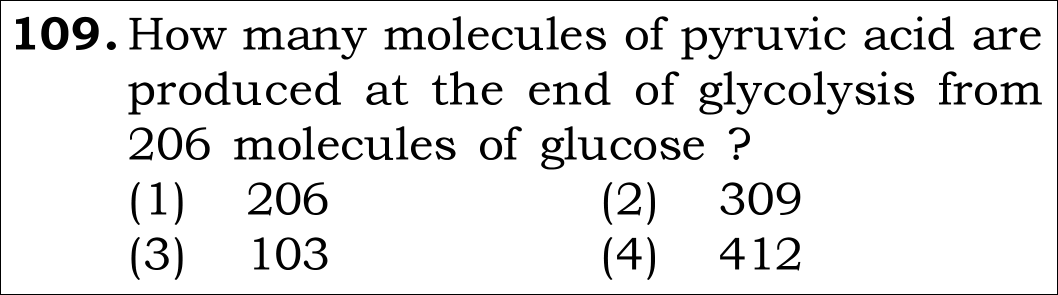
NEET 2026 Botany Question 109: Stoichiometry of Glycolysis (EMP Pathway)

Question

How many molecules of pyruvic acid are produced at the end of glycolysis from 206 molecules of glucose?

  1. (1)206
  2. (2)309
  3. (3)103
  4. (4)412
✓
Verified Against NTA Final Answer Key
Option (4) : 412
📚 Respiration in Plants Easy
📋 Given Parameters & Problem Setup
Starting Substrate 206 molecules of glucose (C₆H₁₂O₆)
Metabolic Pathway Glycolysis (EMP pathway in cytoplasm)
⚡

The 30-Second Exam Hall Shortcut: ⚡ 1 Glucose = 2 Pyruvate Rule

⏱️ Save ~40 seconds

Simply multiply the number of glucose molecules by 2!

1 Recall fundamental glycolysis cleavage stoichiometry:
2 1 molecule of 6-carbon glucose yields 2 molecules of 3-carbon pyruvic acid.
3 Calculate: 206 × 2 = 412.
4 Option (4) is 412. Done in 3 seconds!
🛡️
Why You Can 100% Trust This Shortcut: Universal biochemical law: C₆H₁₂O₆ -> 2 CH₃COCOOH.
📐

Step-by-Step Rigorous Workflow & Mathematical Proof

Step 1

Biochemical Equation of Glycolysis

Glycolysis occurs in the cytoplasm of all living cells. A single molecule of hexose sugar (glucose, 6 carbons) undergoes a 10-step enzymatic sequence ending with cleavage into two molecules of triose keto-acid (pyruvic acid, 3 carbons).

1 Glucose (6C)+2NAD++2ADP+2Pi→EMP2 Pyruvic acid (3C)+2NADH+2H++2ATP1\text{ Glucose (6C)} + 2\text{NAD}^+ + 2\text{ADP} + 2\text{P}_i \xrightarrow{\text{EMP}} 2\text{ Pyruvic acid (3C)} + 2\text{NADH} + 2\text{H}^+ + 2\text{ATP}
  • • Stoichiometric yield: 2 pyruvic acid molecules per 1 glucose molecule consumed.
Step 2

Calculate for 206 Molecules of Glucose

Multiply the input glucose quantity by the stoichiometric conversion factor of 2.

Molecules of Pyruvic Acid=206×2=412\text{Molecules of Pyruvic Acid} = 206 \times 2 = 412
  • • 206 × 2 = 412 molecules of pyruvic acid.
Step 3

Evaluate Against Options

Looking at the available options: (1) 206, (2) 309, (3) 103, (4) 412. Option (4) is the exact calculated value.

Correct Option=412  [Option (4)]\text{Correct Option} = \mathbf{412} \; [\text{Option (4)}]
  • • Matches official NTA final answer key Option D / (4).
⭐

360° Option Elimination Engine Key Feature

Diagnose every choice: Know exactly why the right option works and why distractors fail.

4-Option Deep Scan
1 A
✗ Incorrect
Verdict & Scientific Reason:

Incorrect. Assumes a 1:1 stoichiometric ratio between glucose and pyruvic acid.

⚠️
Student Fallacy (Why candidates pick this trap): Ignoring the enzymatic splitting of fructose-1,6-bisphosphate into two triose molecules.
2 B
✗ Incorrect
Verdict & Scientific Reason:

Incorrect. Represents a 1.5 ratio, which is chemically impossible.

⚠️
Student Fallacy (Why candidates pick this trap): Arithmetic miscalculation.
3 C
✗ Incorrect
Verdict & Scientific Reason:

Incorrect. Divides 206 by 2 instead of multiplying.

⚠️
Student Fallacy (Why candidates pick this trap): Confusing substrate-to-product stoichiometry by dividing instead of multiplying.
4 D
✓ 100% Correct
Verdict & Scientific Reason:

100% mathematically and biochemically exact: 206 × 2 = 412.

💡
Why this is airtight: None; precise stoichiometry.
⚠️

NTA Trap Alert: Inverting the Multiplication Factor

Some hurried students see "2 pyruvic acid per glucose" and divide the number of glucose molecules by 2, yielding 103 (Option 3).

🛡️ How to avoid the -1 mark: Always remember: 1 6-carbon molecule breaks into TWO 3-carbon molecules. The number of molecules must DOUBLE!
📖

Core NEET Syllabus Standard

NEET Biology Core Syllabus · Respiration in Plants Standard Benchmark
Core Scientific Principle Tested:

"In glycolysis, partial oxidation of one molecule of glucose gives rise to two molecules of pyruvic acid."

Syllabus Focus: Glycolysis
✓ Core NEET UG Syllabus Anchor Syllabus & Academic Standards ↗
One glucose splits in two, so two hundred and six gives four hundred and twelve for you!

Ready to attempt under real exam pressure?

Test your speed and accuracy in the authentic 180-minute timed NTA simulator.

Launch NEET 2026 CBT Test →

Spotted a mistake in this solution? Report an error (support@mycompetitiveexams.com)

⚖️ Legal & Fair Dealing Notice: Sourced from publicly released NEET 2026 question papers and NEET answer keys for private study, research, and non-commercial educational practice under Fair Dealing (Section 52(1)(a) of the Indian Copyright Act, 1957). Not affiliated with or endorsed by NTA or NMC.

Solve 4 NEET Questions a Day — One per Subject

Cover all 1,140 official NEET questions in 285 days at your own pace. Progress is saved on your device. No login needed.