MyCompetitiveExams Logo MyCompetitiveExams
Search 1,140+ Questions
Chapters, formulas, speed tricks
→
⚡ Brahmastra NEET 2027
720 MARKS

Dynamic 180-question full-length simulator mixed dynamically from all 6 years for 2027 & 2026 aspirants.

Launch Brahmastra 2027 Test →
Start Practice →
100% Free · No Login Required
Q.91 Botany ⭐ 360° Option Elimination Active
Vault ↗

NEET 2025 Botany Question 91 Solution

Topic: Respiration in Plants · Official NTA Booklet Code 45
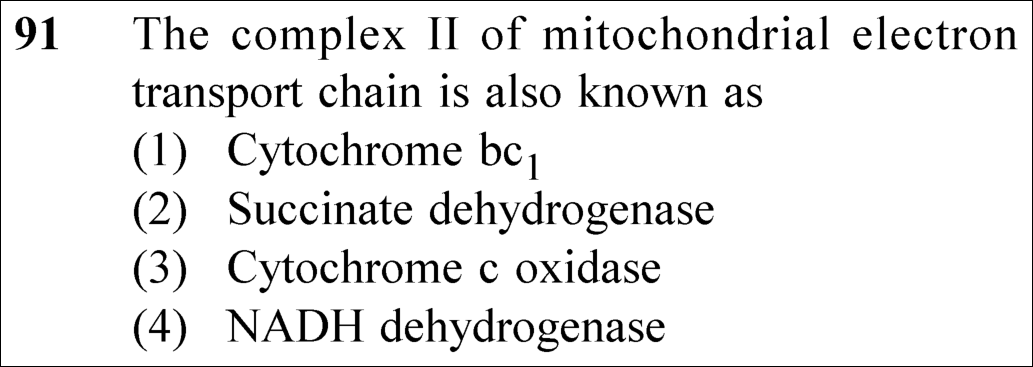
NEET 2025 Botany Question 91: Enzyme Complexes of the Mitochondrial Electron Transport Chain

Question

The complex II of mitochondrial electron transport chain is also known as

✓
Verified Against NTA Final Answer Key
Option (2) : Succinate dehydrogenase
📚 Respiration in Plants Easy
📋 Given Parameters & Problem Setup
Target Complex Complex II of the mitochondrial Electron Transport Chain (ETC)
Organelle Location Inner mitochondrial membrane
⚡

The 30-Second Exam Hall Shortcut: ⚡ ETS Enzyme Complex Fingerprint

⏱️ Save ~25 seconds

Complex I = NADH dehydrogenase, Complex II = Succinate dehydrogenase, Complex III = Cytochrome bc₁, Complex IV = Cytochrome c oxidase, Complex V = ATP synthase! Complex II is Succinate dehydrogenase!

1 Recall the 5 multi-protein complexes of the inner mitochondrial membrane:
2 - Complex I: NADH dehydrogenase (transfers electrons from NADH to ubiquinone).
3 - Complex II: Succinate dehydrogenase (oxidizes succinate to fumarate in Krebs cycle and transfers electrons to ubiquinone via FADH₂).
4 - Complex III: Cytochrome bc₁ complex.
5 - Complex IV: Cytochrome c oxidase (contains cytochromes a and a₃ and two Cu centres).
6 - Complex V: ATP synthase (coupling factor F₀-F₁).
7 Complex II is uniquely Succinate dehydrogenase!
8 Select Option (2) in under 5 seconds!
🛡️
Why You Can 100% Trust This Shortcut: NCERT Biology · Respiration in Plants (Mitochondrial ETS: Complex II is succinate dehydrogenase).
📐

Step-by-Step Rigorous Workflow & Mathematical Proof

Step 1

Organization of the Mitochondrial Electron Transport System (ETS)

Metabolic oxidation of NADH + H⁺ and FADH₂ generated during glycolysis and the TCA cycle transfers electrons through a series of enzyme complexes embedded in the inner mitochondrial membrane:

Complex I=NADH:ubiquinone oxidoreductase (NADH dehydrogenase)\text{Complex I} = \text{NADH:ubiquinone oxidoreductase (NADH dehydrogenase)}
  • • Complex I transfers electrons from NADH to ubiquinone (coenzyme Q) with concomitant proton pumping.
Step 2

Identification and Dual Role of Complex II

Complex II functions simultaneously as an enzyme of the Krebs cycle and a component of the electron transport chain:

Succinate+FAD→Complex II (Succinate dehydrogenase)Fumarate+FADH2\text{Succinate} + \text{FAD} \xrightarrow{\text{Complex II (Succinate dehydrogenase)}} \text{Fumarate} + \text{FADH}_2
  • • Electrons from FADH₂ are transferred to ubiquinone to generate ubiquinol (QH₂).
  • • Unlike Complexes I, III, and IV, Complex II does not pump protons across the inner mitochondrial membrane.
Step 3

Review Complexes III, IV, and V

Contrast Complex II with the other options:

Complex III=Cytochrome bc1,Complex IV=Cytochrome c oxidase\text{Complex III} = \text{Cytochrome } bc_1, \quad \text{Complex IV} = \text{Cytochrome } c \text{ oxidase}
  • • Thus Complex II is specifically Succinate dehydrogenase, matching Option (2).
⭐

360° Option Elimination Engine Key Feature

Diagnose every choice: Know exactly why the right option works and why distractors fail.

4-Option Deep Scan
1 A
✗ Incorrect
Verdict & Scientific Reason:

Incorrect. Cytochrome bc₁ is Complex III.

⚠️
Student Fallacy (Why candidates pick this trap): Confusing Complex II with Complex III.
2 B
✓ 100% Correct
Verdict & Scientific Reason:

100% correct. Complex II is canonically Succinate dehydrogenase.

💡
Why this is airtight: None; verbatim NCERT recall.
3 C
✗ Incorrect
Verdict & Scientific Reason:

Incorrect. Cytochrome c oxidase is Complex IV.

⚠️
Student Fallacy (Why candidates pick this trap): Confusing terminal complex with Complex II.
4 D
✗ Incorrect
Verdict & Scientific Reason:

Incorrect. NADH dehydrogenase is Complex I.

⚠️
Student Fallacy (Why candidates pick this trap): Confusing Complex I with Complex II.
⚠️

NTA Trap Alert: Scrambling Numbers of ETS Complexes

Candidates often mix up Complex I (NADH dehydrogenase) and Complex II (Succinate dehydrogenase). Remember that NADH enters first at Complex I, while FADH₂ enters at Complex II!

🛡️ How to avoid the -1 mark: Order of electron entry: NADH at Complex I; Succinate/FADH₂ at Complex II!
📖

Core NEET Syllabus Standard

NEET Biology Core Syllabus · Respiration in Plants Standard Benchmark
Core Scientific Principle Tested:

"Complex II of mitochondrial ETS is succinate dehydrogenase."

Syllabus Focus: Electron Transport System (ETS) and Oxidative Phosphorylation
✓ Core NEET UG Syllabus Anchor Syllabus & Academic Standards ↗
1 = NADH, 2 = Succinate, 3 = bc₁, 4 = Cytochrome c Oxidase ⟹ Complex II = Succinate (Option 2)!

Ready to attempt under real exam pressure?

Test your speed and accuracy in the authentic 180-minute timed NTA simulator.

Launch NEET 2025 CBT Test →

Spotted a mistake in this solution? Report an error (support@mycompetitiveexams.com)

⚖️ Legal & Fair Dealing Notice: Sourced from publicly released NEET 2025 question papers and NEET answer keys for private study, research, and non-commercial educational practice under Fair Dealing (Section 52(1)(a) of the Indian Copyright Act, 1957). Not affiliated with or endorsed by NTA or NMC.

Solve 4 NEET Questions a Day — One per Subject

Cover all 1,140 official NEET questions in 285 days at your own pace. Progress is saved on your device. No login needed.