MyCompetitiveExams Logo MyCompetitiveExams
Search 1,140+ Questions
Chapters, formulas, speed tricks
→
⚡ Brahmastra NEET 2027
720 MARKS

Dynamic 180-question full-length simulator mixed dynamically from all 6 years for 2027 & 2026 aspirants.

Launch Brahmastra 2027 Test →
Start Practice →
100% Free · No Login Required
Q.22 Physics ⭐ 360° Option Elimination Active
Vault ↗

NEET 2025 Physics Question 22 Solution

Topic: System of Particles and Rotational Motion · Official NTA Booklet Code 45
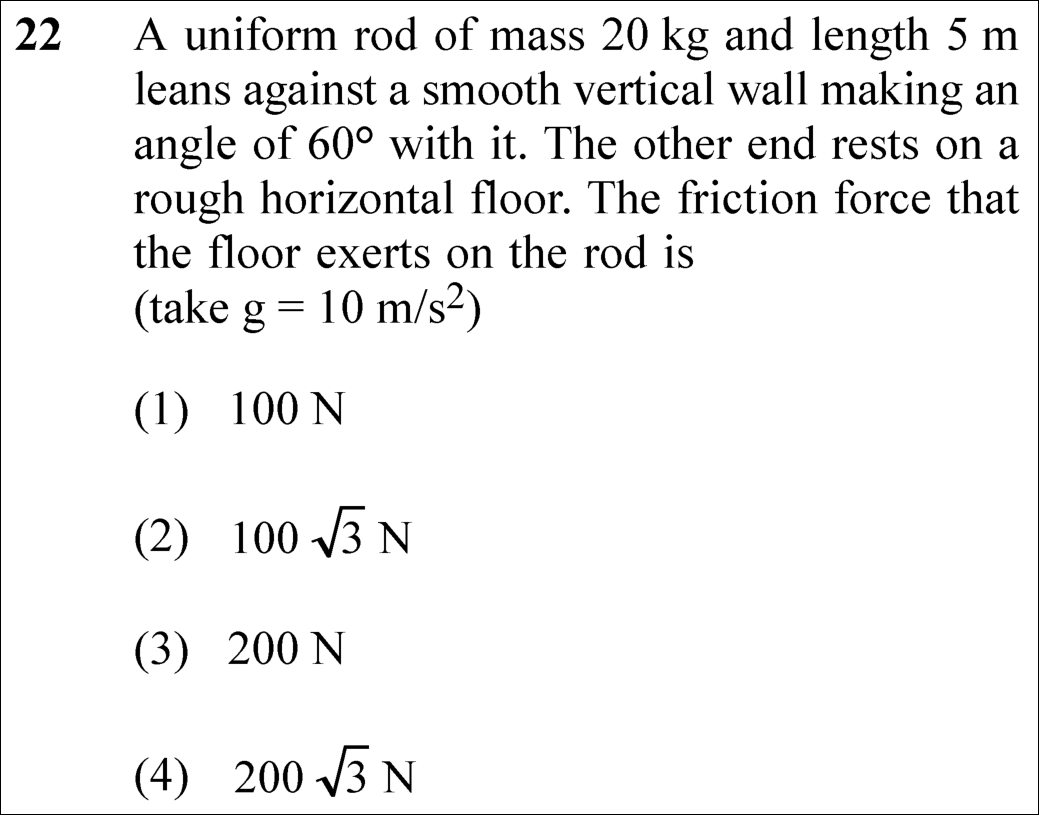
NEET 2025 Physics Question 22: Leaning Rod Equilibrium & Static Friction from Floor

Question

A uniform rod of mass 20 kg and length 5 m leans against a smooth vertical wall making an angle of 60° with it. The other end rests on a rough horizontal floor. The friction force that the floor exerts on the rod is (take g = 10 m/s²)

✓
Verified Against NTA Final Answer Key
Option (2) : 100\sqrt{3} N
📚 System of Particles and Rotational Motion Medium
📋 Given Parameters & Problem Setup
Rod Mass (m) 20 kg (Weight W = mg = 200 N)
Rod Length (L) 5 m
Inclination Angle 60° with the smooth vertical wall
Wall & Floor Characteristics Vertical wall is frictionless (smooth); Floor is rough horizontal
⚡

The 30-Second Exam Hall Shortcut: ⚡ Wall Reaction & Friction Torque Shortcut

⏱️ Save ~45 seconds

Angle with wall is 60° ⟹ Angle with floor is 30°! Torque about base: N_w (L cos 60°) = mg (L/2 sin 60°) ⟹ N_w = (mg/2) tan 60° = (200/2) √3 = 100√3 N = Friction!

1 Notice: The problem says "making an angle of 60° with IT" (with the vertical wall).
2 Floor friction f balances the horizontal normal reaction from the wall N_w: f = N_w.
3 Take torque about base contact point on floor:
4 Torque of N_w = N_w × L cos 60° (counter-clockwise).
5 Torque of weight mg = mg × (L/2) sin 60° (clockwise).
6 Equate: N_w = (mg / 2) × (sin 60° / cos 60°) = (mg / 2) tan 60° = 100 × √3 = 100√3 N.
7 Since f = N_w, friction force = 100√3 N.
8 Select Option (2) in under 20 seconds!
🛡️
Why You Can 100% Trust This Shortcut: Rotational Equilibrium of Rigid Bodies (NCERT Physics · System of Particles and Rotational Motion: Στ = 0).
📐

Step-by-Step Rigorous Workflow & Mathematical Proof

Step 1

Force Balance on the Leaning Rod

Four forces act on the uniform rod in equilibrium: (1) Normal reaction at the smooth wall N_w acting horizontally to the right. (2) Static friction force f from the rough floor acting horizontally to the left. (3) Normal reaction from the floor N_f acting vertically upward. (4) Weight of the rod W = mg = 20 × 10 = 200 N acting downward at the midpoint.

∑Fx=0  ⟹  f=Nw,∑Fy=0  ⟹  Nf=mg=200 N\sum F_x = 0 \implies f = N_w, \quad \sum F_y = 0 \implies N_f = mg = 200\text{ N}
  • • The wall is smooth, so there is no vertical friction at the wall.
Step 2

Rotational Equilibrium About Base Contact Point

Let the rod have length L. The angle with the vertical wall is θ = 60°. The top of the rod is at height h = L cos 60°, and the center of mass is at horizontal distance x_cm = (L/2) sin 60° from the base. Taking torque about the base point on the floor:

∑τbase=0  ⟹  Nw⋅(Lcos⁡60∘)=mg⋅(L2sin⁡60∘)\sum \tau_{base} = 0 \implies N_w \cdot (L \cos 60^\circ) = mg \cdot \left(\frac{L}{2} \sin 60^\circ\right)
  • • N_w = (mg / 2) tan 60°.
Step 3

Calculate Wall Reaction and Friction Force

Substitute the given values mg = 200 N and tan 60° = √3:

Nw=200 N2×3=1003 N  ⟹  f=Nw=1003 NN_w = \frac{200\text{ N}}{2} \times \sqrt{3} = 100\sqrt{3}\text{ N} \implies f = N_w = 100\sqrt{3}\text{ N}
  • • Thus the friction force exerted by the floor on the rod is 100√3 N, matching Option (2).
⭐

360° Option Elimination Engine Key Feature

Diagnose every choice: Know exactly why the right option works and why distractors fail.

4-Option Deep Scan
1 A
✗ Incorrect
Verdict & Scientific Reason:

Incorrect. Forgets the tan 60° = √3 factor (takes mg/2 = 100 N).

⚠️
Student Fallacy (Why candidates pick this trap): Omitting the angular geometric lever arm factor.
2 B
✓ 100% Correct
Verdict & Scientific Reason:

100% correct. f = N_w = (mg/2) tan 60° = 100√3 N.

💡
Why this is airtight: None; rigorous rigid body torque balance.
3 C
✗ Incorrect
Verdict & Scientific Reason:

Incorrect. 200 N is the vertical normal reaction from the floor N_f, not horizontal friction.

⚠️
Student Fallacy (Why candidates pick this trap): Confusing vertical normal reaction with horizontal friction force.
4 D
✗ Incorrect
Verdict & Scientific Reason:

Incorrect. Forgets the factor of 1/2 from the center of mass position (L/2).

⚠️
Student Fallacy (Why candidates pick this trap): Treating weight as acting at the top of the rod instead of center of mass.
⚠️

NTA Trap Alert: Angle Reference Ambiguity (Wall vs. Floor)

The question states: "making an angle of 60° with IT" (the vertical wall). If a student misreads this as 60° with the floor, they calculate (mg/2) tan 30° = 100/√3 N. Always read the reference surface carefully!

🛡️ How to avoid the -1 mark: Identify what "it" refers to: smooth vertical wall ⟹ angle with wall = 60°.
📖

Core NEET Syllabus Standard

NEET Physics Core Syllabus · System of Particles and Rotational Motion Standard Benchmark
Core Scientific Principle Tested:

"Translational equilibrium (Σ F = 0) and rotational equilibrium (Σ τ = 0) uniquely determine support reactions."

Syllabus Focus: Equilibrium of a Rigid Body
✓ Core NEET UG Syllabus Anchor Syllabus & Academic Standards ↗
Torque about base: N_w = (mg/2) tan(θ_wall) = (200/2) √3 = 100√3 N!

Ready to attempt under real exam pressure?

Test your speed and accuracy in the authentic 180-minute timed NTA simulator.

Launch NEET 2025 CBT Test →

Spotted a mistake in this solution? Report an error (support@mycompetitiveexams.com)

⚖️ Legal & Fair Dealing Notice: Sourced from publicly released NEET 2025 question papers and NEET answer keys for private study, research, and non-commercial educational practice under Fair Dealing (Section 52(1)(a) of the Indian Copyright Act, 1957). Not affiliated with or endorsed by NTA or NMC.

Solve 4 NEET Questions a Day — One per Subject

Cover all 1,140 official NEET questions in 285 days at your own pace. Progress is saved on your device. No login needed.