MyCompetitiveExams Logo MyCompetitiveExams
Search 1,140+ Questions
Chapters, formulas, speed tricks
→
⚡ Brahmastra NEET 2027
720 MARKS

Dynamic 180-question full-length simulator mixed dynamically from all 6 years for 2027 & 2026 aspirants.

Launch Brahmastra 2027 Test →
Start Practice →
100% Free · No Login Required
Q.132 Botany ⭐ 360° Option Elimination Active
Vault ↗

NEET 2025 Botany Question 132 Solution

Topic: Biological Classification · Official NTA Booklet Code 45
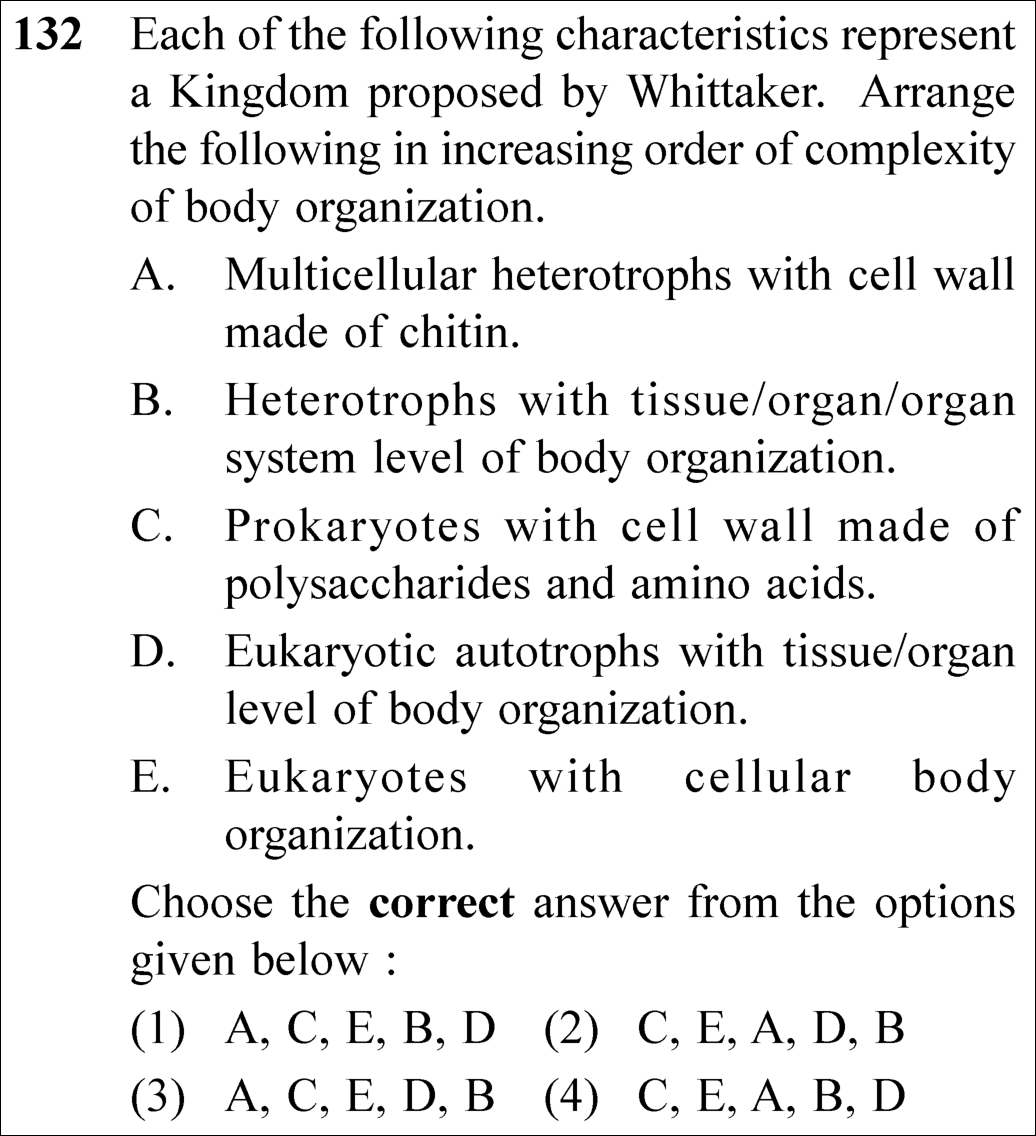
NEET 2025 Botany Question 132: Whittaker's Five Kingdoms: Hierarchy of Body Organization Complexity

Question

Each of the following characteristics represent a Kingdom proposed by Whittaker. Arrange the following in increasing order of complexity of body organization. A. Multicellular heterotrophs with cell wall made of chitin. B. Heterotrophs with tissue/organ/organ system level of body organization. C. Prokaryotes with cell wall made of polysaccharides and amino acids. D. Eukaryotic autotrophs with tissue/organ level of body organization. E. Eukaryotes with cellular body organization. Choose the correct answer from the options given below:

✓
Verified Against NTA Final Answer Key
Option (2) : C, E, A, D, B
📚 Biological Classification Medium
📋 Given Parameters & Problem Setup
Trait A Multicellular heterotrophs with cell wall made of chitin (Kingdom Fungi)
Trait B Heterotrophs with tissue/organ/organ system level of body organization (Kingdom Animalia)
Trait C Prokaryotes with cell wall made of polysaccharides and amino acids (Kingdom Monera)
Trait D Eukaryotic autotrophs with tissue/organ level of body organization (Kingdom Plantae)
Trait E Eukaryotes with cellular body organization (Kingdom Protista)
⚡

The 30-Second Exam Hall Shortcut: ⚡ Five Kingdom Body Complexity Hierarchy

⏱️ Save ~35 seconds

Evolutionary body complexity: Monera (Prokaryotic cellular, C) -> Protista (Eukaryotic cellular, E) -> Fungi (Multicellular/loose tissue, A) -> Plantae (Tissue/organ, D) -> Animalia (Tissue/organ/organ system, B)! Sequence: C -> E -> A -> D -> B!

1 Identify each Kingdom from NCERT Table 2.1:
2 - C: Monera (Prokaryotic, cellular organization).
3 - E: Protista (Eukaryotic, unicellular/cellular organization).
4 - A: Fungi (Multicellular, loose tissue organization).
5 - D: Plantae (Tissue / organ level organization).
6 - B: Animalia (Tissue / organ / organ system level organization).
7 Arrange in INCREASING complexity:
8 C (Cellular prokaryote) < E (Cellular eukaryote) < A (Multicellular/loose tissue) < D (Tissue/organ) < B (Organ system).
9 Correct order: C, E, A, D, B (Option 2)!
10 Select Option (2)!
🛡️
Why You Can 100% Trust This Shortcut: Five Kingdom Classification Diagnostic Traits (NCERT Biology · Biological Classification: Whittaker criteria).
📐

Step-by-Step Rigorous Workflow & Mathematical Proof

Step 1

Deciphering the Five Kingdoms from the Descriptions

R.H. Whittaker (1969) proposed the Five Kingdom Classification based on cell structure, body organization, mode of nutrition, reproduction, and phylogenetic relationships:

  • • Statement C: "Prokaryotes with cell wall made of polysaccharides and amino acids (peptidoglycan)" -> Kingdom Monera (Cellular level, prokaryotic).
  • • Statement E: "Eukaryotes with cellular body organization" -> Kingdom Protista (Cellular level, eukaryotic).
  • • Statement A: "Multicellular heterotrophs with cell wall made of chitin" -> Kingdom Fungi (Multicellular / loose tissue level).
  • • Statement D: "Eukaryotic autotrophs with tissue/organ level of body organization" -> Kingdom Plantae (Tissue / organ level).
  • • Statement B: "Heterotrophs with tissue/organ/organ system level of body organization" -> Kingdom Animalia (Tissue / organ / organ system level).
Step 2

Ordering by Increasing Complexity of Body Organization

Tracing the progressive structural advancement according to NCERT Table 2.1:

  • • 1. Monera (C): Cellular (simplest, lacking membrane-bound nucleus and organelles).
  • • 2. Protista (E): Cellular (eukaryotic cell with defined compartmentalization).
  • • 3. Fungi (A): Multicellular / loose tissue.
  • • 4. Plantae (D): Tissue / organ.
  • • 5. Animalia (B): Tissue / organ / organ system (highest structural complexity).
Step 3

Conclusion

The unambiguous increasing sequence of body complexity is C -> E -> A -> D -> B, which is Option (2).

Hierarchy: C→E→A→D→B\text{Hierarchy: } C \rightarrow E \rightarrow A \rightarrow D \rightarrow B
⭐

360° Option Elimination Engine Key Feature

Diagnose every choice: Know exactly why the right option works and why distractors fail.

4-Option Deep Scan
1 A
✗ Incorrect
Verdict & Scientific Reason:

Incorrect. Places fungi (A) before monera (C) and protista (E).

⚠️
Student Fallacy (Why candidates pick this trap): Ignoring the requirement for increasing complexity.
2 B
✓ 100% Correct
Verdict & Scientific Reason:

100% correct. Flawlessly aligns the five kingdoms from unicellular prokaryote up to complex organ systems.

💡
Why this is airtight: None; rigorous phylogenetic and anatomical understanding.
3 C
✗ Incorrect
Verdict & Scientific Reason:

Incorrect. Starts with multicellular fungi rather than unicellular monera.

⚠️
Student Fallacy (Why candidates pick this trap): Misinterpreting Kingdom descriptions.
4 D
✗ Incorrect
Verdict & Scientific Reason:

Incorrect. Places animalia (B) before plantae (D), violating increasing order since animals possess organ system level.

⚠️
Student Fallacy (Why candidates pick this trap): Swapping Plantae and Animalia levels of organization.
⚠️

NTA Trap Alert: Plantae vs Animalia Level of Organization

NCERT Table 2.1 explicitly states: Plantae body organization is "Tissue/organ", whereas Animalia is "Tissue/organ/organ system". Animalia has organ systems (digestive, respiratory, circulatory, etc.) making it more complex than Plantae!

🛡️ How to avoid the -1 mark: Plantae (Tissue/organ) comes BEFORE Animalia (Organ system).
📖

Core NEET Syllabus Standard

NEET Biology Core Syllabus · Biological Classification Standard Benchmark
Core Scientific Principle Tested:

"Body organization complexity increases from Monera (cellular prokaryotic) -> Protista (cellular eukaryotic) -> Fungi (loose tissue) -> Plantae (tissue/organ) -> Animalia (organ system)."

Syllabus Focus: Five Kingdom Classification · Table 2.1
✓ Core NEET UG Syllabus Anchor Syllabus & Academic Standards ↗
M-P-F-P-A: Monera(C) -> Protista(E) -> Fungi(A) -> Plantae(D) -> Animalia(B)!

Ready to attempt under real exam pressure?

Test your speed and accuracy in the authentic 180-minute timed NTA simulator.

Launch NEET 2025 CBT Test →

Spotted a mistake in this solution? Report an error (support@mycompetitiveexams.com)

⚖️ Legal & Fair Dealing Notice: Sourced from publicly released NEET 2025 question papers and NEET answer keys for private study, research, and non-commercial educational practice under Fair Dealing (Section 52(1)(a) of the Indian Copyright Act, 1957). Not affiliated with or endorsed by NTA or NMC.

Solve 4 NEET Questions a Day — One per Subject

Cover all 1,140 official NEET questions in 285 days at your own pace. Progress is saved on your device. No login needed.