MyCompetitiveExams Logo MyCompetitiveExams
Search 1,140+ Questions
Chapters, formulas, speed tricks
→
⚡ Brahmastra NEET 2027
720 MARKS

Dynamic 180-question full-length simulator mixed dynamically from all 6 years for 2027 & 2026 aspirants.

Launch Brahmastra 2027 Test →
Start Practice →
100% Free · No Login Required
Q.101 Botany ⭐ 360° Option Elimination Active
Vault ↗

NEET 2025 Botany Question 101 Solution

Topic: Locomotion and Movement & Human Physiology · Official NTA Booklet Code 45
NEET 2025 Botany Question 101: Matching Clinical Disorders with Diagnostic Pathological Symptoms

Question

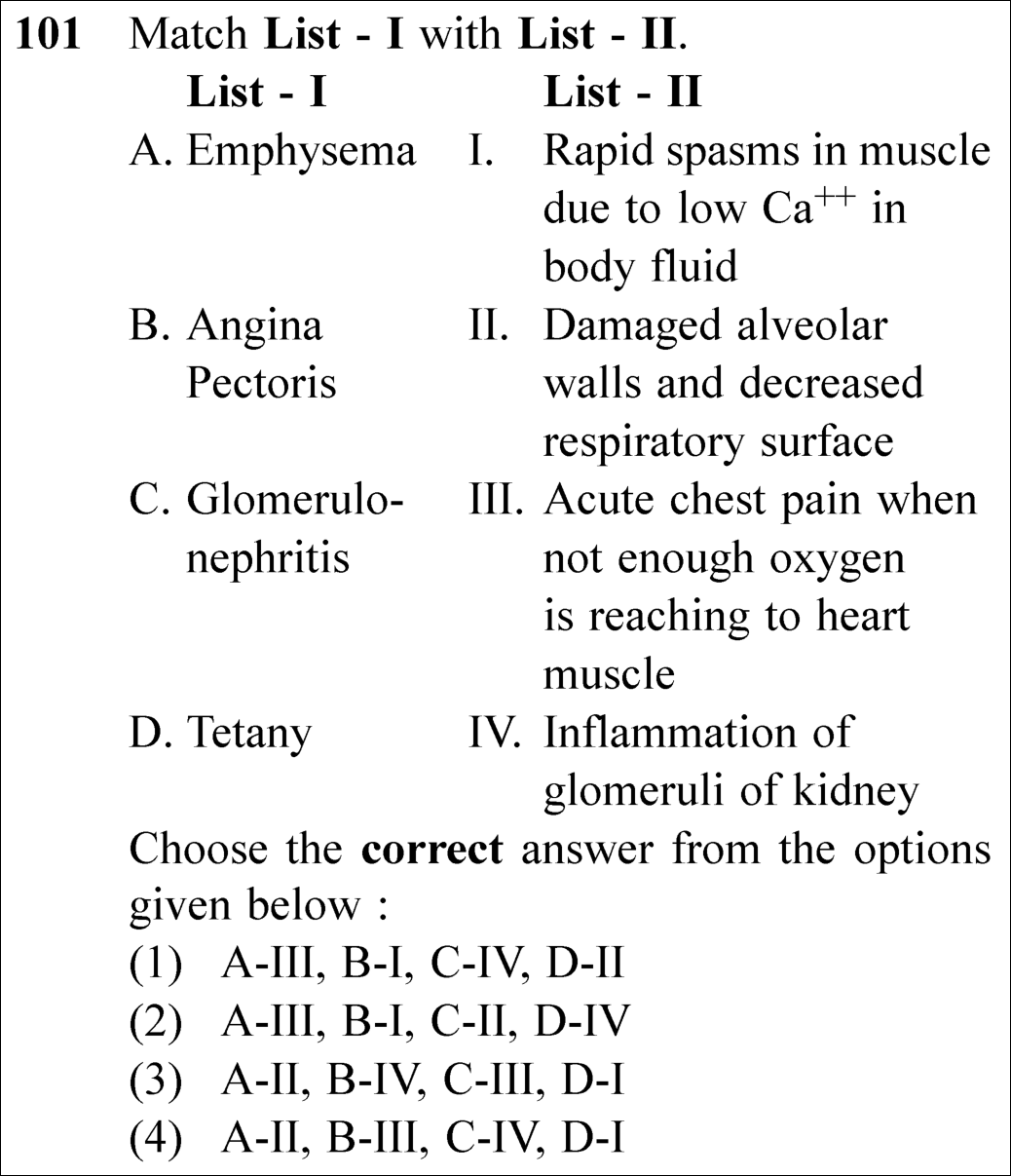
Match List - I with List - II. List I: A. Emphysema; B. Angina Pectoris; C. Glomerulonephritis; D. Tetany. List II: I. Rapid spasms in muscle due to low Ca²⁺ in body fluid; II. Damaged alveolar walls and decreased respiratory surface; III. Acute chest pain when not enough oxygen is reaching to heart muscle; IV. Inflammation of glomeruli of kidney. Choose the correct answer from the options given below:

✓
Verified Against NTA Final Answer Key
Option (4) : A-II, B-III, C-IV, D-I
📚 Locomotion and Movement & Human Physiology Easy
📋 Given Parameters & Problem Setup
List I (Disorders) A. Emphysema, B. Angina Pectoris, C. Glomerulonephritis, D. Tetany
List II (Symptoms/Pathology) I. Rapid spasms in muscle due to low Ca⁺⁺ in body fluid, II. Damaged alveolar walls and decreased respiratory surface, III. Acute chest pain when not enough oxygen is reaching to heart muscle, IV. Inflammation of glomeruli of kidney
⚡

The 30-Second Exam Hall Shortcut: ⚡ Physiological Pathology Match

⏱️ Save ~30 seconds

Emphysema = Damaged alveolar walls (A-II). Angina Pectoris = Heart ischemic chest pain (B-III). Glomerulonephritis = Glomerular kidney inflammation (C-IV). Tetany = Low Ca²⁺ muscle spasms (D-I)! ⟹ A-II, B-III, C-IV, D-I!

1 A. Emphysema: Chronic obstructive pulmonary disease where alveolar walls are damaged, reducing surface area for gas exchange ⟹ A matches II.
2 B. Angina Pectoris: Symptom of coronary ischemia characterized by acute retrosternal chest pain due to insufficient oxygen supply to myocardium ⟹ B matches III.
3 C. Glomerulonephritis: Inflammation of the renal glomeruli ⟹ C matches IV.
4 D. Tetany: Hypocalcemic tetany characterized by wild, rapid muscle spasms caused by low extracellular Ca²⁺ ⟹ D matches I.
5 Combined match: A-II, B-III, C-IV, D-I.
6 Select Option (4) in under 10 seconds!
🛡️
Why You Can 100% Trust This Shortcut: NCERT Biology Chapters 17, 18, 19, 20 (Disorders Sections) verbatim.
📐

Step-by-Step Rigorous Workflow & Mathematical Proof

Step 1

Match Emphysema and Angina Pectoris

Examine respiratory and cardiovascular pathology from NCERT:

Emphysema (A)  ⟹  Damaged alveolar walls (II),Angina Pectoris (B)  ⟹  Ischemic chest pain (III)\text{Emphysema (A)} \implies \text{Damaged alveolar walls (II)}, \quad \text{Angina Pectoris (B)} \implies \text{Ischemic chest pain (III)}
  • • A matches II (A-II).
  • • B matches III (B-III).
Step 2

Match Glomerulonephritis and Tetany

Examine excretory and musculoskeletal disorders:

Glomerulonephritis (C)  ⟹  Kidney glomeruli inflammation (IV),Tetany (D)  ⟹  Low Ca2+ muscle spasms (I)\text{Glomerulonephritis (C)} \implies \text{Kidney glomeruli inflammation (IV)}, \quad \text{Tetany (D)} \implies \text{Low Ca}^{2+} \text{ muscle spasms (I)}
  • • C matches IV (C-IV).
  • • D matches I (D-I).
Step 3

Synthesize the Complete Match

Assemble the pairs:

A-II, B-III, C-IV, D-I  ⟹  Option (4)\text{A-II, B-III, C-IV, D-I} \implies \text{Option (4)}
  • • Matches Option (4) perfectly.
⭐

360° Option Elimination Engine Key Feature

Diagnose every choice: Know exactly why the right option works and why distractors fail.

4-Option Deep Scan
1 A
✗ Incorrect
Verdict & Scientific Reason:

Incorrect. Assigns chest pain to emphysema.

⚠️
Student Fallacy (Why candidates pick this trap): Confusing respiratory and cardiac disorders.
2 B
✗ Incorrect
Verdict & Scientific Reason:

Incorrect. Completely scrambled match.

⚠️
Student Fallacy (Why candidates pick this trap): Scrambling multiple organ disorders.
3 C
✗ Incorrect
Verdict & Scientific Reason:

Incorrect. Swaps angina pectoris and glomerulonephritis.

⚠️
Student Fallacy (Why candidates pick this trap): Confusing kidney inflammation with heart pain.
4 D
✓ 100% Correct
Verdict & Scientific Reason:

100% correct. Direct canonical match of all four NCERT disorders.

💡
Why this is airtight: None; flawless medical physiology recall.
⚠️

NTA Trap Alert: Confusing Tetany with Tetanus

Tetanus is caused by Clostridium tetani bacteria (lockjaw). TETANY is caused by low calcium (hypocalcemia) in extracellular fluid, leading to wild muscle twitches and spasms!

🛡️ How to avoid the -1 mark: Remember: Tetany = Low Calcium; Tetanus = Clostridium toxin!
📖

Core NEET Syllabus Standard

NEET Biology Core Syllabus · Locomotion and Movement & Excretory Products Standard Benchmark
Core Scientific Principle Tested:

"Emphysema: damaged alveolar walls; Angina: cardiac chest pain; Glomerulonephritis: inflamed glomeruli; Tetany: low Ca²⁺ spasms."

Syllabus Focus: Disorders of Human Systems (Respiratory, Circulatory, Excretory, Muscular)
✓ Core NEET UG Syllabus Anchor Syllabus & Academic Standards ↗
Emphysema = Alveoli (II), Angina = Chest Pain (III), Nephritis = Glomeruli (IV), Tetany = Low Calcium (I) ⟹ Option 4!

Ready to attempt under real exam pressure?

Test your speed and accuracy in the authentic 180-minute timed NTA simulator.

Launch NEET 2025 CBT Test →

Spotted a mistake in this solution? Report an error (support@mycompetitiveexams.com)

⚖️ Legal & Fair Dealing Notice: Sourced from publicly released NEET 2025 question papers and NEET answer keys for private study, research, and non-commercial educational practice under Fair Dealing (Section 52(1)(a) of the Indian Copyright Act, 1957). Not affiliated with or endorsed by NTA or NMC.

Solve 4 NEET Questions a Day — One per Subject

Cover all 1,140 official NEET questions in 285 days at your own pace. Progress is saved on your device. No login needed.