MyCompetitiveExams Logo MyCompetitiveExams
Search 1,140+ Questions
Chapters, formulas, speed tricks
→
⚡ Brahmastra NEET 2027
720 MARKS

Dynamic 180-question full-length simulator mixed dynamically from all 6 years for 2027 & 2026 aspirants.

Launch Brahmastra 2027 Test →
Start Practice →
100% Free · No Login Required
Q.117 Botany ⭐ 360° Option Elimination Active
Vault ↗

NEET 2026 Botany Question 117 Solution

Topic: Body Fluids and Circulation · Official NTA Booklet Code 50
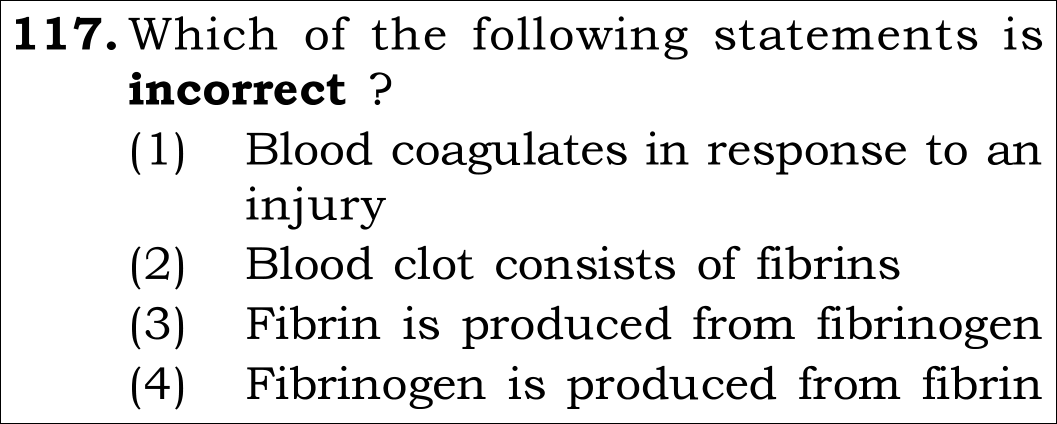
NEET 2026 Botany Question 117: Biochemical Cascade of Blood Coagulation & Clot Formation

Question

Which of the following statements is incorrect?

  1. (1)Blood coagulates in response to an injury
  2. (2)Blood clot consists of fibrins
  3. (3)Fibrin is produced from fibrinogen
  4. (4)Fibrinogen is produced from fibrin
✓
Verified Against NTA Final Answer Key
Option (4) : Fibrinogen is produced from fibrin
📚 Body Fluids and Circulation Easy
📋 Given Parameters & Problem Setup
Physiological Process Blood coagulation (hemostasis)
Key Components Thrombokinase, Prothrombin, Thrombin, Fibrinogen, Fibrin
⚡

The 30-Second Exam Hall Shortcut: ⚡ Clotting Precursor Direction Rule

⏱️ Save ~35 seconds

Thrombin turns inactive Fibrinogen INTO active Fibrin, NEVER the reverse!

1 Recall the final common pathway of coagulation:
2 Prothrombin -> Thrombin (via Thrombokinase + Ca²⁺).
3 Fibrinogen -> Fibrin (catalyzed by Thrombin).
4 Statement (3) correctly says "Fibrin is produced from fibrinogen".
5 Statement (4) falsely states "Fibrinogen is produced from fibrin". That is backwards!
6 The question asks for the INCORRECT statement -> Select Option (4) immediately!
🛡️
Why You Can 100% Trust This Shortcut: NCERT Body Fluids and Circulation verbatim: Fibrins are formed by the conversion of inactive fibrinogens in the plasma by the enzyme thrombin.
📐

Step-by-Step Rigorous Workflow & Mathematical Proof

Step 1

Understand the Blood Clotting Cascade

When a blood vessel suffers trauma or injury, platelets and injured tissues release thromboplastin, triggering an enzymatic cascade leading to the formation of thrombokinase (prothrombinase).

Prothrombin→Thrombokinase+Ca2+Thrombin\text{Prothrombin} \xrightarrow{\text{Thrombokinase} + \text{Ca}^{2+}} \text{Thrombin}
  • • Thrombokinase converts inactive plasma prothrombin into active thrombin.
Step 2

Fibrinogen to Fibrin Conversion

Thrombin then acts as an enzyme to cleave soluble inactive fibrinogen into insoluble fibrin monomers, which polymerize into long threads trapping blood cells to form the clot (coagulum).

Fibrinogen (soluble)→ThrombinFibrin (insoluble threads)\text{Fibrinogen (soluble)} \xrightarrow{\text{Thrombin}} \text{Fibrin (insoluble threads)}
  • • Therefore, Fibrin is derived from Fibrinogen, never Fibrinogen from Fibrin!
Step 3

Evaluate Each Statement

(1) Blood coagulates in response to injury: Correct physiological defense mechanism. (2) Blood clot consists of fibrins: Correct, fibrin meshwork forms the structural framework. (3) Fibrin is produced from fibrinogen: Correct. (4) Fibrinogen is produced from fibrin: Incorrect (inverted).

Incorrect Statement="Fibrinogen is produced from fibrin"  ⟹  Option (4)\text{Incorrect Statement} = \text{"Fibrinogen is produced from fibrin"} \implies \text{Option (4)}
  • • Matches official NTA final answer key Option D / (4).
⭐

360° Option Elimination Engine Key Feature

Diagnose every choice: Know exactly why the right option works and why distractors fail.

4-Option Deep Scan
1 A
✗ Incorrect
Verdict & Scientific Reason:

Factually correct statement, hence not the answer to this negative-stem question.

⚠️
Student Fallacy (Why candidates pick this trap): Failing to read the word "incorrect" in the question stem.
2 B
✗ Incorrect
Verdict & Scientific Reason:

Factually correct statement (coagulum is a mesh of fibrin threads trapping dead formed elements).

⚠️
Student Fallacy (Why candidates pick this trap): Confusing correct facts with incorrect choices.
3 C
✗ Incorrect
Verdict & Scientific Reason:

Factually correct biochemical reaction catalyzed by thrombin.

⚠️
Student Fallacy (Why candidates pick this trap): Not noticing the inversion between option 3 and option 4.
4 D
✓ 100% Correct
Verdict & Scientific Reason:

100% incorrect statement, making it the correct answer to the question. Fibrinogen is produced by hepatocytes in the liver, not from fibrin.

💡
Why this is airtight: None; carefully spotted the inverted precursor-product relationship.
⚠️

NTA Trap Alert: The Inversion Trap

Examiners place reciprocal statements (Statement 3 vs Statement 4) knowing that tired candidates may misread who converts into whom.

🛡️ How to avoid the -1 mark: The suffix "-ogen" always means precursor (inactive generator)! Fibrinogen GENERATES Fibrin; Pepsinogen GENERATES Pepsin.
📖

Core NEET Syllabus Standard

NEET Biology Core Syllabus · Body Fluids and Circulation Standard Benchmark
Core Scientific Principle Tested:

"In blood clotting, thrombin converts soluble fibrinogen into insoluble fibrin threads. Fibrinogen is never synthesized from fibrin."

Syllabus Focus: Coagulation of Blood
✓ Core NEET UG Syllabus Anchor Syllabus & Academic Standards ↗
-OGEN means the origin: Fibrinogen makes Fibrin, never reverse the spin!

Ready to attempt under real exam pressure?

Test your speed and accuracy in the authentic 180-minute timed NTA simulator.

Launch NEET 2026 CBT Test →

Spotted a mistake in this solution? Report an error (support@mycompetitiveexams.com)

⚖️ Legal & Fair Dealing Notice: Sourced from publicly released NEET 2026 question papers and NEET answer keys for private study, research, and non-commercial educational practice under Fair Dealing (Section 52(1)(a) of the Indian Copyright Act, 1957). Not affiliated with or endorsed by NTA or NMC.

Solve 4 NEET Questions a Day — One per Subject

Cover all 1,140 official NEET questions in 285 days at your own pace. Progress is saved on your device. No login needed.