MyCompetitiveExams Logo MyCompetitiveExams
Search 1,140+ Questions
Chapters, formulas, speed tricks
→
⚡ Brahmastra NEET 2027
720 MARKS

Dynamic 180-question full-length simulator mixed dynamically from all 6 years for 2027 & 2026 aspirants.

Launch Brahmastra 2027 Test →
Start Practice →
100% Free · No Login Required
Q.95 Chemistry ⭐ 360° Option Elimination Active
Vault ↗

NEET 2021 Chemistry Question 95 Solution

Topic: Aldehydes, Ketones and Carboxylic Acids · Official NTA Booklet Code M1
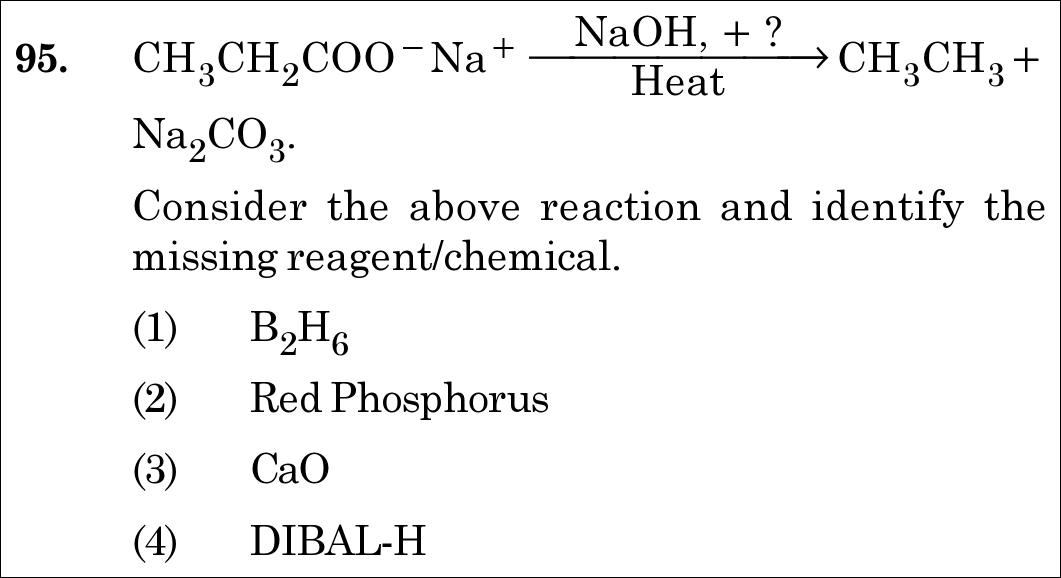
NEET 2021 Chemistry Question 95: Soda Lime Decarboxylation: Identification of Missing Reagent (CaO)

Question

CH₃CH₂COO⁻Na⁺ + NaOH, ? → (Heat) CH₃CH₃ + Na₂CO₃. Consider the above reaction and identify the missing reagent/chemical.

✓
Verified Against NTA Final Answer Key
Option (3) : CaO
📚 Aldehydes, Ketones and Carboxylic Acids Easy
📋 Given Parameters & Problem Setup
Reactant Sodium propanoate (CH3CH2COO- Na+)
Reagent Combination NaOH + ? / Heat
Products Ethane (CH3CH3) + Na2CO3
⚡

The 30-Second Exam Hall Shortcut: ⚡ Soda Lime = NaOH + CaO in 3:1 Ratio

⏱️ Save ~15 seconds

Decarboxylation of sodium salts of carboxylic acids to alkanes requires heating with soda lime, which is a 3:13:1 solid mixture of sodium hydroxide (NaOH\text{NaOH}) and calcium oxide (CaO\text{CaO}). The prompt presents NaOH+?→ΔEthane+Na2CO3\text{NaOH} + ? \xrightarrow{\Delta} \text{Ethane} + Na_2CO_3. The missing component is CaO! Match Option (3)!

1 Inspect reaction: CH3CH2COONa→NaOH+?/ΔCH3CH3+Na2CO3CH_3CH_2COONa \xrightarrow{\text{NaOH} + ? / \Delta} CH_3CH_3 + Na_2CO_3.
2 The carboxylate carbon is eliminated as carbonate (Na2CO3Na_2CO_3), producing an alkane with one fewer carbon atom.
3 This is the classic soda-lime decarboxylation reaction (Dumas reaction).
4 Soda lime is composed of NaOH\text{NaOH} and CaO\text{CaO}.
5 Therefore, the missing chemical is CaO\text{CaO} (calcium oxide / quicklime).
6 Match Option (3).
🛡️
Why You Can 100% Trust This Shortcut: Canonical NCERT Carboxylic Acids and Hydrocarbons preparation of alkanes.
📐

Step-by-Step Rigorous Workflow & Mathematical Proof

Step 1

Identifying the Decarboxylation Reaction

When sodium salts of carboxylic acids are heated strongly with soda lime, they undergo decarboxylation (loss of carbon dioxide) to form an alkane containing one less carbon atom than the parent carboxylic acid: R−COO−Na++NaOH→CaO,ΔR−H+Na2CO3R-COO^-Na^+ + \text{NaOH} \xrightarrow{\text{CaO}, \Delta} R-H + Na_2CO_3

Step 2

Applying to Sodium Propanoate

Here, sodium propanoate (CH3CH2COONaCH_3CH_2COONa, 3 carbons) is heated to produce ethane (CH3CH3CH_3CH_3, 2 carbons) and sodium carbonate:

CH3CH2COO−Na++NaOH→ΔCaOCH3CH3+Na2CO3CH_3CH_2COO^-Na^+ + \text{NaOH} \xrightarrow[\Delta]{\mathbf{CaO}} CH_3CH_3 + Na_2CO_3
Step 3

Role of Calcium Oxide (CaO) in Soda Lime

In soda lime (3NaOH:1CaO3\text{NaOH} : 1\text{CaO}): 1. CaO\text{CaO} keeps the reaction mixture dry by absorbing atmospheric moisture (NaOH\text{NaOH} is deliquescent and would turn into a sticky liquid). 2. It raises the fusion temperature, allowing the reaction mixture to be heated to high temperatures without melting glass containers.

⭐

360° Option Elimination Engine Key Feature

Diagnose every choice: Know exactly why the right option works and why distractors fail.

4-Option Deep Scan
1 1
✗ Incorrect
Verdict & Scientific Reason:

Diborane is a reducing agent that reduces carboxylic acids to primary alcohols, not soda lime component.

⚠️
Student Fallacy (Why candidates pick this trap): Confusing reduction with decarboxylation.
2 2
✗ Incorrect
Verdict & Scientific Reason:

Red phosphorus is used with HIHI for reduction or with X2X_2 in the Hell-Volhard-Zelinsky (HVZ) α\alpha-halogenation reaction.

⚠️
Student Fallacy (Why candidates pick this trap): Confusing HVZ reaction with decarboxylation.
3 3
✓ 100% Correct
Verdict & Scientific Reason:

Exact partner of NaOH\text{NaOH} constituting soda lime (NaOH+CaO\text{NaOH} + \text{CaO}) for decarboxylation.

💡
Why this is airtight: None; textbook organic synthesis recall.
4 4
✗ Incorrect
Verdict & Scientific Reason:

Diisobutylaluminium hydride reduces esters/nitriles to aldehydes at low temperature (−78∘C-78^\circ\text{C}).

⚠️
Student Fallacy (Why candidates pick this trap): Confusing organoaluminium hydride with soda lime.
⚠️

NTA Trap Alert: Decarboxylation Reagents vs. HVZ Reagents Trap

Students frequently mix up the reagents for carboxylic acid reactions: - Decarboxylation: NaOH+CaO\text{NaOH} + \text{CaO} (Soda lime) - α\alpha-Halogenation (HVZ): X2/Red PX_2 / \text{Red P} - Reduction to alkane: HI/Red PHI / \text{Red P} at 200∘C200^\circ\text{C}

🛡️ How to avoid the -1 mark: NaOH+⋯  ⟹  \text{NaOH} + \dots \implies Soda Lime   ⟹  \implies Missing reagent is CaO\text{CaO}.
📖

Core NEET Syllabus Standard

NCERT Chemistry · Aldehydes, Ketones and Carboxylic Acids Standard Benchmark
Core Scientific Principle Tested:

"Carboxylic acids lose carbon dioxide to form hydrocarbons when their sodium salts are heated with soda lime (NaOH and CaO in the ratio 3:1)."

Syllabus Focus: Chemical Reactions of Carboxylic Acids (Decarboxylation)
✓ Core NEET UG Syllabus Anchor Syllabus & Academic Standards ↗

Ready to attempt under real exam pressure?

Test your speed and accuracy in the authentic 200-minute timed NTA simulator.

Launch NEET 2021 CBT Test →

Spotted a mistake in this solution? Report an error (support@mycompetitiveexams.com)

⚖️ Legal & Fair Dealing Notice: Sourced from publicly released NEET 2021 question papers and NEET answer keys for private study, research, and non-commercial educational practice under Fair Dealing (Section 52(1)(a) of the Indian Copyright Act, 1957). Not affiliated with or endorsed by NTA or NMC.

Solve 4 NEET Questions a Day — One per Subject

Cover all 1,140 official NEET questions in 285 days at your own pace. Progress is saved on your device. No login needed.