MyCompetitiveExams Logo MyCompetitiveExams
Search 1,140+ Questions
Chapters, formulas, speed tricks
→
⚡ Brahmastra NEET 2027
720 MARKS

Dynamic 180-question full-length simulator mixed dynamically from all 6 years for 2027 & 2026 aspirants.

Launch Brahmastra 2027 Test →
Start Practice →
100% Free · No Login Required
Q.52 Chemistry ⭐ 360° Option Elimination Active
Vault ↗

NEET 2021 Chemistry Question 52 Solution

Topic: The p-Block Elements · Official NTA Booklet Code M1
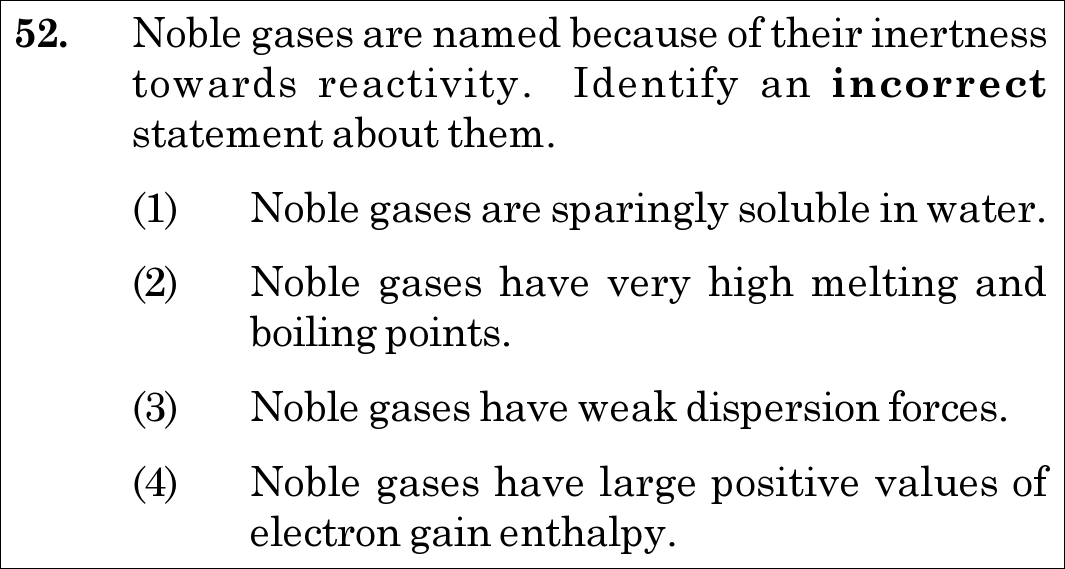
NEET 2021 Chemistry Question 52: Physical and Chemical Properties of Noble Gases

Question

Noble gases are named because of their inertness towards reactivity. Identify an incorrect statement about them.

  1. (1)Noble gases are sparingly soluble in water.
  2. (2)Noble gases have very high melting and boiling points.
  3. (3)Noble gases have weak dispersion forces.
  4. (4)Noble gases have large positive values of electron gain enthalpy.
✓
Verified Against NTA Final Answer Key
Option (2) : Noble gases have very high melting and boiling points.
📚 The p-Block Elements Easy
📋 Given Parameters & Problem Setup
Chemical Family Group 18 (Noble Gases: He, Ne, Ar, Kr, Xe, Rn)
Question Objective Identify the INCORRECT statement
⚡

The 30-Second Exam Hall Shortcut: ⚡ London Forces = Very Low Boiling Points!

⏱️ Save ~20 seconds

Noble gases are monoatomic with completely filled valence octets. The only intermolecular forces operating between them are extremely weak London dispersion forces. Hence, noble gases have extraordinarily LOW melting and boiling points (Helium boils at 4.2 K, the lowest of any substance)! Statement (2) claiming "very high" is completely false! Match Option (2)!

1 Check Statement (1): Noble gases are non-polar and dissolve sparingly in water via dipole-induced dipole interactions -> True.
2 Check Statement (2): Claims "very high melting and boiling points". But monoatomic noble gases have the LOWEST boiling points in the periodic table -> False (Incorrect statement).
3 Check Statement (3): Monoatomic noble gas atoms interact solely via weak dispersion forces -> True.
4 Check Statement (4): Noble gases have stable closed-shell ns2np6ns^2 np^6 configurations; adding an extra electron requires entering a higher principal shell, giving large positive electron gain enthalpies -> True.
5 Match Option (2).
🛡️
Why You Can 100% Trust This Shortcut: Canonical NCERT Group 18 Elements physical properties.
📐

Step-by-Step Rigorous Workflow & Mathematical Proof

Step 1

Analyzing Interatomic Forces in Noble Gases

Noble gases (Group 18) are monoatomic gases with stable closed-shell electronic configurations (ns2np6ns^2 np^6, except He which has 1s21s^2). Because they possess neither permanent electric dipole moments nor covalent bonds between atoms, the only attractive forces holding them together in condensed states are exceedingly weak London dispersion forces (induced dipole - induced dipole interactions).

Step 2

Evaluating Melting and Boiling Points (Statement 2)

Owing to the weakness of dispersion forces, very little thermal energy is required to overcome these interactions. Consequently, noble gases have extremely low melting and boiling points. Helium has the lowest boiling point of any known element at 4.2 K4.2\text{ K} (−268.95∘C-268.95^\circ\text{C}). Therefore, Statement (2) asserting that noble gases have "very high melting and boiling points" is factually and scientifically incorrect.

Step 3

Verifying Statements (1), (3), and (4)

- Statement 1: Noble gases are sparingly soluble in water due to weak dipole-induced dipole forces with polar water molecules (True). - Statement 3: Interatomic forces are indeed weak dispersion forces (True). - Statement 4: Noble gases possess stable octets; accepting an electron into the next higher quantum shell requires substantial energy input, resulting in large positive electron gain enthalpy (ΔegH>0\Delta_{\text{eg}}H > 0) (True).

⭐

360° Option Elimination Engine Key Feature

Diagnose every choice: Know exactly why the right option works and why distractors fail.

4-Option Deep Scan
1 1
✗ Incorrect
Verdict & Scientific Reason:

This statement is scientifically true (dipole-induced dipole dissolution).

⚠️
Student Fallacy (Why candidates pick this trap): Thinking noble gases are completely insoluble.
2 2
✓ 100% Correct
Verdict & Scientific Reason:

This is the INCORRECT statement: noble gases have exceptionally low melting and boiling points.

💡
Why this is airtight: None; textbook periodic property recall.
3 3
✗ Incorrect
Verdict & Scientific Reason:

This statement is scientifically true (London dispersion forces predominate).

⚠️
Student Fallacy (Why candidates pick this trap): Assuming ionic or covalent lattice bonds exist in noble gases.
4 4
✗ Incorrect
Verdict & Scientific Reason:

This statement is scientifically true (closed octets resist electron addition).

⚠️
Student Fallacy (Why candidates pick this trap): Confusing positive electron gain enthalpy with negative electron affinity.
⚠️

NTA Trap Alert: Stable Configuration vs. High Boiling Point Fallacy

Students frequently confuse chemical stability (unreactive octet) with physical cohesive strength. A stable atom does NOT mean high boiling point! In fact, closed octets mean zero valence electrons available for chemical bonding, leading solely to weak dispersion forces and extremely LOW boiling points.

🛡️ How to avoid the -1 mark: Remember: Chemical inertness   ⟹  \implies monoatomic   ⟹  \implies weak London forces   ⟹  \implies LOWEST boiling points.
📖

Core NEET Syllabus Standard

NCERT Chemistry · The p-Block Elements Standard Benchmark
Core Scientific Principle Tested:

"Noble gases have very low melting and boiling points because the only interatomic interactions are weak dispersion forces."

Syllabus Focus: Group 18 Elements (Noble Gases - Physical Properties)
✓ Core NEET UG Syllabus Anchor Syllabus & Academic Standards ↗

Ready to attempt under real exam pressure?

Test your speed and accuracy in the authentic 200-minute timed NTA simulator.

Launch NEET 2021 CBT Test →

Spotted a mistake in this solution? Report an error (support@mycompetitiveexams.com)

⚖️ Legal & Fair Dealing Notice: Sourced from publicly released NEET 2021 question papers and NEET answer keys for private study, research, and non-commercial educational practice under Fair Dealing (Section 52(1)(a) of the Indian Copyright Act, 1957). Not affiliated with or endorsed by NTA or NMC.

Solve 4 NEET Questions a Day — One per Subject

Cover all 1,140 official NEET questions in 285 days at your own pace. Progress is saved on your device. No login needed.