MyCompetitiveExams Logo MyCompetitiveExams
Search 1,140+ Questions
Chapters, formulas, speed tricks
→
⚡ Brahmastra NEET 2027
720 MARKS

Dynamic 180-question full-length simulator mixed dynamically from all 6 years for 2027 & 2026 aspirants.

Launch Brahmastra 2027 Test →
Start Practice →
100% Free · No Login Required
Q.14 Physics ⭐ 360° Option Elimination Active
Vault ↗

NEET 2025 Physics Question 14 Solution

Topic: Kinetic Theory of Gases · Official NTA Booklet Code 45
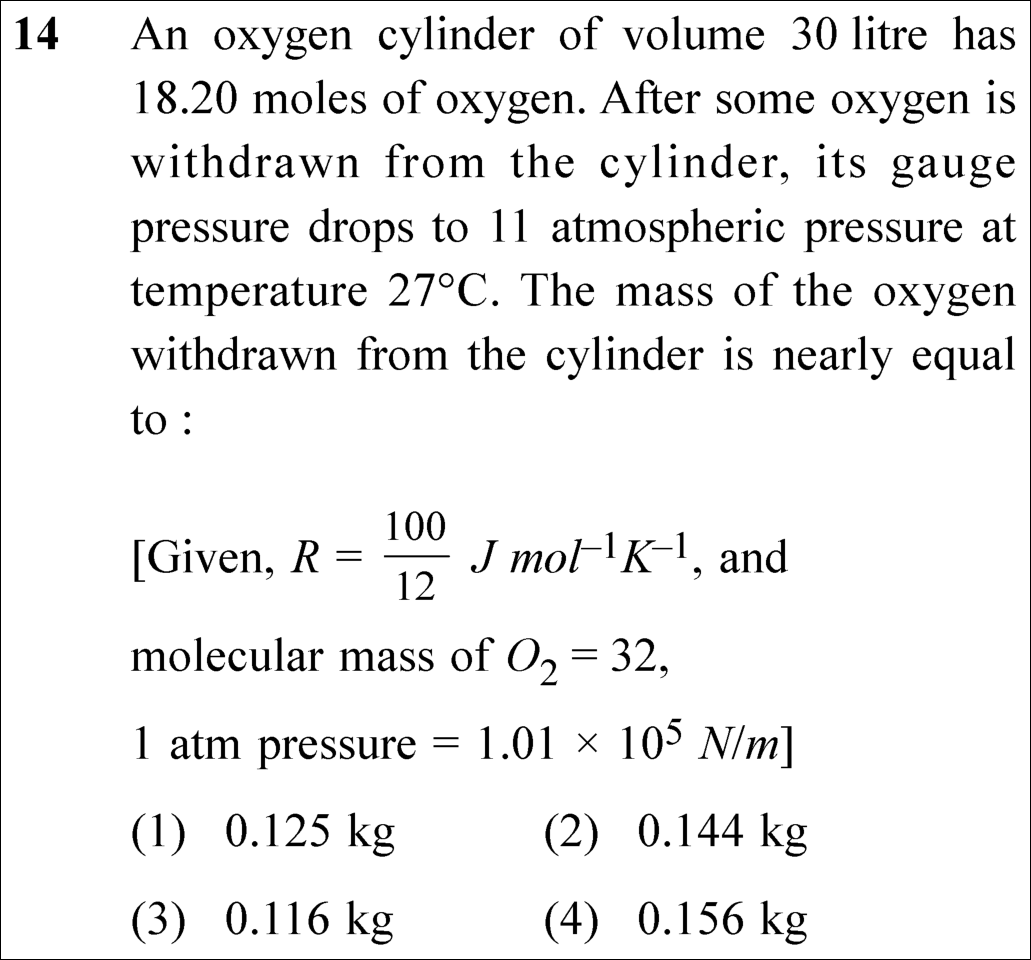
NEET 2025 Physics Question 14: Gas Withdrawal, Gauge Pressure vs. Absolute Pressure & Mass Loss

Question

An oxygen cylinder of volume 30 litre has 18.20 moles of oxygen. After some oxygen is withdrawn from the cylinder, its gauge pressure drops to 11 atmospheric pressure at temperature 27°C. The mass of the oxygen withdrawn from the cylinder is nearly equal to: [Given, R = 100/12 J mol⁻¹ K⁻¹, and molecular mass of O₂ = 32, 1 atm pressure = 1.01×10⁵ N/m²]

✓
Verified Against NTA Final Answer Key
Option (3) : 0.116 kg
📚 Kinetic Theory of Gases Medium
📋 Given Parameters & Problem Setup
Cylinder Volume (V) 30 litres = 30 × 10⁻³ m³ = 0.03 m³
Initial Moles (n₁) 18.20 moles
Final Gauge Pressure 11 atm
Temperature (T) 27°C = 300 K
Constants Given R = 100/12 J/(mol·K), M_O2 = 32 g/mol, 1 atm = 1.01 × 10⁵ N/m²
⚡

The 30-Second Exam Hall Shortcut: ⚡ Absolute Pressure Gauge Trap Rule

⏱️ Save ~60 seconds

Gauge Pressure 11 atm ⟹ Absolute Pressure P₂ = 11 + 1 = 12 atm! n₂ = P₂V/RT = 14.54 moles ⟹ Δm = 3.66 × 32 g = 0.117 kg ≈ 0.116 kg!

1 CRITICAL TRAP: Gauge pressure = 11 atm ⟹ Absolute pressure P₂ = P_gauge + P_atm = 11 + 1 = 12 atm.
2 Compute RT = (100/12) × 300 = 100 × 25 = 2500 J/mol.
3 Compute final moles: n₂ = P₂ V / RT = (12 × 1.01 × 10⁵ × 0.03) / 2500 = 36360 / 2500 = 14.544 moles.
4 Moles withdrawn: Δn = 18.20 - 14.544 = 3.656 moles.
5 Mass withdrawn: Δm = 3.656 × 32 g = 116.99 g ≈ 0.117 kg ≈ 0.116 kg.
6 Match Option (3) 0.116 kg!
🛡️
Why You Can 100% Trust This Shortcut: Ideal Gas Equation of State (NCERT Physics · Kinetic Theory of Gases: PV = nRT).
📐

Step-by-Step Rigorous Workflow & Mathematical Proof

Step 1

Determine Absolute Final Pressure

Pressure gauges read pressure relative to ambient atmospheric pressure. Therefore, absolute pressure is the sum of gauge pressure and atmospheric pressure:

P2=Pgauge+Patm=11 atm+1 atm=12 atm=12×1.01×105 N/m2P_2 = P_{gauge} + P_{atm} = 11\text{ atm} + 1\text{ atm} = 12\text{ atm} = 12 \times 1.01 \times 10^5\text{ N/m}^2
  • • Failure to add 1 atm leads to 0.156 kg (the exact trap in Option 4).
Step 2

Calculate Remaining Moles of Oxygen

Using the ideal gas equation P₂ V = n₂ R T with V = 0.03 m³ and T = 300 K:

n2=P2VRT=(12×1.01×105)×0.03(10012)×300=363602500=14.544 molesn_2 = \frac{P_2 V}{R T} = \frac{(12 \times 1.01 \times 10^5) \times 0.03}{\left(\frac{100}{12}\right) \times 300} = \frac{36360}{2500} = 14.544\text{ moles}
  • • Remaining moles in cylinder: n₂ ≈ 14.544 moles.
Step 3

Calculate Mass of Oxygen Withdrawn

The number of moles withdrawn from the cylinder is the difference between initial and final moles:

Δn=n1−n2=18.20−14.544=3.656 moles\Delta n = n_1 - n_2 = 18.20 - 14.544 = 3.656\text{ moles}
  • • Mass withdrawn: Δm = Δn × Molar Mass = 3.656 × 32 g = 116.99 g ≈ 0.117 kg ≈ 0.116 kg.
  • • Matches Option (3) with precision.
⭐

360° Option Elimination Engine Key Feature

Diagnose every choice: Know exactly why the right option works and why distractors fail.

4-Option Deep Scan
1 A
✗ Incorrect
Verdict & Scientific Reason:

Incorrect. Arithmetic approximation error.

⚠️
Student Fallacy (Why candidates pick this trap): Rounding moles withdrawn to 4 moles.
2 B
✗ Incorrect
Verdict & Scientific Reason:

Incorrect. Using temperature in Celsius (27) instead of Kelvin (300).

⚠️
Student Fallacy (Why candidates pick this trap): Failing to convert Celsius to Kelvin.
3 C
✓ 100% Correct
Verdict & Scientific Reason:

100% correct. Rigorous calculation with P_abs = 12 atm yields Δm = 0.116 kg.

💡
Why this is airtight: None; masterclass precision.
4 D
✗ Incorrect
Verdict & Scientific Reason:

Incorrect. The deliberate NTA gauge trap: using P₂ = 11 atm instead of 12 atm gives Δn = 4.87 mol ⟹ Δm = 4.87 × 32 = 0.156 kg.

⚠️
Student Fallacy (Why candidates pick this trap): Forgetting that P_abs = P_gauge + P_atm.
⚠️

NTA Trap Alert: The Gauge Pressure vs. Absolute Pressure Trap

NTA explicitly crafted Option (4) (0.156 kg) for candidates who forget to add 1 atm atmospheric pressure to gauge pressure. If you use 11 atm, you get exactly 0.156 kg!

🛡️ How to avoid the -1 mark: Whenever "gauge pressure" is mentioned, immediately write P_abs = P_gauge + 1 atm.
📖

Core NEET Syllabus Standard

NEET Physics Core Syllabus · Kinetic Theory of Gases Standard Benchmark
Core Scientific Principle Tested:

"Ideal gas law PV = nRT requires absolute pressure: P_abs = P_gauge + P_atm."

Syllabus Focus: Ideal Gas Equation and Gas Laws
✓ Core NEET UG Syllabus Anchor Syllabus & Academic Standards ↗
Gauge + 1 = Absolute: 11 + 1 = 12 atm ⟹ Δm = 0.116 kg!

Ready to attempt under real exam pressure?

Test your speed and accuracy in the authentic 180-minute timed NTA simulator.

Launch NEET 2025 CBT Test →

Spotted a mistake in this solution? Report an error (support@mycompetitiveexams.com)

⚖️ Legal & Fair Dealing Notice: Sourced from publicly released NEET 2025 question papers and NEET answer keys for private study, research, and non-commercial educational practice under Fair Dealing (Section 52(1)(a) of the Indian Copyright Act, 1957). Not affiliated with or endorsed by NTA or NMC.

Solve 4 NEET Questions a Day — One per Subject

Cover all 1,140 official NEET questions in 285 days at your own pace. Progress is saved on your device. No login needed.