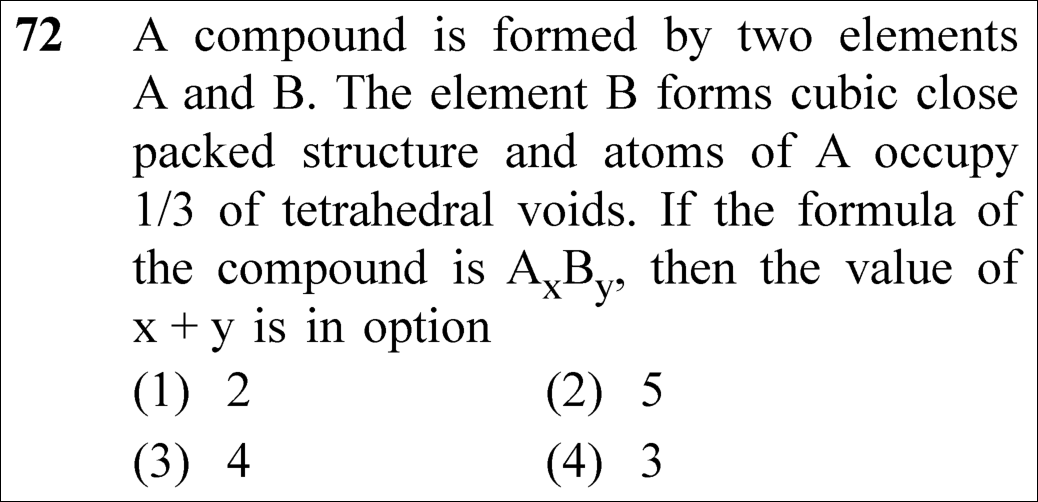
The 30-Second Exam Hall Shortcut: ⚡ Void Ratio Rule: N atoms in ccp ⟹ 2N Tetrahedral Voids
Let B = 1. Tetrahedral voids = 2. A occupies 1/3 of them ⟹ A = 2 × (1/3) = 2/3. Formula = A_(2/3) B_1 = A₂B₃ ⟹ x = 2, y = 3 ⟹ x + y = 2 + 3 = 5 in 10 seconds!
Step-by-Step Rigorous Workflow & Mathematical Proof
Number of Voids in a Cubic Close-Packed (ccp) Array
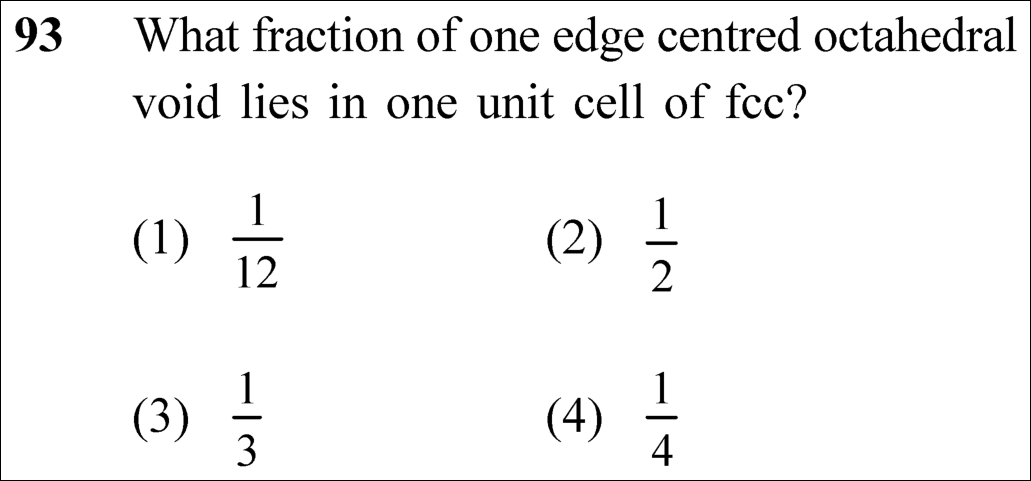
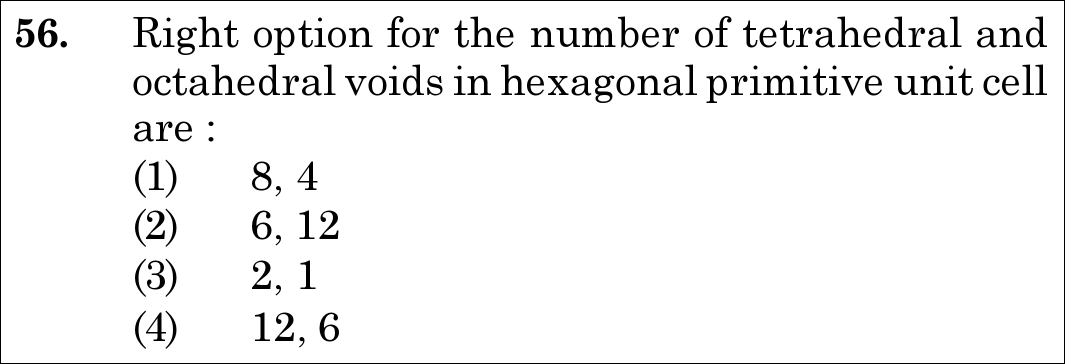
In a cubic close packed (ccp / face-centered cubic) lattice of spheres, let the number of close-packed constituent atoms forming the lattice be N. Geometrical packing dictates that the number of octahedral voids is N, and the number of tetrahedral voids is 2N:
Calculation of Constituent Atoms of Element A
Atoms of element A occupy one-third (1/3) of the available tetrahedral voids. Therefore, the total number of atoms of A per N atoms of B is:
Determination of the Simplest Empirical Formula
Find the simplest whole-number stoichiometric ratio between elements A and B:
Evaluation of the Requested Sum (x + y)
Comparing the empirical formula A₂B₃ with A_x B_y identifies x = 2 and y = 3. Computing their sum:
360° Option Elimination Engine Key Feature
Diagnose every choice: Know exactly why the right option works and why distractors fail.
Represents only subscript x, not the sum x + y.
Accurate sum of subscripts: In A₂B₃, x = 2 and y = 3 ⟹ x + y = 5.
Result of assuming tetrahedral voids equal N instead of 2N (A_(1/3) B_1 = AB₃ ⟹ 1 + 3 = 4).
Represents only subscript y, not the sum x + y.
NTA Trap Alert: Confusing Tetrahedral Voids (2N) with Octahedral Voids (N)
If a student mistakenly assumes there are N tetrahedral voids per N lattice atoms, they calculate A = (1/3)N ⟹ AB₃ ⟹ x + y = 1 + 3 = 4 (Option 3). In close-packed lattices, tetrahedral voids are ALWAYS TWICE the number of lattice spheres (2N)!
Core NEET Syllabus Standard
"Number of tetrahedral voids generated is double the number of close-packed particles. A occupies 1/3 of 2N ⟹ A₂B₃ ⟹ x + y = 5."