MyCompetitiveExams Logo MyCompetitiveExams
Search 1,140+ Questions
Chapters, formulas, speed tricks
→
⚡ Brahmastra NEET 2027
720 MARKS

Dynamic 180-question full-length simulator mixed dynamically from all 6 years for 2027 & 2026 aspirants.

Launch Brahmastra 2027 Test →
Start Practice →
100% Free · No Login Required
🧪 Chemistry Moderate Frequency

NEET The d- and f-Block Elements & Group 17 Elements Previous Year Questions with Solutions

Complete repository of official NTA NEET questions for The d- and f-Block Elements & Group 17 Elements from 2020 to 2026. Every question includes 30-second elimination tricks, step-by-step NCERT solutions, option-by-option traps, and official answer keys.

1 Questions 1 Exam Years (2026) 0 Easy · 1 Medium · 0 Challenging
NEET 2026 · Q65 Medium
Official NEET 2026 Question 65 - The d- and f-Block Elements & Group 17 Elements
1
2
3
4 ✓ Key
💡 Verified Solution & 30-Second Hack
✓
Verified Against NTA Final Answer Key
Option (4) : Statement-I is incorrect but Statement-II is correct.
📚 The d- and f-Block Elements & Group 17 Elements Medium
📋 Given Parameters & Problem Setup
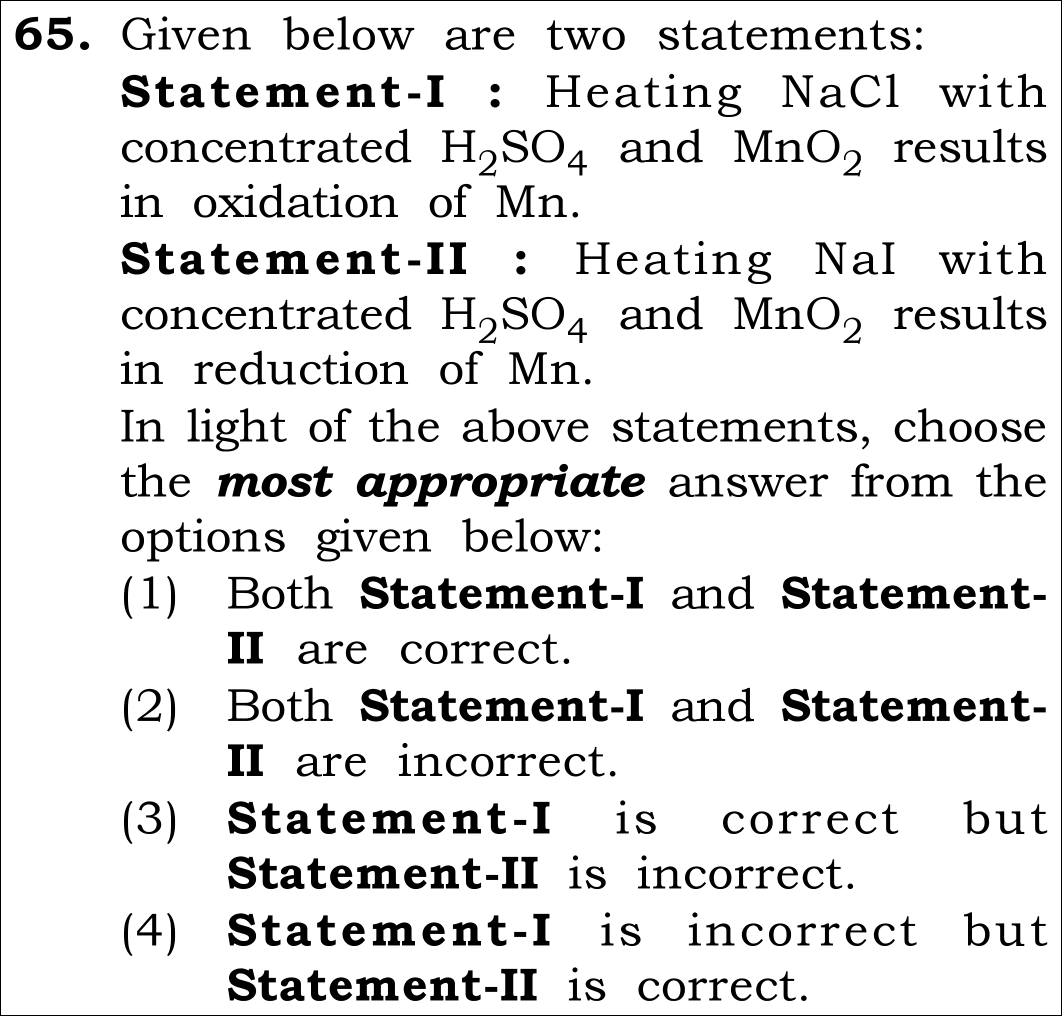
Statement-I Heating NaCl with concentrated H₂SO₄ and MnO₂ results in oxidation of Mn.
Statement-II Heating NaI with concentrated H₂SO₄ and MnO₂ results in reduction of Mn.
⚡

The 30-Second Exam Hall Shortcut: ⚡ MnO₂ is an OXIDIZING Agent (It gets REDUCED!)

⏱️ Save ~50 seconds

MnO₂ oxidizes halides (Cl⁻/I⁻) to halogens, so Mn(+4) is REDUCED to Mn(+2) in BOTH cases!

1 Identify reagent role: MnO₂ (pyrolusite) is an oxidizing agent.
2 In both reactions with halides in acid: Halide is oxidized (2X⁻ → X₂ + 2e⁻).
3 Therefore, Manganese MUST be REDUCED (Mn⁺⁴ in MnO₂ → Mn⁺² in MnSO₄).
4 Statement-I claims "oxidation of Mn" -> FALSE! (Mn is reduced, not oxidized).
5 Statement-II claims "reduction of Mn" -> TRUE! (Mn is reduced to +2).
6 Statement-I is incorrect but Statement-II is correct -> Option (4) immediately!
🛡️
Why You Can 100% Trust This Shortcut: Fundamental redox principle: In any redox reaction, the oxidizing agent undergoes reduction. MnO₂ is the oxidizing agent and is reduced from +4 to +2.
📐

Step-by-Step Rigorous Workflow & Mathematical Proof

Step 1

Analyze Statement-I (Reaction with NaCl)

Laboratory preparation of chlorine gas involves heating sodium chloride with concentrated sulfuric acid and manganese dioxide:

4NaCl+MnO2+4H2SO4⟶MnSO4+2NaHSO4+2H2O+Cl2↑4\text{NaCl} + \text{MnO}_2 + 4\text{H}_2\text{SO}_4 \longrightarrow \text{MnSO}_4 + 2\text{NaHSO}_4 + 2\text{H}_2\text{O} + \text{Cl}_2\uparrow
  • • Chloride (Cl⁻) is oxidized from -1 to 0 (in Cl₂).
  • • Manganese in MnO₂ has oxidation state +4.
  • • Manganese in MnSO₄ has oxidation state +2.
  • • Because the oxidation number of Mn decreases from +4 to +2, Manganese undergoes REDUCTION, NOT oxidation!
  • • Statement-I is incorrect.
Step 2

Analyze Statement-II (Reaction with NaI)

Similarly, heating sodium iodide with concentrated sulfuric acid and manganese dioxide produces iodine vapor:

2NaI+MnO2+2H2SO4⟶MnSO4+Na2SO4+2H2O+I2↑2\text{NaI} + \text{MnO}_2 + 2\text{H}_2\text{SO}_4 \longrightarrow \text{MnSO}_4 + \text{Na}_2\text{SO}_4 + 2\text{H}_2\text{O} + \text{I}_2\uparrow
  • • Iodide (I⁻) is oxidized from -1 to 0 (in I₂).
  • • Manganese is reduced from +4 (in MnO₂) to +2 (in MnSO₄).
  • • Because Mn gains electrons and its oxidation state decreases, Manganese undergoes REDUCTION.
  • • Statement-II is correct.
Step 3

Conclusion

Statement-I is incorrect, but Statement-II is correct.

Statement-I: False(Mn is reduced, not oxidized),Statement-II: True\text{Statement-I: False} \quad (\text{Mn is reduced, not oxidized}), \quad \text{Statement-II: True}
  • • Matches Option (4).
⭐

360° Option Elimination Engine Key Feature

Diagnose every choice: Know exactly why the right option works and why distractors fail.

4-Option Deep Scan
1 A
✗ Incorrect
Verdict & Scientific Reason:

Incorrect. Statement-I falsely asserts that Mn is oxidized.

⚠️
Student Fallacy (Why candidates pick this trap): Confusing the substance being oxidized (Cl⁻) with the reagent causing the oxidation (MnO₂).
2 B
✗ Incorrect
Verdict & Scientific Reason:

Incorrect. Statement-II is factually correct (Mn is indeed reduced).

⚠️
Student Fallacy (Why candidates pick this trap): Thinking Mn undergoes no redox change.
3 C
✗ Incorrect
Verdict & Scientific Reason:

Incorrect. Exactly backwards.

⚠️
Student Fallacy (Why candidates pick this trap): Inverting the redox definitions of oxidation and reduction.
4 D
✓ 100% Correct
Verdict & Scientific Reason:

Scientifically rigorous: Mn undergoes reduction (+4 to +2) in both reactions, making Statement-I false and Statement-II true.

💡
Why this is airtight: None; flawless tracking of oxidation numbers.
⚠️

NTA Trap Alert: Confusing "Oxidizing Agent" with "Undergoing Oxidation"

A classic linguistic trap: students read "MnO₂ oxidizes NaCl" and mistakenly jump to the conclusion that "Mn is oxidized". An oxidizing agent is REDUCED during the reaction!

🛡️ How to avoid the -1 mark: Always assign oxidation states: Mn in MnO₂ is +4; Mn in MnSO₄ is +2. A drop in oxidation number is REDUCTION.
📖

Core NEET Syllabus Standard

NEET Chemistry Core Syllabus · The d- and f-Block Elements & p-Block Elements Standard Benchmark
Core Scientific Principle Tested:

"MnO₂ acts as an oxidizing agent in acidic solution, reducing from Mn(IV) to Mn(II)."

Syllabus Focus: Oxidizing properties of MnO₂ and preparation of halogens
✓ Core NEET UG Syllabus Anchor Syllabus & Academic Standards ↗
MnO₂ oxidizes the halide crew; Mn itself is reduced from +4 to +2!

Solve 4 NEET Questions a Day — One per Subject

Cover all 1,140 official NEET questions in 285 days at your own pace. Progress is saved on your device. No login needed.