MyCompetitiveExams Logo MyCompetitiveExams
Search 1,140+ Questions
Chapters, formulas, speed tricks
→
⚡ Brahmastra NEET 2027
720 MARKS

Dynamic 180-question full-length simulator mixed dynamically from all 6 years for 2027 & 2026 aspirants.

Launch Brahmastra 2027 Test →
Start Practice →
100% Free · No Login Required
🧪 Chemistry Moderate Frequency

NEET Hydrogen Previous Year Questions with Solutions

Complete repository of official NTA NEET questions for Hydrogen from 2020 to 2026. Every question includes 30-second elimination tricks, step-by-step NCERT solutions, option-by-option traps, and official answer keys.

3 Questions 3 Exam Years (2023, 2021, 2020) 3 Easy · 0 Medium · 0 Challenging
NEET 2023 · Q60 Easy
Official NEET 2023 Question 60 - Hydrogen
1
2
3
4 ✓ Key
💡 Verified Solution & 30-Second Hack
✓
Verified Against NTA Final Answer Key
Option (4) : D, E only
📚 Hydrogen Easy
📋 Given Parameters & Problem Setup
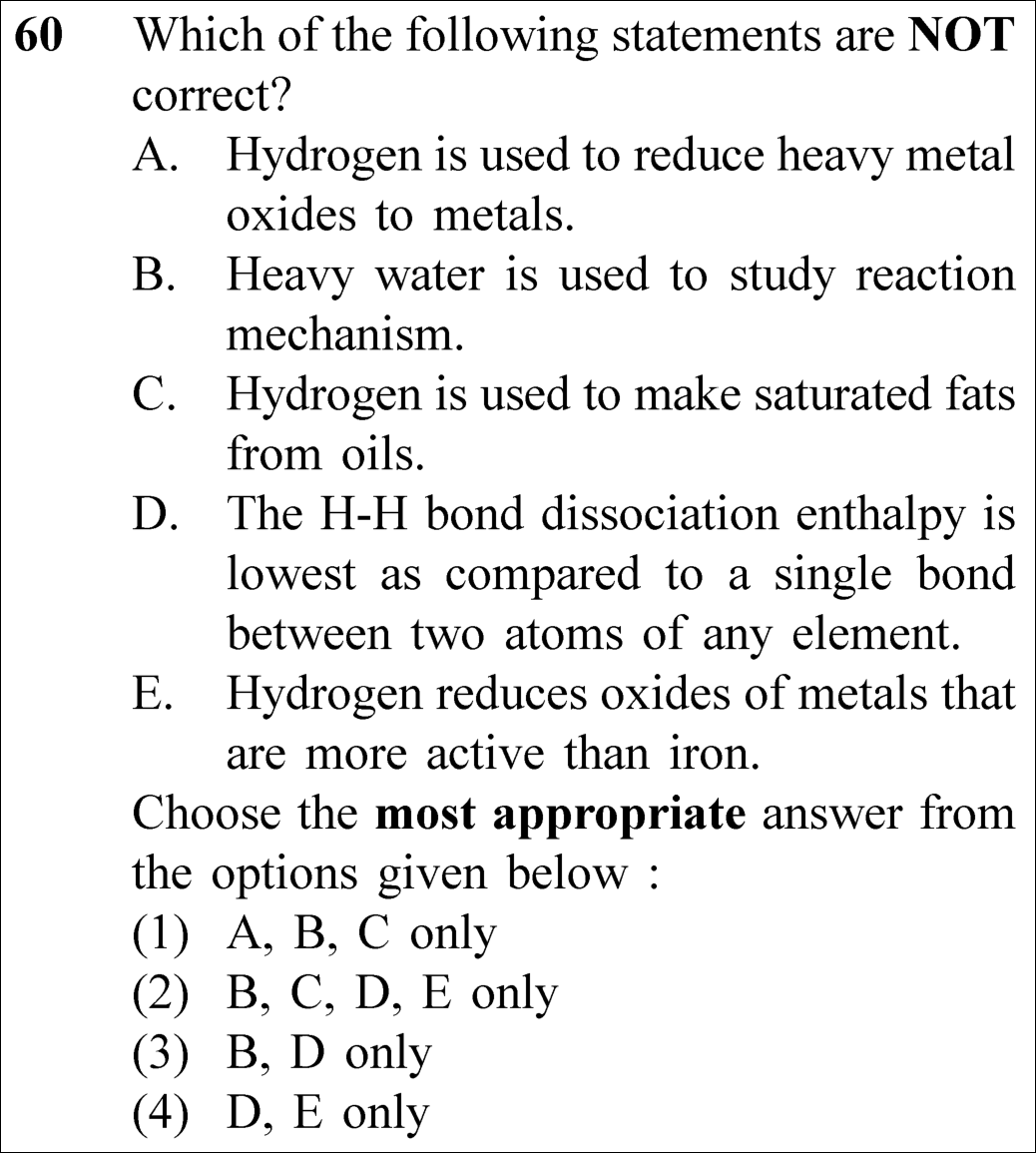
Statement A Used to reduce heavy metal oxides to metals
Statement B Heavy water is used to study reaction mechanisms
Statement C Used to make saturated fats from oils
Statement D H-H bond dissociation enthalpy is lowest for any single bond
Statement E Reduces oxides of metals more active than iron
⚡

The 30-Second Exam Hall Shortcut: ⚡ Fact Elimination Hack: H-H Has HIGHEST Single Bond Energy!

⏱️ Save ~40 seconds

H-H bond enthalpy (435.9 kJ/mol) is the HIGHEST single bond enthalpy of any element, not lowest ⟹ D is FALSE! H₂ CANNOT reduce oxides of metals more active than Fe (Na, Mg, Al) ⟹ E is FALSE! Option (4) in 15 seconds!

1 Check Statement D: The H–H bond dissociation enthalpy is 435.88 kJ mol⁻¹, which is the HIGHEST (not lowest) for a single bond between two atoms of any element. Thus D is INCORRECT.
2 Check Statement E: Highly electropositive metals (more active than iron, like Na, Mg, Al, Zn) have higher oxygen affinity than hydrogen; their oxides cannot be reduced by H₂. Thus E is INCORRECT.
3 Check Statements A, B, C: All are standard, correct NCERT statements (A: metallurgy of W, Mo, Cu; B: D₂O isotopic tracer; C: hydrogenation of vegetable oils).
4 The question asks for statements that are NOT correct ⟶ D and E only.
5 Lock Option (4) D, E only immediately!
🛡️
Why You Can 100% Trust This Shortcut: Inorganic Chemistry · Dihydrogen Properties (The H-H single bond enthalpy is the highest known for any single homonuclear bond, and dihydrogen reduces only oxides of metals less active than iron).
📐

Step-by-Step Rigorous Workflow & Mathematical Proof

Step 1

Analysis of Statement A (Metallurgical Reduction)

Dihydrogen is used in metallurgy to reduce oxides of metals less active than iron (such as tungsten, molybdenum, copper) to their respective elemental metals at elevated temperatures. Therefore, Statement A is correct.

WO3+3H2→ΔW+3H2O(Correct)\text{WO}_3 + 3\text{H}_2 \xrightarrow{\Delta} \text{W} + 3\text{H}_2\text{O} \quad (\text{Correct})
Step 2

Analysis of Statement B (Heavy Water as Tracer)

Heavy water (D₂O) is extensively employed as an isotopic tracer to elucidate organic and biochemical reaction mechanisms by tracking deuterium exchange. Therefore, Statement B is correct.

D2O serves as an isotopic tracer in mechanism studies (Correct)\text{D}_2\text{O} \text{ serves as an isotopic tracer in mechanism studies } (\text{Correct})
Step 3

Analysis of Statement C (Industrial Hydrogenation)

Hydrogenation of polyunsaturated vegetable oils using finely divided nickel catalyst at ~473 K yields saturated edible fats (vanaspati ghee). Therefore, Statement C is correct.

Vegetable oil (liquid)+H2→Ni, ΔVanaspati fat (solid)(Correct)\text{Vegetable oil (liquid)} + \text{H}_2 \xrightarrow{\text{Ni, } \Delta} \text{Vanaspati fat (solid)} \quad (\text{Correct})
Step 4

Analysis of Statement D (H–H Bond Dissociation Enthalpy)

Owing to the small size of hydrogen atoms and the effective overlap of 1s orbitals, the H–H bond dissociation enthalpy is 435.88 kJ mol⁻¹, which is the HIGHEST for a single bond between two atoms of any element. Statement D falsely claims it is the lowest, making Statement D INCORRECT.

ΔbondH(H−H)=435.88 kJ mol−1(Highest, not lowest   ⟹  INCORRECT)\Delta_{\text{bond}}H(\text{H}-\text{H}) = 435.88\text{ kJ mol}^{-1} \quad (\text{Highest, not lowest } \implies \text{INCORRECT})
Step 5

Analysis of Statement E (Activity Series and Oxide Reduction)

Hydrogen can reduce only the oxides of metals that are less electropositive than iron in the activity series (e.g., CuO, PbO, Fe₂O₃ under vigorous conditions). It CANNOT reduce oxides of metals more active than iron (such as Na, K, Ca, Mg, Al). Therefore, Statement E is INCORRECT.

H2+MgO\centernot⟶Mg+H2O(INCORRECT)\text{H}_2 + \text{MgO} \centernot\longrightarrow \text{Mg} + \text{H}_2\text{O} \quad (\text{INCORRECT})
⭐

360° Option Elimination Engine Key Feature

Diagnose every choice: Know exactly why the right option works and why distractors fail.

4-Option Deep Scan
1 (1)
✗ Incorrect
Verdict & Scientific Reason:

These are the correct statements, but the question asks for NOT correct statements.

⚠️
Student Fallacy (Why candidates pick this trap): Candidate misread "NOT correct" and selected the true statements.
2 (2)
✗ Incorrect
Verdict & Scientific Reason:

Incorrectly includes true statements B and C.

⚠️
Student Fallacy (Why candidates pick this trap): Candidate doubted the uses of heavy water and hydrogenation.
3 (3)
✗ Incorrect
Verdict & Scientific Reason:

B is true; omits false statement E.

⚠️
Student Fallacy (Why candidates pick this trap): Candidate did not evaluate metal activity series.
4 (4)
✓ 100% Correct
Verdict & Scientific Reason:

Accurate: Both D (claims lowest bond enthalpy) and E (claims reduction of metals more active than Fe) are false.

💡
Why this is airtight: None. Candidate carefully isolated the two incorrect claims.
⚠️

NTA Trap Alert: Misreading "NOT correct" and Picking the Correct Statements (A, B, C)

Under examination stress, candidates frequently ignore the bold word "NOT" and hurriedly choose Option (1) "A, B, C only" because they recognize them as familiar facts from the textbook.

🛡️ How to avoid the -1 mark: Circle the negative word: "NOT correct" means find the FALSE statements (D and E).
📖

Core NEET Syllabus Standard

National Eligibility cum Entrance Test (NEET UG) · Hydrogen Standard Benchmark
Core Scientific Principle Tested:

"The H-H bond enthalpy is the highest for a single bond of any element, and dihydrogen reduces only oxides of metals less active than iron."
Syllabus Focus: Chemical Properties and Uses of Dihydrogen
Preserved in Rationalized Curriculum Syllabus & Academic Standards ↗
NEET 2021 · Q66 Easy
Official NEET 2021 Question 66 - Hydrogen
1 ✓ Key
2
3
4
💡 Verified Solution & 30-Second Hack
✓
Verified Against NTA Final Answer Key
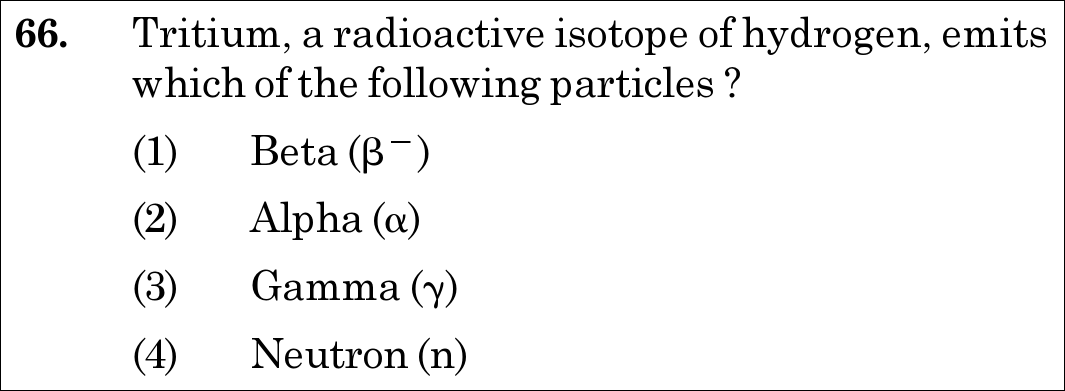
Option (1) : Beta (β-)
📚 Hydrogen Easy
📋 Given Parameters & Problem Setup
Radioactive Isotope Tritium (3_1 H or T)
⚡

The 30-Second Exam Hall Shortcut: ⚡ NCERT Hydrogen Fact: Tritium Emits Low-Energy β⁻ Particles

⏱️ Save ~15 seconds

Verbatim NCERT Hydrogen: "Of these isotopes, only tritium is radioactive and emits low energy β−\beta^- particles (t1/2=12.33t_{1/2} = 12.33 years)." The nuclear transmutation is 13H→ 23He+β−+νˉe^3_1H \to\ ^3_2He + \beta^- + \bar{\nu}_e. Match Option (1)!

1 Recall hydrogen's three isotopes: Protium (11H^1_1H), Deuterium (12H^2_1H), and Tritium (13H^3_1H).
2 Only Tritium is radioactive, with high neutron-to-proton ratio (n/p=2/1=2n/p = 2/1 = 2).
3 To achieve nuclear stability, a neutron converts to a proton, emitting a negative beta particle (β−\beta^-) and an antineutrino.
4 Reaction: 13H⟶ 23He+ −10e^3_1H \longrightarrow\ ^3_2He +\ ^0_{-1}e (β−\beta^-).
5 Match Option (1).
🛡️
Why You Can 100% Trust This Shortcut: Canonical NCERT Hydrogen chapter section on Isotopes of Hydrogen.
📐

Step-by-Step Rigorous Workflow & Mathematical Proof

Step 1

Identifying the Isotopes of Hydrogen

Hydrogen has three naturally occurring isotopes: Protium (11H^1_1H), Deuterium (12H^2_1H or DD), and Tritium (13H^3_1H or TT). Protium and deuterium are non-radioactive stable isotopes, whereas tritium is unstable.

Step 2

Radioactivity and Mode of Decay of Tritium

Tritium contains 1 proton and 2 neutrons in its nucleus. The high neutron-to-proton ratio (n/p=2n/p = 2) places it above the nuclear stability belt. Stability is achieved by beta-minus (β−\beta^-) decay, in which a nuclear neutron transforms into a proton, an electron (beta particle), and an electron antineutrino:

13H⟶ 23He+ −10e  (β−)+νˉe^{3}_{1}\text{H} \longrightarrow\ ^{3}_{2}\text{He} +\ ^{0}_{-1}e\;(\beta^-) + \bar{\nu}_e
Step 3

Properties of Emitted Radiation

The emitted β−\beta^- particle has very low maximum kinetic energy (Emax≈18.6 keVE_{\text{max}} \approx 18.6\text{ keV}), and tritium has a half-life of t1/2=12.33 yearst_{1/2} = 12.33\text{ years}.

⭐

360° Option Elimination Engine Key Feature

Diagnose every choice: Know exactly why the right option works and why distractors fail.

4-Option Deep Scan
1 1
✓ 100% Correct
Verdict & Scientific Reason:

Verbatim NCERT fact: tritium decays via low-energy β−\beta^- emission.

💡
Why this is airtight: None; textbook nuclear chemistry recall.
2 2
✗ Incorrect
Verdict & Scientific Reason:

Alpha emission requires loss of a 24He^4_2He nucleus, impossible for a nucleus of mass 3.

⚠️
Student Fallacy (Why candidates pick this trap): Confusing heavy element decay (U, Ra) with light isotope decay.
3 3
✗ Incorrect
Verdict & Scientific Reason:

Tritium decay is a pure ground-state beta decay without accompanying gamma de-excitation.

⚠️
Student Fallacy (Why candidates pick this trap): Assuming all radioactive decays release gamma rays.
4 4
✗ Incorrect
Verdict & Scientific Reason:

Neutron emission does not occur spontaneously in tritium.

⚠️
Student Fallacy (Why candidates pick this trap): Assuming excess neutrons are expelled directly.
⚠️

NTA Trap Alert: Alpha vs. Beta Particle Trap

Students who associate radioactivity strictly with alpha particles often guess α\alpha (Option 2). A tritium nucleus has mass number 3, making it physically impossible to emit an alpha particle (mass 4).

🛡️ How to avoid the -1 mark: Tritium has A=3A=3. It emits a single β−\beta^- particle to convert into 3He^3He.
📖

Core NEET Syllabus Standard

NCERT Chemistry · Hydrogen Standard Benchmark
Core Scientific Principle Tested:

"Tritium is a radioactive isotope of hydrogen with a half-life of 12.33 years that decays by emitting low energy beta particles."

Syllabus Focus: Isotopes of Hydrogen
✓ Core NEET UG Syllabus Anchor Syllabus & Academic Standards ↗
NEET 2020 · Q130 Easy
Official NEET 2020 Question 130 - Hydrogen
1 (iii) (i) (ii) (iv) ✓ Key
2 (iii) (ii) (i) (iv)
3 (iii) (iv) (ii) (i)
4 (i) (iii) (ii) (iv)
💡 Verified Solution & 30-Second Hack
✓
Verified Against NTA Final Answer Key
Option (1) : (a)-(iii), (b)-(i), (c)-(ii), (d)-(iv)
📚 Hydrogen Easy
📋 Given Parameters & Problem Setup
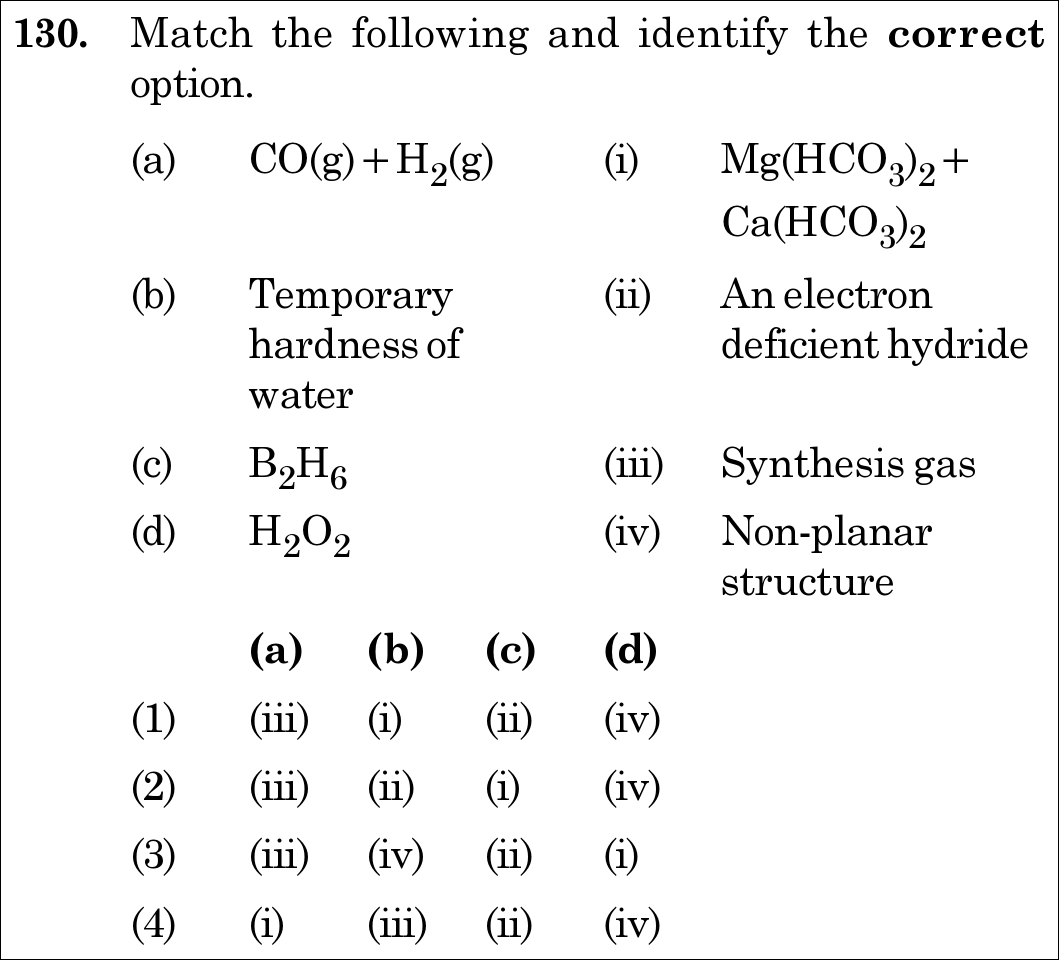
Column I (Substances/Concepts) (a) CO(g) + H2(g), (b) Temporary hardness of water, (c) B2H6, (d) H2O2
Column II (Descriptions) (i) Mg(HCO3)2 + Ca(HCO3)2, (ii) An electron deficient hydride, (iii) Synthesis gas, (iv) Non-planar structure
⚡

The 30-Second Exam Hall Shortcut: ⚡ "CO + H2 = Syngas; Hardness = Bicarbonates; B2H6 = Electron Deficient; H2O2 = Open-Book Non-Planar!"

⏱️ 20 seconds

CO + H2 is Synthesis gas / water gas (a->iii). Temporary hardness is caused by bicarbonates of magnesium and calcium (b->i). Diborane B2H6 is an electron deficient hydride with 3c-2e banana bonds (c->ii). H2O2 has a non-planar open-book structure (d->iv). Match gives Option (1) in 5 seconds!

1 CO(g) + H2(g) is known as Synthesis gas or syngas -> (a)-(iii).
2 Temporary hardness of water is due to Mg(HCO3)2 and Ca(HCO3)2 -> (b)-(i).
3 B2H6 (diborane) is a classic electron-deficient hydride -> (c)-(ii).
4 H2O2 has a non-planar open-book structure with dihedral angle 111.5° (gas) -> (d)-(iv).
5 Mapping: (a)-(iii), (b)-(i), (c)-(ii), (d)-(iv) -> Option 1.
🛡️
Why You Can 100% Trust This Shortcut: NCERT Chemistry · Hydrogen (Water Gas, Hardness of Water, Hydrides & Hydrogen Peroxide Structure)
📐

Step-by-Step Rigorous Workflow & Mathematical Proof

Step 1

Match CO(g) + H2(g)

The equimolar mixture of CO\text{CO} and H2\text{H}_2 is called water gas or synthesis gas ('syngas') because it is widely used in the synthesis of methanol and a number of hydrocarbons. Thus, (a) matches (iii).

Step 2

Match Temporary Hardness of Water

Temporary hardness of water is caused by the presence of soluble bicarbonates (hydrogen carbonates) of calcium and magnesium, namely Ca(HCO3)2\text{Ca(HCO}_3)_2 and Mg(HCO3)2\text{Mg(HCO}_3)_2, which precipitate as carbonates on boiling. Thus, (b) matches (i).

Step 3

Match Diborane (B2H6)

Diborane (B2H6\text{B}_2\text{H}_6) has 12 valence electrons, insufficient to form conventional 2-center 2-electron bonds for all atoms, requiring two 3-center 2-electron (3c−2e3c-2e) B-H-B banana bonds. It is classified as an electron-deficient hydride. Thus, (c) matches (ii).

Step 4

Match Hydrogen Peroxide (H2O2)

Hydrogen peroxide has a non-planar structure resembling an open book, with the two O-H bonds located on different intersecting planes with a dihedral angle of 111.5∘111.5^\circ in the gas phase and 90.2∘90.2^\circ in crystalline phase. Thus, (d) matches (iv).

⭐

360° Option Elimination Engine Key Feature

Diagnose every choice: Know exactly why the right option works and why distractors fail.

4-Option Deep Scan
1 A
✓ 100% Correct
Verdict & Scientific Reason:

Accurate pairing across all four hydrogen and hydride concepts.

💡
Why this is airtight: None; textbook matching.
2 B
✗ Incorrect
Verdict & Scientific Reason:

Incorrect; claims temporary hardness is an electron deficient hydride.

⚠️
Student Fallacy (Why candidates pick this trap): Swapping items (b) and (c).
3 C
✗ Incorrect
Verdict & Scientific Reason:

Incorrect; assigns non-planar structure to temporary hardness.

⚠️
Student Fallacy (Why candidates pick this trap): Arbitrary matching error.
4 D
✗ Incorrect
Verdict & Scientific Reason:

Incorrect; claims CO + H2 is temporary hardness.

⚠️
Student Fallacy (Why candidates pick this trap): Swapping syngas and temporary hardness.
⚠️

NTA Trap Alert: Temporary vs Permanent Hardness Salts

- TEMPORARY hardness: Bicarbonates (Ca(HCO3)2,Mg(HCO3)2\text{Ca(HCO}_3)_2, \text{Mg(HCO}_3)_2). - PERMANENT hardness: Chlorides and Sulphates (CaCl2,MgCl2,CaSO4,MgSO4\text{CaCl}_2, \text{MgCl}_2, \text{CaSO}_4, \text{MgSO}_4).

🛡️ How to avoid the -1 mark: Temporary = Bicarbonates! Permanent = Chlorides and Sulphates!
📖

Core NEET Syllabus Standard

Chemistry · Hydrogen Standard Benchmark
Core Scientific Principle Tested:

""

Syllabus Focus: Hydrogen Compounds Match: Syngas, Temporary Hardness, Diborane & H2O2 Structure
✓ Core NEET UG Syllabus Anchor Syllabus & Academic Standards ↗

Solve 4 NEET Questions a Day — One per Subject

Cover all 1,140 official NEET questions in 285 days at your own pace. Progress is saved on your device. No login needed.