MyCompetitiveExams Logo MyCompetitiveExams
Search 1,140+ Questions
Chapters, formulas, speed tricks
→
⚡ Brahmastra NEET 2027
720 MARKS

Dynamic 180-question full-length simulator mixed dynamically from all 6 years for 2027 & 2026 aspirants.

Launch Brahmastra 2027 Test →
Start Practice →
100% Free · No Login Required
Q.146 Zoology ⭐ 360° Option Elimination Active
Vault ↗

NEET 2026 Zoology Question 146 Solution

Topic: Ecosystem · Official NTA Booklet Code 50
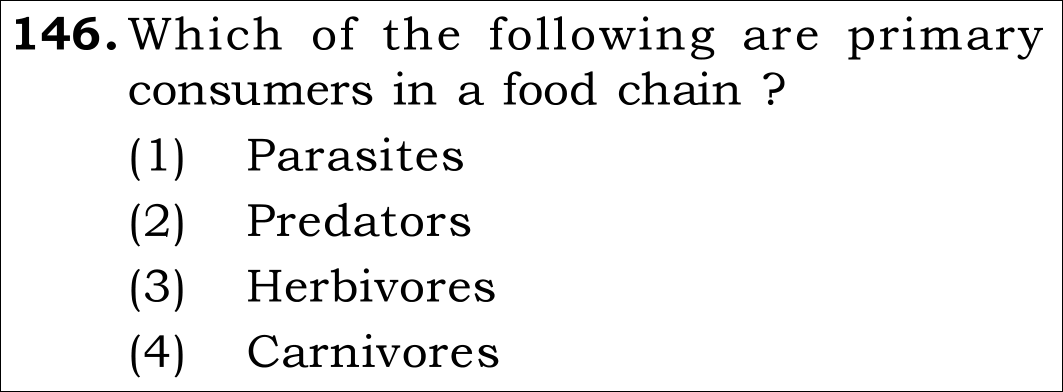
NEET 2026 Zoology Question 146: Trophic Levels and Consumer Classification in Grazing Food Chains

Question

Which of the following are primary consumers in a food chain?

  1. (1)Parasites
  2. (2)Predators
  3. (3)Herbivores
  4. (4)Carnivores
✓
Verified Against NTA Final Answer Key
Option (3) : Herbivores
📚 Ecosystem Easy
📋 Given Parameters & Problem Setup
Ecological Entity Food chain trophic levels
Target Category Primary consumers
⚡

The 30-Second Exam Hall Shortcut: ⚡ Trophic Level Ladder Rule

⏱️ Save ~40 seconds

T1 = Producers (Plants); T2 = Primary Consumers (Herbivores); T3 = Secondary Consumers (Carnivores)!

1 Recall standard trophic hierarchy:
2 First trophic level (T1T_1): Producers (autotrophs / green plants).
3 Second trophic level (T2T_2): Primary consumers (herbivores that feed on plants).
4 Third trophic level (T3T_3): Secondary consumers (primary carnivores).
5 Primary consumers are strictly Herbivores.
6 Option (3) is Herbivores. Pick Option (3) in 2 seconds!
🛡️
Why You Can 100% Trust This Shortcut: NCERT Biology · Ecosystem (Ecological Pyramids: Pyramid of biomass in sea is generally inverted).
📐

Step-by-Step Rigorous Workflow & Mathematical Proof

Step 1

Trophic Level Definitions in an Ecosystem

Organisms occupy a place in the natural surroundings or in a community according to their feeding relationship with other organisms. Based on the source of their nutrition or food, organisms occupy a specific place in the food chain known as their trophic level.

Trophic Level 1 (T1):Primary Producers (Phytoplankton, Trees, Grass)Trophic Level 2 (T2):Primary Consumers (Zooplankton, Grasshopper, Cow) = HerbivoresTrophic Level 3 (T3):Secondary Consumers (Birds, Fishes, Wolf) = CarnivoresTrophic Level 4 (T4):Tertiary Consumers (Man, Lion) = Top Carnivores\begin{aligned} \text{Trophic Level 1 } (T_1) &: \text{Primary Producers (Phytoplankton, Trees, Grass)} \\ \mathbf{Trophic\text{ Level 2 } (T_2)} &: \mathbf{Primary\text{ Consumers (Zooplankton, Grasshopper, Cow) = Herbivores}} \\ \text{Trophic Level 3 } (T_3) &: \text{Secondary Consumers (Birds, Fishes, Wolf) = Carnivores} \\ \text{Trophic Level 4 } (T_4) &: \text{Tertiary Consumers (Man, Lion) = Top Carnivores} \end{aligned}
  • • Herbivores convert plant biomass into animal biomass (key industry animals).
Step 2

Eliminate Other Options

Parasites (Option 1) can feed on any trophic level (plants, herbivores, or carnivores). Predators (Option 2) are typically secondary or tertiary consumers. Carnivores (Option 4) are secondary or tertiary consumers that eat other animals. Only herbivores are primary consumers.

Primary Consumers≡Herbivores  ⟹  Option (3)\text{Primary Consumers} \equiv \mathbf{Herbivores} \implies \text{Option (3)}
  • • Option (3) is the solely accurate response.
Step 3

Conclusion

Herbivores directly graze or feed on primary producers, defining them as primary consumers.

Correct Match=Option (3)\text{Correct Match} = \text{Option (3)}
  • • Matches official NTA final answer key Option C / (3).
⭐

360° Option Elimination Engine Key Feature

Diagnose every choice: Know exactly why the right option works and why distractors fail.

4-Option Deep Scan
1 A
✗ Incorrect
Verdict & Scientific Reason:

Incorrect. Parasites are specialized heterotrophs living on various host trophic levels, not defined as primary consumers.

⚠️
Student Fallacy (Why candidates pick this trap): Confusing nutritional specialization with trophic rank.
2 B
✗ Incorrect
Verdict & Scientific Reason:

Incorrect. Predators hunt and consume other living animals (carnivores), placing them at secondary consumer level or higher.

⚠️
Student Fallacy (Why candidates pick this trap): Treating all consumers as predators.
3 C
✓ 100% Correct
Verdict & Scientific Reason:

100% accurate. Herbivores are the canonical primary consumers feeding directly on primary producers.

💡
Why this is airtight: None; fundamental ecology recall.
4 D
✗ Incorrect
Verdict & Scientific Reason:

Incorrect. Carnivores eat herbivores or other carnivores, making them secondary or tertiary consumers.

⚠️
Student Fallacy (Why candidates pick this trap): Confusing secondary consumers with primary consumers.
⚠️

NTA Trap Alert: Equating "Consumer" with "Carnivore"

Beginners sometimes confuse "Primary Consumer" with "Primary Carnivore". A primary carnivore is a SECONDARY consumer because it eats the herbivore!

🛡️ How to avoid the -1 mark: Rule: Primary Consumer = Eats Plants (Herbivore); Secondary Consumer = Primary Carnivore.
📖

Core NEET Syllabus Standard

NEET Biology Core Syllabus · Ecosystem Standard Benchmark
Core Scientific Principle Tested:

"Primary consumers in a grazing food chain are herbivores that feed directly on autotrophic primary producers."

Syllabus Focus: Trophic Levels and Food Chains
✓ Core NEET UG Syllabus Anchor Syllabus & Academic Standards ↗
Plants are Producers number One, Herbivores Eat them when day is done (Primary Consumers)!

Ready to attempt under real exam pressure?

Test your speed and accuracy in the authentic 180-minute timed NTA simulator.

Launch NEET 2026 CBT Test →

Spotted a mistake in this solution? Report an error (support@mycompetitiveexams.com)

⚖️ Legal & Fair Dealing Notice: Sourced from publicly released NEET 2026 question papers and NEET answer keys for private study, research, and non-commercial educational practice under Fair Dealing (Section 52(1)(a) of the Indian Copyright Act, 1957). Not affiliated with or endorsed by NTA or NMC.

Solve 4 NEET Questions a Day — One per Subject

Cover all 1,140 official NEET questions in 285 days at your own pace. Progress is saved on your device. No login needed.