MyCompetitiveExams Logo MyCompetitiveExams
Search 1,140+ Questions
Chapters, formulas, speed tricks
→
⚡ Brahmastra NEET 2027
720 MARKS

Dynamic 180-question full-length simulator mixed dynamically from all 6 years for 2027 & 2026 aspirants.

Launch Brahmastra 2027 Test →
Start Practice →
100% Free · No Login Required
Q.150 Zoology ⭐ 360° Option Elimination Active
Vault ↗

NEET 2025 Zoology Question 150 Solution

Topic: Ecosystem · Official NTA Booklet Code 45
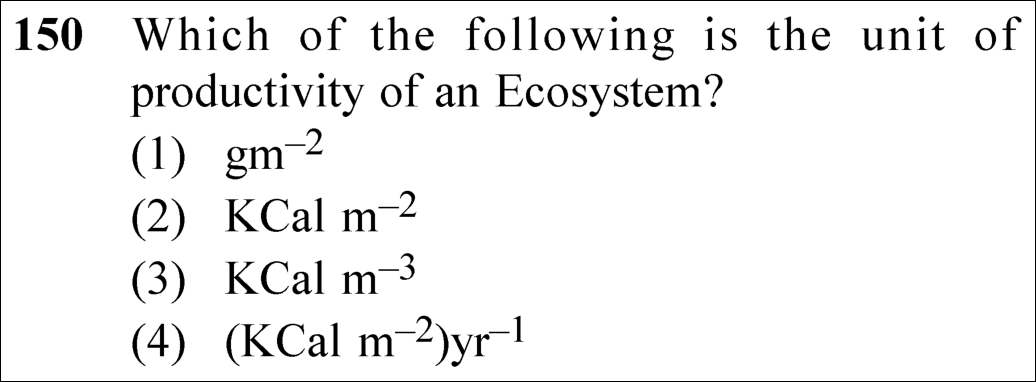
NEET 2025 Zoology Question 150: Productivity of an Ecosystem and Its Units

Question

Which of the following is the unit of productivity of an Ecosystem?

✓
Verified Against NTA Final Answer Key
Option (4) : (KCal m⁻²)yr⁻¹
📚 Ecosystem Easy
📋 Given Parameters & Problem Setup
Ecological Parameter Productivity of an Ecosystem
Target Standard dimensional unit of productivity
⚡

The 30-Second Exam Hall Shortcut: ⚡ Production vs Productivity Unit Fingerprint

⏱️ Save ~20 seconds

Primary PRODUCTION = Biomass per unit area (g m⁻² or kcal m⁻²)! PRODUCTIVITY = RATE of production per unit area PER UNIT TIME -> (kcal m⁻²) yr⁻¹ or (g m⁻²) yr⁻¹! Must include time (yr⁻¹)!

1 Recall NCERT Section 14.2 (Productivity):
2 - Primary production is expressed as weight (g m⁻²) or energy (kcal m⁻²).
3 - "The rate of biomass production is called productivity."
4 - "It is expressed in terms of (g m⁻²) yr⁻¹ or (kcal m⁻²) yr⁻¹ to compare the productivity of different ecosystems."
5 - Options (1) and (2) omit the time component (yr⁻¹); Option (3) has volume (m⁻³).
6 - Option (4) has both area and time: (KCal m⁻²) yr⁻¹!
7 Select Option (4)!
🛡️
Why You Can 100% Trust This Shortcut: Ecological Succession & Pioneer to Climax Communities (NCERT Biology · Ecosystem: Hydrarch and xerarch succession).
📐

Step-by-Step Rigorous Workflow & Mathematical Proof

Step 1

Fundamental Distinction: Production vs Productivity

In ecosystem energetics, production and productivity represent related but dimensionally distinct quantities:

  • • Primary Production: The total quantity of organic matter or biomass produced per unit area during photosynthesis over an arbitrary period. Expressed in terms of biomass weight (g/m2g/m^2 or g⋅m−2g \cdot m^{-2}) or energy content (kcal/m2kcal/m^2 or kcal⋅m−2kcal \cdot m^{-2}).
  • • Productivity: The rate at which biomass is generated per unit area per unit time. Because it is a rate, it must incorporate a time dimension (typically per year, yr−1yr^{-1}).
Step 2

Dimensional Analysis of Productivity Units

Evaluating the mathematical dimensions:

  • • In terms of biomass: (g⋅m−2)⋅yr−1(g \cdot m^{-2}) \cdot yr^{-1}.
  • • In terms of energy content: (kcal⋅m−2)⋅yr−1(kcal \cdot m^{-2}) \cdot yr^{-1}.
  • • This standardized unit enables rigorous comparison of biological conversion efficiencies across diverse biomes (e.g. coral reefs vs tropical rainforests vs deserts).
Step 3

Evaluation of the Options

Reviewing the provided choices:

  • • Option (1) g⋅m−2g \cdot m^{-2}: Unit of production, lacks time dimension.
  • • Option (2) kcal⋅m−2kcal \cdot m^{-2}: Unit of production, lacks time dimension.
  • • Option (3) kcal⋅m−3kcal \cdot m^{-3}: Energy per unit volume, inappropriate for aerial/surface ecosystem productivity.
  • • Option (4) (kcal⋅m−2)⋅yr−1(kcal \cdot m^{-2}) \cdot yr^{-1}: True rate unit containing energy, area, and time dimensions.
Step 4

Conclusion

The unit of productivity of an ecosystem is (KCal⋅m−2)yr−1(KCal \cdot m^{-2})yr^{-1}, which is Option (4).

Unit of Productivity=(kcal⋅m−2)yr−1\text{Unit of Productivity} = (\text{kcal} \cdot m^{-2})\text{yr}^{-1}
⭐

360° Option Elimination Engine Key Feature

Diagnose every choice: Know exactly why the right option works and why distractors fail.

4-Option Deep Scan
1 A
✗ Incorrect
Verdict & Scientific Reason:

Incorrect. This is the unit of primary production (biomass per unit area), not productivity (rate over time).

⚠️
Student Fallacy (Why candidates pick this trap): Forgetting that productivity is a rate that requires a time dimension.
2 B
✗ Incorrect
Verdict & Scientific Reason:

Incorrect. This represents energy per unit area (production), lacking the per unit time component.

⚠️
Student Fallacy (Why candidates pick this trap): Confusing accumulated energy with the rate of energy fixation.
3 C
✗ Incorrect
Verdict & Scientific Reason:

Incorrect. This represents energy per unit volume (m⁻³).

⚠️
Student Fallacy (Why candidates pick this trap): Confusing area with volume.
4 D
✓ 100% Correct
Verdict & Scientific Reason:

100% correct. Correctly incorporates energy, unit area, and unit time (yr−1yr^{-1}) as specified by NCERT.

💡
Why this is airtight: None; rigorous dimensional and ecological understanding.
⚠️

NTA Trap Alert: Production vs Productivity Unit Trap

This is one of the most common traps in NEET ecology: Production = gm⁻² or kcal m⁻² (No time). Productivity = (gm⁻²)yr⁻¹ or (kcal m⁻²)yr⁻¹ (WITH time component!). Always check for yr−1yr^{-1}!

🛡️ How to avoid the -1 mark: Productivity = RATE = MUST have time in denominator (yr−1yr^{-1}).
📖

Core NEET Syllabus Standard

NEET Biology Core Syllabus · Ecosystem Standard Benchmark
Core Scientific Principle Tested:

"Productivity is the rate of biomass production, expressed as (g m⁻²)yr⁻¹ or (kcal m⁻²)yr⁻¹."

Syllabus Focus: Ecosystem Structure and Function · Productivity
✓ Core NEET UG Syllabus Anchor Syllabus & Academic Standards ↗
Productivity is a PACE: (Energy / Area) per YEAR (yr⁻¹)!

Ready to attempt under real exam pressure?

Test your speed and accuracy in the authentic 180-minute timed NTA simulator.

Launch NEET 2025 CBT Test →

Spotted a mistake in this solution? Report an error (support@mycompetitiveexams.com)

⚖️ Legal & Fair Dealing Notice: Sourced from publicly released NEET 2025 question papers and NEET answer keys for private study, research, and non-commercial educational practice under Fair Dealing (Section 52(1)(a) of the Indian Copyright Act, 1957). Not affiliated with or endorsed by NTA or NMC.

Solve 4 NEET Questions a Day — One per Subject

Cover all 1,140 official NEET questions in 285 days at your own pace. Progress is saved on your device. No login needed.