MyCompetitiveExams Logo MyCompetitiveExams
Search 1,140+ Questions
Chapters, formulas, speed tricks
→
⚡ Brahmastra NEET 2027
720 MARKS

Dynamic 180-question full-length simulator mixed dynamically from all 6 years for 2027 & 2026 aspirants.

Launch Brahmastra 2027 Test →
Start Practice →
100% Free · No Login Required
Q.122 Botany ⭐ 360° Option Elimination Active
Vault ↗

NEET 2026 Botany Question 122 Solution

Topic: Photosynthesis in Higher Plants · Official NTA Booklet Code 50
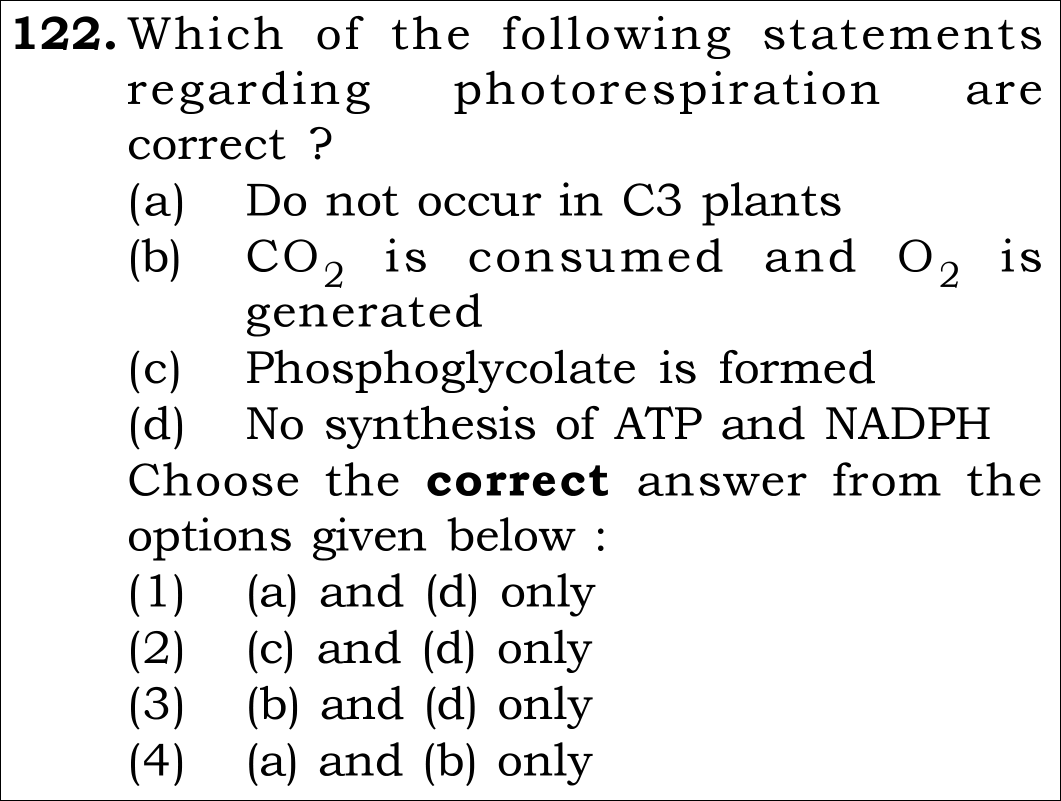
NEET 2026 Botany Question 122: Biochemical Characteristics and Energetics of Photorespiration

Question

Which of the following statements regarding photorespiration are correct? (a) Do not occur in C3 plants (b) CO₂ is consumed and O₂ is generated (c) Phosphoglycolate is formed (d) No synthesis of ATP and NADPH Choose the correct answer from the options given below:

✓
Verified Against NTA Final Answer Key
Option (2) : (c) and (d) only
📚 Photosynthesis in Higher Plants Medium
📋 Given Parameters & Problem Setup
Metabolic Pathway Photorespiration (C₂ / glycolate pathway)
Statements Evaluated (a) Do not occur in C3 plants, (b) CO₂ is consumed and O₂ is generated, (c) Phosphoglycolate is formed, (d) No synthesis of ATP and NADPH
⚡

The 30-Second Exam Hall Shortcut: ⚡ Photorespiration Fact-Check

⏱️ Save ~40 seconds

Photorespiration occurs IN C₃ plants and WASTES energy with NO ATP/NADPH formed!

1 Examine (a): Claims it does NOT occur in C₃ plants. False! Photorespiration is characteristic of C₃ plants and absent in C₄ plants.
2 Examine (b): Claims CO₂ is consumed and O₂ generated. False! It uses O₂ and releases CO₂ (hence "respiration").
3 Examine (c): RuBisCO oxygenase reaction forms 1 PGA + 1 2-Phosphoglycolate (2C compound). True!
4 Examine (d): No synthesis of ATP or NADPH occurs; ATP is actually consumed. True!
5 Correct statements: (c) and (d) only -> Option (2)!
6 Mark Option (2) in under 10 seconds.
🛡️
Why You Can 100% Trust This Shortcut: NCERT Biology · Photosynthesis in Higher Plants (C4 Pathway / Hatch-Slack: Initial CO2 acceptor is Phosphoenolpyruvate PEP in mesophyll).
📐

Step-by-Step Rigorous Workflow & Mathematical Proof

Step 1

Evaluate Statement (a): Occurrence in Plants

Photorespiration occurs prominently in C₃ plants when RuBisCO binds oxygen instead of carbon dioxide under high temperature, high O₂ concentration, and low CO₂ concentration. In contrast, C₄ plants have evolved a CO₂-concentrating mechanism (Kranz anatomy) which prevents photorespiration. Thus, statement (a) is definitively false.

Photorespiration∈C3 plants(Absent in C4 plants)  ⟹  (a) is FALSE\text{Photorespiration} \in C_3\text{ plants} \quad (\text{Absent in } C_4\text{ plants}) \implies \text{(a) is FALSE}
  • • Eliminates Option (1) and Option (4).
Step 2

Evaluate Statement (b): Gas Exchange Direction

In photorespiration, RuBisCO functions as an oxygenase, consuming oxygen (O₂) and releasing carbon dioxide (CO₂). Statement (b) claims that "CO₂ is consumed and O₂ is generated", which is the exact opposite (normal photosynthesis). Hence, statement (b) is false.

Photorespiration:O2 consumed⟶CO2 released  ⟹  (b) is FALSE\text{Photorespiration}: \text{O}_2\text{ consumed} \longrightarrow \text{CO}_2\text{ released} \implies \text{(b) is FALSE}
  • • Eliminates Option (3).
Step 3

Evaluate Statement (c): Formation of Phosphoglycolate

When RuBisCO oxygenates ribulose-1,5-bisphosphate (RuBP), the 5-carbon substrate is cleaved into one molecule of 3-carbon phosphoglycerate (3-PGA) and one molecule of 2-carbon 2-phosphoglycolate.

RuBP (5C)+O2→RuBisCO (Oxygenase)3-PGA (3C)+2-Phosphoglycolate (2C)\text{RuBP (5C)} + \text{O}_2 \xrightarrow{\text{RuBisCO (Oxygenase)}} \text{3-PGA (3C)} + \mathbf{2\text{-Phosphoglycolate (2C)}}
  • • Statement (c) is factually correct.
Step 4

Evaluate Statement (d): Energetics of Pathway

NCERT states verbatim: "In the photorespiratory pathway, there is neither synthesis of sugars, nor of ATP. Rather it results in the release of CO₂ with the utilization of ATP. There is also no synthesis of NADPH." Therefore, statement (d) is factually correct.

ATP, NADPH synthesis=0(Wasteful ATP consumption occurs)  ⟹  (d) is TRUE\text{ATP, NADPH synthesis} = 0 \quad (\text{Wasteful ATP consumption occurs}) \implies \text{(d) is TRUE}
  • • Photorespiration is a biologically wasteful process.
Step 5

Conclusion

Statements (c) and (d) are correct, while (a) and (b) are false. The correct option is Option (2).

Correct Statements=(c) and (d) only  ⟹  Option (2)\text{Correct Statements} = \mathbf{(c) \text{ and } (d) \text{ only}} \implies \text{Option (2)}
  • • Matches official NTA final answer key Option B / (2).
⭐

360° Option Elimination Engine Key Feature

Diagnose every choice: Know exactly why the right option works and why distractors fail.

4-Option Deep Scan
1 A
✗ Incorrect
Verdict & Scientific Reason:

Incorrect. Statement (a) is false because photorespiration is rampant in C₃ plants.

⚠️
Student Fallacy (Why candidates pick this trap): Confusing C₃ with C₄ plants.
2 B
✓ 100% Correct
Verdict & Scientific Reason:

100% accurate. 2-Phosphoglycolate is formed and no ATP or NADPH is synthesized.

💡
Why this is airtight: None; precise understanding of C₂ cycle biochemistry.
3 C
✗ Incorrect
Verdict & Scientific Reason:

Incorrect. Statement (b) reverses gas exchange (it consumes O₂ and releases CO₂).

⚠️
Student Fallacy (Why candidates pick this trap): Confusing photorespiration gas exchange with Calvin cycle.
4 D
✗ Incorrect
Verdict & Scientific Reason:

Completely incorrect; pairs the two unequivocally false statements.

⚠️
Student Fallacy (Why candidates pick this trap): Total conceptual reversal.
⚠️

NTA Trap Alert: The C3 vs C4 Inversion

C₄ plants avoid photorespiration by maintaining high CO₂ around RuBisCO in bundle sheath cells. Students frequently mix up C₃ and C₄ plants in assertion/statement questions.

🛡️ How to avoid the -1 mark: Rule: C₄ says "NO" to photorespiration; C₃ suffers from it!
📖

Core NEET Syllabus Standard

NEET Biology Core Syllabus · Photosynthesis in Higher Plants Standard Benchmark
Core Scientific Principle Tested:

"In C₃ plants, oxygenation of RuBP forms 3-PGA and phosphoglycolate without producing ATP, NADPH, or sugars."

Syllabus Focus: Photorespiration
✓ Core NEET UG Syllabus Anchor Syllabus & Academic Standards ↗
Photorespiration: Phosphoglycolate appears, but ATP and NADPH disappear!

Ready to attempt under real exam pressure?

Test your speed and accuracy in the authentic 180-minute timed NTA simulator.

Launch NEET 2026 CBT Test →

Spotted a mistake in this solution? Report an error (support@mycompetitiveexams.com)

⚖️ Legal & Fair Dealing Notice: Sourced from publicly released NEET 2026 question papers and NEET answer keys for private study, research, and non-commercial educational practice under Fair Dealing (Section 52(1)(a) of the Indian Copyright Act, 1957). Not affiliated with or endorsed by NTA or NMC.

Solve 4 NEET Questions a Day — One per Subject

Cover all 1,140 official NEET questions in 285 days at your own pace. Progress is saved on your device. No login needed.