MyCompetitiveExams Logo MyCompetitiveExams
Search 1,140+ Questions
Chapters, formulas, speed tricks
→
⚡ Brahmastra NEET 2027
720 MARKS

Dynamic 180-question full-length simulator mixed dynamically from all 6 years for 2027 & 2026 aspirants.

Launch Brahmastra 2027 Test →
Start Practice →
100% Free · No Login Required
Q.140 Zoology ⭐ 360° Option Elimination Active
Vault ↗

NEET 2026 Zoology Question 140 Solution

Topic: Locomotion and Movement · Official NTA Booklet Code 50
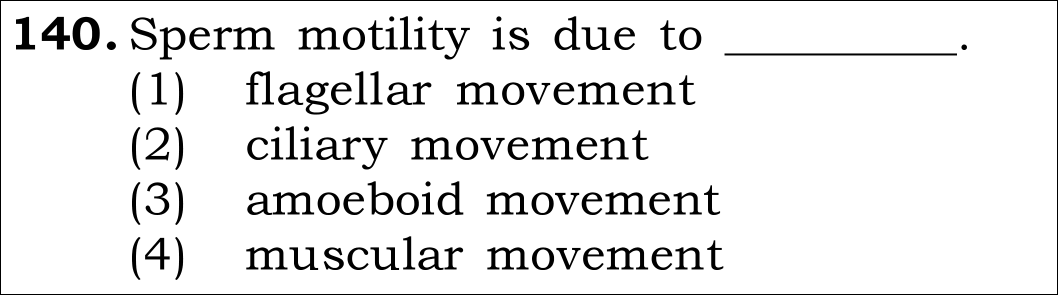
NEET 2026 Zoology Question 140: Types of Cellular Movement in the Human Body - Flagellar Movement

Question

Sperm motility is due to.

  1. (1)flagellar movement
  2. (2)ciliary movement
  3. (3)amoeboid movement
  4. (4)muscular movement
✓
Verified Against NTA Final Answer Key
Option (1) : flagellar movement
📚 Locomotion and Movement Easy
📋 Given Parameters & Problem Setup
Cell Type Human spermatozoon (sperm cell)
Tested Mechanism Type of cellular motility powering forward swimming
⚡

The 30-Second Exam Hall Shortcut: ⚡ Sperm Tail Motility Match

⏱️ Save ~40 seconds

Sperm tail is a Flagellum -> Motility is FLAGELLAR movement!

1 Recall human cell motility types from NCERT Locomotion:
2 Amoeboid movement: Macrophages and leukocytes.
3 Ciliary movement: Ciliated epithelium of respiratory tract and Fallopian tubes.
4 Muscular movement: Skeletal, visceral, and cardiac muscles.
5 Flagellar movement: Spermatozoa swimming via their axial filament/tail!
6 Scan options: Option (1) is flagellar movement.
7 Mark Option (1) in 3 seconds!
🛡️
Why You Can 100% Trust This Shortcut: NCERT Biology · Locomotion and Movement (Amoeboid, Ciliary, and Flagellar Movement in Humans).
📐

Step-by-Step Rigorous Workflow & Mathematical Proof

Step 1

Review Types of Movements Exhibited by Human Cells

Cells of the human body exhibit three main types of movements: amoeboid, ciliary, and muscular, along with flagellar movement exhibited by specialized cells.

Human Cell Movements={Amoeboid:Macrophages, Neutrophils (pseudopodia)Ciliary:Trachea, Oviducts (coordinated cilia)Muscular:Limbs, Jaws, Tongue (myofibrils)Flagellar:Spermatozoa (flagellated tail)\text{Human Cell Movements} = \begin{cases} \text{Amoeboid} &: \text{Macrophages, Neutrophils (pseudopodia)} \\ \text{Ciliary} &: \text{Trachea, Oviducts (coordinated cilia)} \\ \text{Muscular} &: \text{Limbs, Jaws, Tongue (myofibrils)} \\ \mathbf{Flagellar} &: \mathbf{Spermatozoa\text{ (flagellated tail)}} \end{cases}
  • • NCERT explicitly singles out spermatozoa for flagellar movement.
Step 2

Structural Basis of Sperm Flagellum

The sperm tail consists of an axoneme comprising a classical "9+2" microtubule doublet arrangement powered by dynein motor arms. ATP generated by the mitochondrial spiral of the middle piece drives sinusoidal wave propagation along the flagellum, propelling the sperm forward through the female genital tract.

Mitochondrial ATP→Dynein ATPaseFlagellar wave propagation  ⟹  Sperm Swimming\text{Mitochondrial ATP} \xrightarrow{\text{Dynein ATPase}} \text{Flagellar wave propagation} \implies \text{Sperm Swimming}
  • • Ciliary movement propels the non-motile ovum along the Fallopian tube, not the sperm itself.
Step 3

Evaluate Options

Option (1) flagellar movement is the exact mechanism. Option (2) ciliary movement is in oviducts/trachea. Option (3) amoeboid is in phagocytes. Option (4) muscular is in tissues.

Sperm Motility=Flagellar movement  ⟹  Option (1)\text{Sperm Motility} = \mathbf{Flagellar\text{ movement}} \implies \text{Option (1)}
  • • Matches official NTA final answer key Option A / (1).
⭐

360° Option Elimination Engine Key Feature

Diagnose every choice: Know exactly why the right option works and why distractors fail.

4-Option Deep Scan
1 A
✓ 100% Correct
Verdict & Scientific Reason:

100% accurate. Sperm propulsion is driven by the undulatory beating of its flagellar tail.

💡
Why this is airtight: None; standard direct textbook recall.
2 B
✗ Incorrect
Verdict & Scientific Reason:

Incorrect. Cilia line the Fallopian tubes and trachea, but the sperm itself moves via a single flagellum.

⚠️
Student Fallacy (Why candidates pick this trap): Confusing the ciliary lining of the female oviduct with sperm motility.
3 C
✗ Incorrect
Verdict & Scientific Reason:

Incorrect. Amoeboid movement occurs in macrophages and leukocytes via pseudopodia.

⚠️
Student Fallacy (Why candidates pick this trap): Confusing phagocyte diapedesis with sperm propulsion.
4 D
✗ Incorrect
Verdict & Scientific Reason:

Incorrect. Muscle tissue contracts using actin-myosin cross-bridges, not flagellar axonemes.

⚠️
Student Fallacy (Why candidates pick this trap): Confusing uterine myometrial peristalsis with sperm motility.
⚠️

NTA Trap Alert: Confusing Ciliary Movement of Oviduct with Flagellar Movement of Sperm

The ovum is non-motile and transported by ciliated epithelial cells lining the Fallopian tube, whereas the sperm moves under its own power via its flagellum.

🛡️ How to avoid the -1 mark: Remember: Sperm has a Flagellum (Flagellar); Fallopian tube has Cilia (Ciliary).
📖

Core NEET Syllabus Standard

NEET Biology Core Syllabus · Locomotion and Movement Standard Benchmark
Core Scientific Principle Tested:

"Flagellar movement enables the swimming of spermatozoa toward the ovum, driven by the axoneme of the sperm tail."

Syllabus Focus: Types of Movement
✓ Core NEET UG Syllabus Anchor Syllabus & Academic Standards ↗
Cilia carry the Egg in line, but the Flagellar tail swims the Sperm in time!

Ready to attempt under real exam pressure?

Test your speed and accuracy in the authentic 180-minute timed NTA simulator.

Launch NEET 2026 CBT Test →

Spotted a mistake in this solution? Report an error (support@mycompetitiveexams.com)

⚖️ Legal & Fair Dealing Notice: Sourced from publicly released NEET 2026 question papers and NEET answer keys for private study, research, and non-commercial educational practice under Fair Dealing (Section 52(1)(a) of the Indian Copyright Act, 1957). Not affiliated with or endorsed by NTA or NMC.

Solve 4 NEET Questions a Day — One per Subject

Cover all 1,140 official NEET questions in 285 days at your own pace. Progress is saved on your device. No login needed.