MyCompetitiveExams Logo MyCompetitiveExams
Search 1,140+ Questions
Chapters, formulas, speed tricks
→
⚡ Brahmastra NEET 2027
720 MARKS

Dynamic 180-question full-length simulator mixed dynamically from all 6 years for 2027 & 2026 aspirants.

Launch Brahmastra 2027 Test →
Start Practice →
100% Free · No Login Required
Q.2 Physics ⭐ 360° Option Elimination Active
Vault ↗

NEET 2021 Physics Question 2 Solution

Topic: Mechanical Properties of Fluids · Official NTA Booklet Code M1
NEET 2021 Physics Question 2: Terminal Velocity and Viscous Force Equilibrium

Question

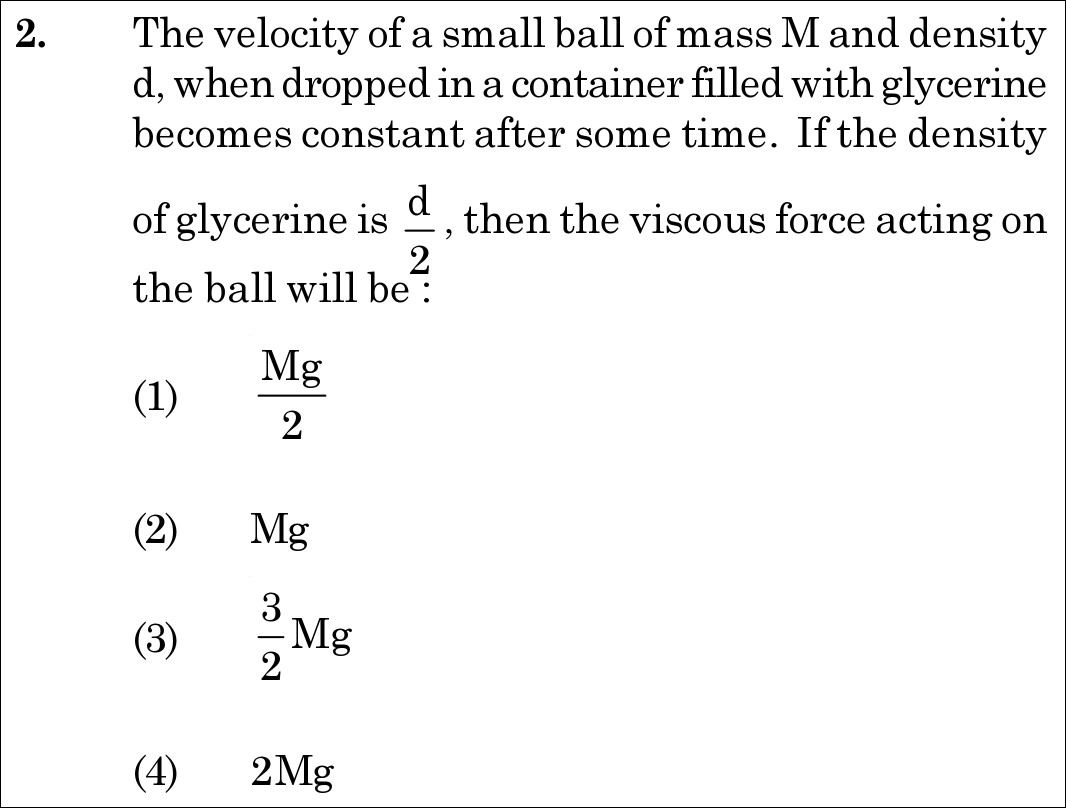
The velocity of a small ball of mass M and density d, when dropped in a container filled with glycerine becomes constant after some time. If the density of glycerine is d, then the viscous force acting on the ball will be:

✓
Verified Against NTA Final Answer Key
Option (1) : Mg / 2
📚 Mechanical Properties of Fluids Easy
📋 Given Parameters & Problem Setup
Mass of Ball M
Density of Ball d
Density of Glycerine d / 2
Kinematic Condition Velocity is constant (terminal velocity)
⚡

The 30-Second Exam Hall Shortcut: ⚡ Terminal Equilibrium: F_v = Weight - Upthrust

⏱️ Save ~20 seconds

At terminal velocity, acceleration is zero: W=FB+FvW = F_B + F_v. Since liquid density is half of ball density (dL=d/2d_L = d/2), the buoyant force is exactly half of the ball weight (FB=W/2F_B = W/2). Thus, the viscous force must support the other half: Fv=W−W/2=Mg/2F_v = W - W/2 = Mg/2! Match Option (1)!

1 Constant velocity   ⟹  a=0  ⟹  \implies a = 0 \implies net vertical force =0= 0.
2 Weight acting downward: W=MgW = Mg.
3 Upward buoyant force: FB=ρLρMg=d/2dMg=Mg2F_B = \frac{\rho_L}{\rho} Mg = \frac{d/2}{d} Mg = \frac{Mg}{2}.
4 Upward viscous force: Fv=W−FB=Mg−Mg2=Mg2F_v = W - F_B = Mg - \frac{Mg}{2} = \frac{Mg}{2}.
5 Match Option (1).
🛡️
Why You Can 100% Trust This Shortcut: Canonical Newton's first law of motion and Archimedes' principle for terminal steady state.
📐

Step-by-Step Rigorous Workflow & Mathematical Proof

Step 1

Formulating the Equilibrium Condition at Terminal Velocity

When the small sphere attains a constant terminal velocity (vtv_t), its downward acceleration is zero (a=0a = 0). By Newton's second law, the downward gravitational force is perfectly balanced by the sum of upward buoyant force (FBF_B) and upward viscous drag (FvF_v):

ΣFy=0  ⟹  W=FB+Fv  ⟹  Fv=W−FB\Sigma F_y = 0 \implies W = F_B + F_v \implies F_v = W - F_B
Step 2

Calculating Weight and Buoyant Force

Let VV be the volume of the sphere. The mass is M=V⋅dM = V \cdot d, so V=M/dV = M / d. The weight is W=MgW = Mg. The buoyant force exerted by glycerine of density ρL=d/2\rho_L = d/2 is:

FB=V⋅ρL⋅g=(Md)(d2)g=Mg2F_B = V \cdot \rho_L \cdot g = \left(\frac{M}{d}\right) \left(\frac{d}{2}\right) g = \frac{Mg}{2}
Step 3

Determining the Viscous Force

Substitute W=MgW = Mg and FB=Mg/2F_B = Mg/2 into the force balance equation:

Fv=Mg−Mg2=Mg2F_v = Mg - \frac{Mg}{2} = \frac{Mg}{2}
⭐

360° Option Elimination Engine Key Feature

Diagnose every choice: Know exactly why the right option works and why distractors fail.

4-Option Deep Scan
1 1
✓ 100% Correct
Verdict & Scientific Reason:

Exact balance of forces: Viscous force = Weight - Buoyant force = Mg - Mg/2 = Mg/2.

💡
Why this is airtight: None; textbook equilibrium derivation.
2 2
✗ Incorrect
Verdict & Scientific Reason:

Ignores the buoyant force completely (FB=0F_B = 0), which is only valid in vacuum.

⚠️
Student Fallacy (Why candidates pick this trap): Equating viscous force directly to gravitational weight without subtracting upthrust.
3 3
✗ Incorrect
Verdict & Scientific Reason:

Incorrectly adds buoyant force to weight (W+FB=Mg+Mg/2=3Mg/2W + F_B = Mg + Mg/2 = 3Mg/2).

⚠️
Student Fallacy (Why candidates pick this trap): Adding forces in the wrong direction instead of subtracting upward buoyant force.
4 4
✗ Incorrect
Verdict & Scientific Reason:

Inverts density ratio and adds unphysical multipliers.

⚠️
Student Fallacy (Why candidates pick this trap): Multiplying by density ratio inverse.
⚠️

NTA Trap Alert: Forgetting Archimedes Upthrust in Viscous Fluid Trap

Students often memorize Stokes' law (6πηrv6\pi\eta r v) and assume the viscous force equals MgMg directly, forgetting that the fluid also exerts a hydrostatic buoyant force that carries half the weight.

🛡️ How to avoid the -1 mark: Always draw the FBD: Downward = MgMg; Upward = FB+FvF_B + F_v. At constant speed, Fv=Mg−FBF_v = Mg - F_B.
📖

Core NEET Syllabus Standard

NCERT Physics · Mechanical Properties of Fluids Standard Benchmark
Core Scientific Principle Tested:

"At terminal velocity, the net downward force on a falling body is zero: Viscous force equals weight minus buoyant force (Fv=W−FBF_v = W - F_B)."

Syllabus Focus: Stokes' Law and Terminal Velocity
✓ Core NEET UG Syllabus Anchor Syllabus & Academic Standards ↗

Ready to attempt under real exam pressure?

Test your speed and accuracy in the authentic 200-minute timed NTA simulator.

Launch NEET 2021 CBT Test →

Spotted a mistake in this solution? Report an error (support@mycompetitiveexams.com)

⚖️ Legal & Fair Dealing Notice: Sourced from publicly released NEET 2021 question papers and NEET answer keys for private study, research, and non-commercial educational practice under Fair Dealing (Section 52(1)(a) of the Indian Copyright Act, 1957). Not affiliated with or endorsed by NTA or NMC.

Solve 4 NEET Questions a Day — One per Subject

Cover all 1,140 official NEET questions in 285 days at your own pace. Progress is saved on your device. No login needed.