MyCompetitiveExams Logo MyCompetitiveExams
Search 1,140+ Questions
Chapters, formulas, speed tricks
→
⚡ Brahmastra NEET 2027
720 MARKS

Dynamic 180-question full-length simulator mixed dynamically from all 6 years for 2027 & 2026 aspirants.

Launch Brahmastra 2027 Test →
Start Practice →
100% Free · No Login Required
Q.190 Zoology ⭐ 360° Option Elimination Active
Vault ↗

NEET 2021 Zoology Question 190 Solution

Topic: Organisms and Populations · Official NTA Booklet Code M1
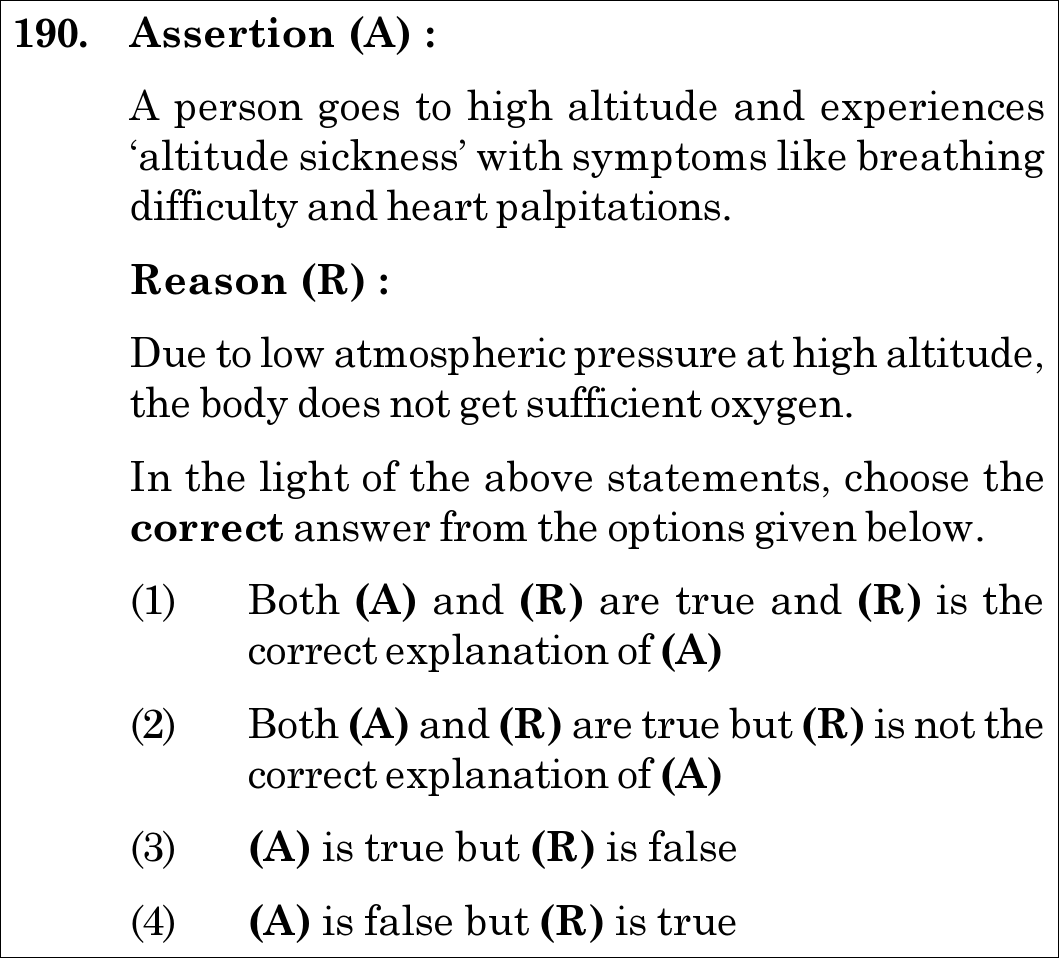
NEET 2021 Zoology Question 190: Altitude Sickness: Hypoxia, Physiological Manifestations, and Acclimatization

Question

Assertion (A): A person goes to high altitude and experiences 'altitude sickness' with symptoms like breathing difficulty and heart palpitations. Reason (R): Due to low atmospheric pressure at high altitude, the body does not get sufficient oxygen. In the light of the above statements, choose the correct answer from the options given below.

  1. (1)Both (A) and (R) are true and (R) is the correct explanation of (A)
  2. (2)Both (A) and (R) are true but (R) is not the correct explanation of (A)
  3. (3)(A) is true but (R) is false
  4. (4)(A) is false but (R) is true
✓
Verified Against NTA Final Answer Key
Option (1) : Both (A) and (R) are true and (R) is the correct explanation of (A)
📚 Organisms and Populations Easy
📋 Given Parameters & Problem Setup
Assertion (A) A person goes to high altitude and experiences ‘altitude sickness’ with symptoms like breathing difficulty and heart palpitations.
Reason (R) Due to low atmospheric pressure at high altitude, the body does not get sufficient oxygen.
⚡

The 30-Second Exam Hall Shortcut: ⚡ "Altitude Sickness is DIRECTLY Caused by Hypobaric Hypoxia (Low Patm → Low O₂)"

⏱️ Save ~20 seconds

At high altitudes (>3,500 m), low barometric atmospheric pressure reduces the partial pressure of oxygen (hypobaric hypoxia), so arterial blood cannot be fully saturated. This directly causes hyperventilation, palpitations, and fatigue! Both (A) and (R) are true, and (R) is the exact scientific cause of (A). Mark Option (1)!

1 Check Assertion (A): Altitude sickness symptoms include nausea, fatigue, heart palpitations, and dyspnea (breathing difficulty) at high altitude (>3,500 m) -> TRUE.
2 Check Reason (R): Low atmospheric pressure decreases alveolar pO2pO_2, causing arterial hypoxia -> TRUE.
3 Test causality: Why does the person experience breathing difficulty and palpitations? Because low atmospheric pressure deprives the body of adequate oxygen! (R) correctly explains (A).
4 Select Option (1).
🛡️
Why You Can 100% Trust This Shortcut: NCERT Biology · Organisms and Populations (Adaptations: Many people experience altitude sickness at high altitude (>3,500m Rohtang Pass). This is because in the low atmospheric pressure of high altitudes, the body does not get enough oxygen).
📐

Step-by-Step Rigorous Workflow & Mathematical Proof

Step 1

Physiological Etiology of Acute Altitude Sickness

When an unacclimatized human ascends rapidly to high altitude (such as Rohtang Pass near Manali, altitude >3,500 m), they experience acute mountain sickness: - Pathophysiology: Total barometric atmospheric pressure (PatmP_{\text{atm}}) decreases exponentially with altitude. Although the fractional concentration of oxygen remains ~21%, its partial pressure (pO2=0.21×PatmpO_2 = 0.21 \times P_{\text{atm}}) drops drastically. - Symptom Manifestations: Inadequate alveolar pO2pO_2 causes arterial hypoxia (tissue oxygen deprivation). The respiratory center in the brainstem stimulates rapid hyperventilation (breathing difficulty), while the sympathetic nervous system triggers tachycardia (heart palpitations) to increase cardiac output and compensate for diminished oxygen transport.

↑Altitude  ⟹  ↓Patm  ⟹  ↓pO2  ⟹  Arterial Hypoxia  ⟹  {↑Ventilation (Dyspnea)↑Heart Rate (Palpitations)\uparrow \text{Altitude} \implies \downarrow P_{\text{atm}} \implies \downarrow pO_2 \implies \text{Arterial Hypoxia} \implies \begin{cases} \uparrow \text{Ventilation (Dyspnea)} \\ \uparrow \text{Heart Rate (Palpitations)} \end{cases}
Step 2

Long-Term Acclimatization Responses

Gradually, the body acclimatizes to high altitude by: 1. Increasing red blood cell production (erythropoietin release from kidneys stimulating bone marrow erythropoiesis). 2. Increasing breathing rate. 3. Decreasing the binding affinity of haemoglobin for oxygen (shifting curve to right via elevated 2,3-BPG) to facilitate easier unloading of O2O_2 in systemic tissues.

⭐

360° Option Elimination Engine Key Feature

Diagnose every choice: Know exactly why the right option works and why distractors fail.

4-Option Deep Scan
1 1
✓ 100% Correct
Verdict & Scientific Reason:

Correct. (A) correctly describes the symptoms of altitude sickness, and (R) provides the direct causal biophysical mechanism (hypobaric hypoxia).

💡
Why this is airtight: None. Candidate establishes the direct cause-and-effect link.
2 2
✗ Incorrect
Verdict & Scientific Reason:

Incorrect. (R) is the exact causal explanation for (A).

⚠️
Student Fallacy (Why candidates pick this trap): Failing to see that oxygen deprivation is the direct reason for breathing difficulty and palpitations.
3 3
✗ Incorrect
Verdict & Scientific Reason:

Incorrect because Reason is a well-established physical fact.

⚠️
Student Fallacy (Why candidates pick this trap): Believing atmospheric pressure remains constant at altitude.
4 4
✗ Incorrect
Verdict & Scientific Reason:

Incorrect because Assertion accurately details standard altitude sickness symptoms.

⚠️
Student Fallacy (Why candidates pick this trap): Denying altitude sickness symptomology.
⚠️

NTA Trap Alert: Fractional O₂ vs Partial Pressure Confusion Trap

Some candidates think oxygen percentage decreases at high altitude. The percentage of O₂ in air is always ~21%; it is the *total atmospheric pressure* that drops, reducing the *partial pressure* of O₂. (R) correctly specifies "low atmospheric pressure".

🛡️ How to avoid the -1 mark: Recognize that hypobaric pressure is the physical driver of hypoxia.
📖

Core NEET Syllabus Standard

NEET / NCERT Biology · Organisms and Populations Standard Benchmark
Core Scientific Principle Tested:

"Low atmospheric pressure at high altitudes leads to insufficient oxygen delivery, causing altitude sickness."

Syllabus Focus: Physiological Adaptations
✓ Core NEET UG Syllabus Anchor Syllabus & Academic Standards ↗

Ready to attempt under real exam pressure?

Test your speed and accuracy in the authentic 200-minute timed NTA simulator.

Launch NEET 2021 CBT Test →

Spotted a mistake in this solution? Report an error (support@mycompetitiveexams.com)

⚖️ Legal & Fair Dealing Notice: Sourced from publicly released NEET 2021 question papers and NEET answer keys for private study, research, and non-commercial educational practice under Fair Dealing (Section 52(1)(a) of the Indian Copyright Act, 1957). Not affiliated with or endorsed by NTA or NMC.

Solve 4 NEET Questions a Day — One per Subject

Cover all 1,140 official NEET questions in 285 days at your own pace. Progress is saved on your device. No login needed.