MyCompetitiveExams Logo MyCompetitiveExams
Search 1,140+ Questions
Chapters, formulas, speed tricks
→
⚡ Brahmastra NEET 2027
720 MARKS

Dynamic 180-question full-length simulator mixed dynamically from all 6 years for 2027 & 2026 aspirants.

Launch Brahmastra 2027 Test →
Start Practice →
100% Free · No Login Required
Q.178 Zoology ⭐ 360° Option Elimination Active
Vault ↗

NEET 2021 Zoology Question 178 Solution

Topic: Body Fluids and Circulation · Official NTA Booklet Code M1
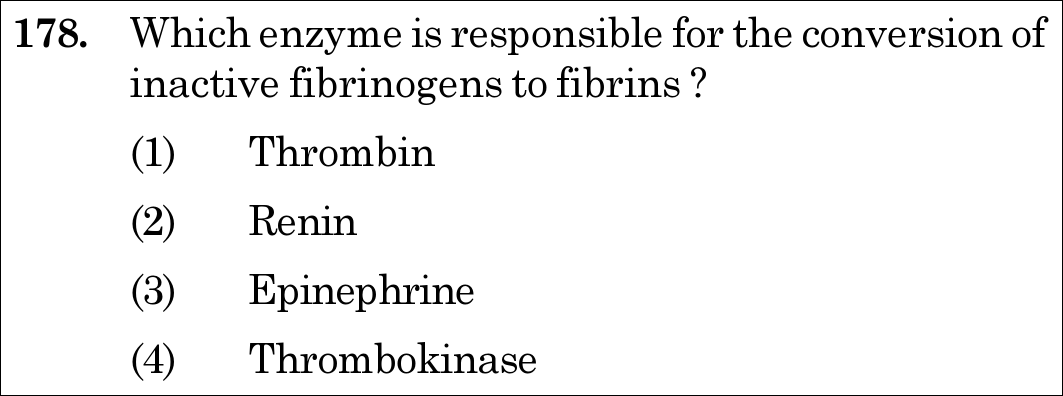
NEET 2021 Zoology Question 178: Final Common Pathway of Blood Clotting: Thrombin Action on Fibrinogen

Question

Which enzyme is responsible for the conversion of inactive fibrinogens to fibrins?

  1. (1)Thrombin
  2. (2)Renin
  3. (3)Epinephrine
  4. (4)Thrombokinase
✓
Verified Against NTA Final Answer Key
Option (1) : Thrombin
📚 Body Fluids and Circulation Easy
📋 Given Parameters & Problem Setup
Substrate Inactive soluble Fibrinogen
Product Insoluble Fibrin threads / clot network
Question Objective Identify the specific enzyme catalyzing this proteolytic cleavage
⚡

The 30-Second Exam Hall Shortcut: ⚡ "Cascade Rule: Thrombokinase activates Prothrombin → Thrombin cleaves Fibrinogen"

⏱️ Save ~20 seconds

Thrombokinase converts Prothrombin to Thrombin; then active Thrombin cleaves soluble Fibrinogen into insoluble Fibrin meshwork! Therefore, the direct enzyme converting fibrinogen to fibrin is Thrombin. Mark Option (1)!

1 Recall the 2-step terminal coagulation cascade: - Step 1: Prothrombin →Thrombokinase+Ca2+\xrightarrow{\text{Thrombokinase} + Ca^{2+}} Thrombin. - Step 2: Fibrinogen →Thrombin\xrightarrow{\textbf{Thrombin}} Fibrin.
2 Identify the direct catalyst of Step 2: Thrombin.
3 Avoid distractor: Thrombokinase acts upstream on prothrombin, not directly on fibrinogen.
4 Select Option (1).
🛡️
Why You Can 100% Trust This Shortcut: NCERT Biology · Body Fluids and Circulation (Coagulation of Blood: Fibrins are formed by the conversion of inactive fibrinogens in the plasma by the enzyme thrombin. Thrombins, in turn are formed from another inactive substance present in the plasma called prothrombin).
📐

Step-by-Step Rigorous Workflow & Mathematical Proof

Step 1

Enzymatic Cascade of Blood Coagulation

Coagulation is an amplified biological cascade where inactive proenzymes are sequentially converted to active serine proteases: 1. Injured tissues and activated platelets release thromboplastin, forming the enzyme complex Thrombokinase (prothrombinase). 2. In the presence of ionic calcium (Ca2+Ca^{2+}), thrombokinase catalyzes the proteolytic conversion of the plasma zymogen Prothrombin into active Thrombin. 3. Thrombin acts directly on soluble globular Fibrinogen (Factor I), cleaving fibrinopeptides A and B to yield insoluble fibrin monomers that polymerize and cross-link into a meshwork trapping blood cells to form the definitive clot.

Prothrombin→Ca2+ThrombokinaseThrombinInactive Fibrinogen→ThrombinInsoluble Fibrin Clot\begin{aligned} \text{Prothrombin} &\xrightarrow[Ca^{2+}]{\text{Thrombokinase}} \mathbf{Thrombin} \\[6pt] \text{Inactive Fibrinogen} &\xrightarrow{\mathbf{Thrombin}} \mathbf{Insoluble\,Fibrin\,Clot} \end{aligned}
Step 2

Elimination of Non-Coagulation Options

- Renin: An aspartic protease secreted by juxtaglomerular cells of the kidney that converts angiotensinogen into angiotensin I (RAAS pathway). - Epinephrine (Adrenaline): An amino acid derivative hormone secreted by the adrenal medulla during fight-or-flight emergencies. - Thrombokinase: Activates prothrombin to thrombin; it does not directly convert fibrinogen to fibrin.

⭐

360° Option Elimination Engine Key Feature

Diagnose every choice: Know exactly why the right option works and why distractors fail.

4-Option Deep Scan
1 1
✓ 100% Correct
Verdict & Scientific Reason:

Correct. Thrombin is the specific serine protease that cleaves fibrinogen into insoluble fibrin.

💡
Why this is airtight: None. Candidate remembers the exact enzymatic substrate of thrombin.
2 2
✗ Incorrect
Verdict & Scientific Reason:

Incorrect. Renin is a renal hormone involved in blood pressure regulation via the RAAS axis.

⚠️
Student Fallacy (Why candidates pick this trap): Confusing renin with coagulating enzymes due to rough phonetic similarity with rennin.
3 3
✗ Incorrect
Verdict & Scientific Reason:

Incorrect. Epinephrine is an emergency catecholamine hormone, not a clotting protease.

⚠️
Student Fallacy (Why candidates pick this trap): Mistaking sympathetic vasoconstrictors for biochemical clotting catalysts.
4 4
✗ Incorrect
Verdict & Scientific Reason:

Incorrect. Thrombokinase converts prothrombin into thrombin, which is the immediate upstream reaction.

⚠️
Student Fallacy (Why candidates pick this trap): Failing to distinguish between the initiator enzyme (thrombokinase) and the terminal effector enzyme (thrombin).
⚠️

NTA Trap Alert: Thrombokinase vs Thrombin Cascade Step Trap

Candidates know that thrombokinase and thrombin are both involved in clotting. The trap lies in confusing which enzyme acts on prothrombin (thrombokinase) versus which enzyme acts directly on fibrinogen (thrombin).

🛡️ How to avoid the -1 mark: Remember: Thrombokinase makes Thrombin; Thrombin makes Fibrin.
📖

Core NEET Syllabus Standard

NEET / NCERT Biology · Body Fluids and Circulation Standard Benchmark
Core Scientific Principle Tested:

"Thrombin converts inactive fibrinogen into insoluble fibrin threads."

Syllabus Focus: Coagulation of Blood
✓ Core NEET UG Syllabus Anchor Syllabus & Academic Standards ↗

Ready to attempt under real exam pressure?

Test your speed and accuracy in the authentic 200-minute timed NTA simulator.

Launch NEET 2021 CBT Test →

Spotted a mistake in this solution? Report an error (support@mycompetitiveexams.com)

⚖️ Legal & Fair Dealing Notice: Sourced from publicly released NEET 2021 question papers and NEET answer keys for private study, research, and non-commercial educational practice under Fair Dealing (Section 52(1)(a) of the Indian Copyright Act, 1957). Not affiliated with or endorsed by NTA or NMC.

Solve 4 NEET Questions a Day — One per Subject

Cover all 1,140 official NEET questions in 285 days at your own pace. Progress is saved on your device. No login needed.