MyCompetitiveExams Logo MyCompetitiveExams
Search 1,140+ Questions
Chapters, formulas, speed tricks
→
⚡ Brahmastra NEET 2027
720 MARKS

Dynamic 180-question full-length simulator mixed dynamically from all 6 years for 2027 & 2026 aspirants.

Launch Brahmastra 2027 Test →
Start Practice →
100% Free · No Login Required
Q.23 Physics ⭐ 360° Option Elimination Active
Vault ↗

NEET 2021 Physics Question 23 Solution

Topic: Semiconductor Electronics: Materials, Devices and Simple Circuits · Official NTA Booklet Code M1
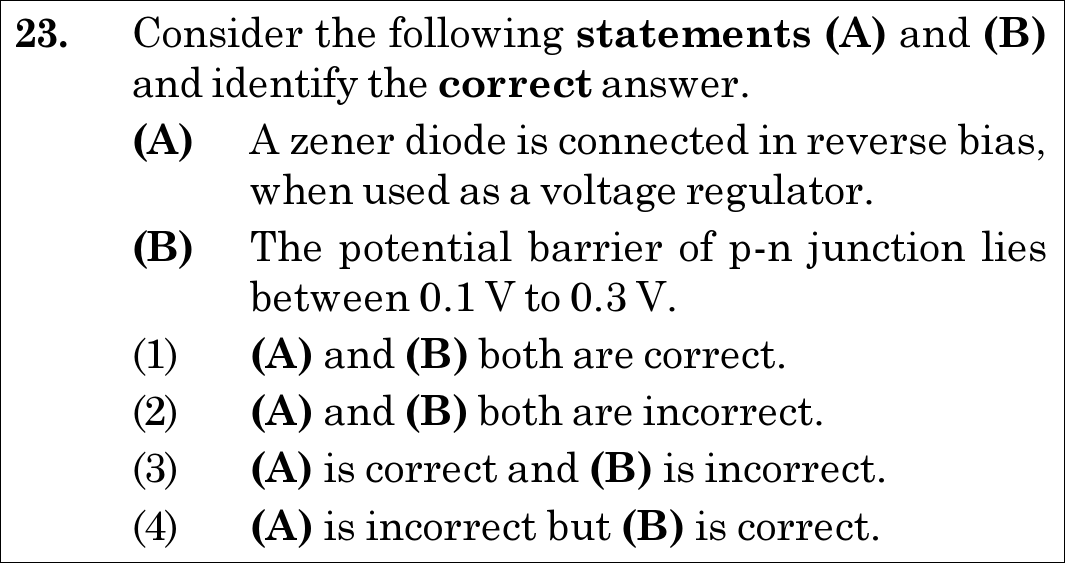
NEET 2021 Physics Question 23: Zener Diode Voltage Regulation and p-n Junction Barrier Potential

Question

Consider the following statements (A) and (B) and identify the correct answer. (A) A zener diode is connected in reverse bias, when used as a voltage regulator. (B) The potential barrier of p-n junction lies between 0.1 V to 0.3 V.

  1. (1)(A) and (B) both are correct.
  2. (2)(A) and (B) both are incorrect.
  3. (3)(A) is correct and (B) is incorrect.
  4. (4)(A) is incorrect but (B) is correct.
✓
Verified Against NTA Final Answer Key
Option (3) : (A) is correct and (B) is incorrect.
📚 Semiconductor Electronics: Materials, Devices and Simple Circuits Easy
📋 Given Parameters & Problem Setup
Statement (A) A zener diode is connected in reverse bias, when used as a voltage regulator.
Statement (B) The potential barrier of p-n junction lies between 0.1 V to 0.3 V.
⚡

The 30-Second Exam Hall Shortcut: ⚡ Zener Reverse Bias + Silicon 0.7 V Barrier Rule

⏱️ Save ~20 seconds

Statement (A) is TRUE: Zener diode operates strictly in reverse-breakdown region for voltage regulation. Statement (B) is FALSE: Silicon p-n junctions have a barrier potential of ≈0.7 V\approx 0.7\text{ V} (Germanium is ≈0.3 V\approx 0.3\text{ V}), so the barrier lies typically between 0.3 V0.3\text{ V} and 0.7 V0.7\text{ V}, not 0.1 V0.1\text{ V} to 0.3 V0.3\text{ V}! Match Option (3)!

1 Check Statement (A): Voltage regulator operation requires reverse bias in breakdown region -> True.
2 Check Statement (B): Claims barrier potential is 0.1 V to 0.3 V. But standard Si barrier is ~0.7 V and Ge is ~0.3 V -> False.
3 Thus, (A) is correct and (B) is incorrect.
4 Match Option (3).
🛡️
Why You Can 100% Trust This Shortcut: Canonical NCERT Semiconductor Electronics semiconductor device fundamentals.
📐

Step-by-Step Rigorous Workflow & Mathematical Proof

Step 1

Evaluation of Statement (A): Zener Diode Operation

A Zener diode is a heavily doped silicon p-n junction diode. When operated in the reverse breakdown region, the voltage across the diode (VZV_Z) remains virtually constant over a wide range of reverse currents (IZI_Z). Therefore, to regulate unregulated DC voltage, it is always connected in reverse bias across the load:

Zener Voltage Regulator  ⟹  Operates in Reverse Breakdown Bias (Statement A is CORRECT)\text{Zener Voltage Regulator} \implies \mathbf{\text{Operates in Reverse Breakdown Bias (Statement A is CORRECT)}}
Step 2

Evaluation of Statement (B): p-n Junction Barrier Potential

In an unbiased p-n junction, diffusion of majority carriers creates a depletion layer with a built-in potential barrier V0V_0. For Germanium, V0≈0.3 VV_0 \approx 0.3\text{ V}, and for Silicon (the ubiquitous material in modern electronics), V0≈0.7 VV_0 \approx 0.7\text{ V}. Thus, the barrier potential typically lies between 0.3 V0.3\text{ V} and 0.7 V0.7\text{ V}, not between 0.1 V0.1\text{ V} and 0.3 V0.3\text{ V}. Statement (B) is unambiguously incorrect.

Step 3

Conclusion

Statement (A) is correct and Statement (B) is incorrect. This corresponds uniquely to Option (3).

⭐

360° Option Elimination Engine Key Feature

Diagnose every choice: Know exactly why the right option works and why distractors fail.

4-Option Deep Scan
1 1
✗ Incorrect
Verdict & Scientific Reason:

Statement (B) is false because Silicon p-n junctions have a barrier potential of ~0.7 V.

⚠️
Student Fallacy (Why candidates pick this trap): Believing 0.1 V to 0.3 V covers all semiconductor junctions.
2 2
✗ Incorrect
Verdict & Scientific Reason:

Statement (A) is an undisputed textbook fact of semiconductor electronics.

⚠️
Student Fallacy (Why candidates pick this trap): Doubting whether Zener diodes operate in reverse bias.
3 3
✓ 100% Correct
Verdict & Scientific Reason:

Statement (A) accurately states reverse-bias operation of Zener regulators, while Statement (B) underestimates the barrier potential range.

💡
Why this is airtight: None; rigorous semiconductor physics knowledge.
4 4
✗ Incorrect
Verdict & Scientific Reason:

Inverts the truth value of both statements.

⚠️
Student Fallacy (Why candidates pick this trap): Gross confusion regarding semiconductor diode physics.
⚠️

NTA Trap Alert: Germanium vs. Silicon Barrier Potential Trap

Students often recall that Germanium has a low barrier potential of ≈0.3 V\approx 0.3\text{ V} and assume Statement (B) is true, forgetting that Silicon (the primary semiconductor in NCERT) has a barrier of ≈0.7 V\approx 0.7\text{ V}.

🛡️ How to avoid the -1 mark: Remember: Silicon barrier potential is ≈0.7 V\approx 0.7\text{ V}. Any range ending at 0.3 V0.3\text{ V} is false for p-n junctions.
📖

Core NEET Syllabus Standard

NCERT Physics · Semiconductor Electronics: Materials, Devices and Simple Circuits Standard Benchmark
Core Scientific Principle Tested:

"A Zener diode is designed to operate continuously in the reverse breakdown region as a voltage regulator. The barrier potential of a silicon p-n junction is approximately 0.7 V."

Syllabus Focus: p-n Junction Diode and Zener Diode
✓ Core NEET UG Syllabus Anchor Syllabus & Academic Standards ↗

Ready to attempt under real exam pressure?

Test your speed and accuracy in the authentic 200-minute timed NTA simulator.

Launch NEET 2021 CBT Test →

Spotted a mistake in this solution? Report an error (support@mycompetitiveexams.com)

⚖️ Legal & Fair Dealing Notice: Sourced from publicly released NEET 2021 question papers and NEET answer keys for private study, research, and non-commercial educational practice under Fair Dealing (Section 52(1)(a) of the Indian Copyright Act, 1957). Not affiliated with or endorsed by NTA or NMC.

Solve 4 NEET Questions a Day — One per Subject

Cover all 1,140 official NEET questions in 285 days at your own pace. Progress is saved on your device. No login needed.