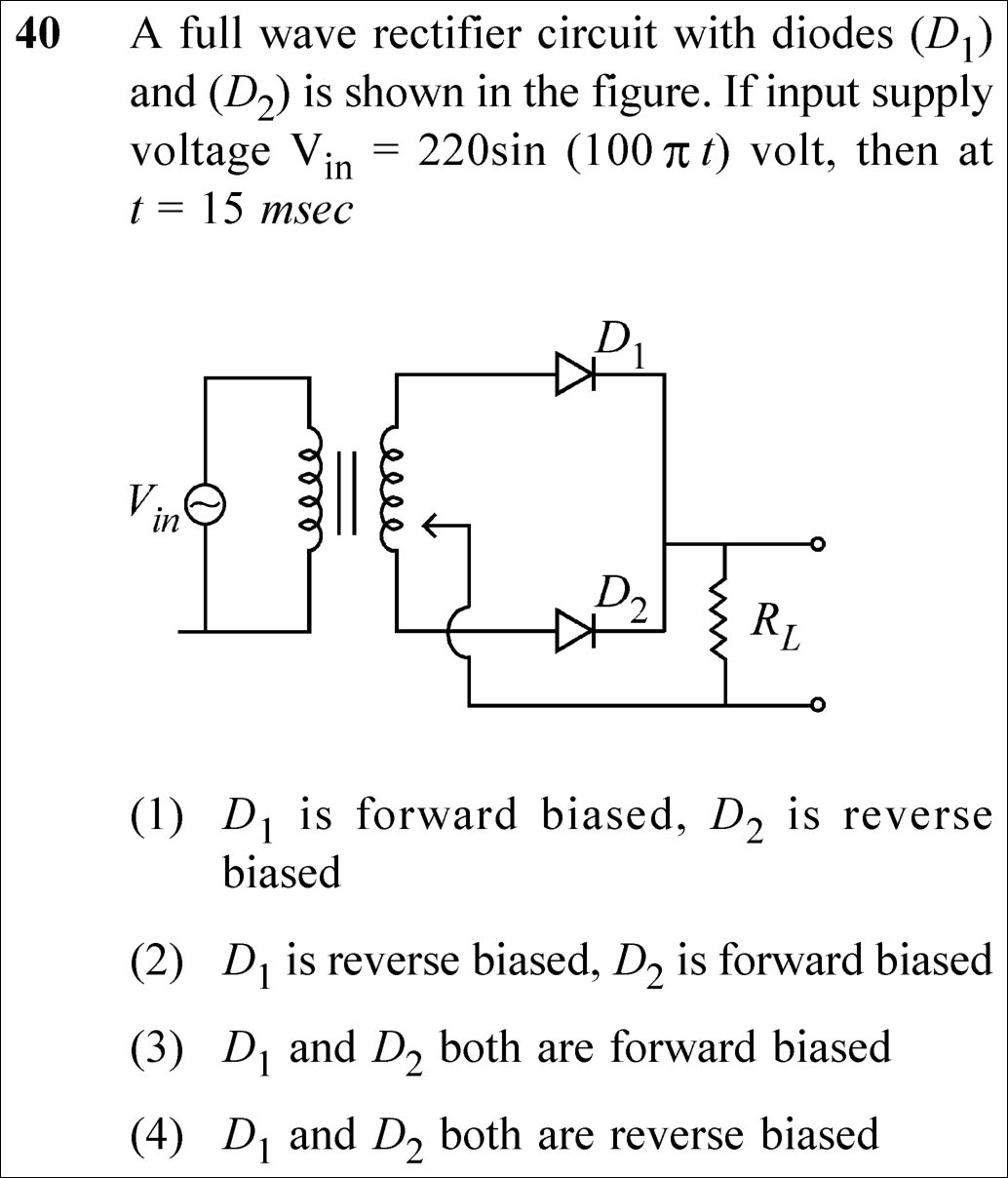
📋 Given Parameters & Problem Setup
Input Supply Voltage (V_in) 220 sin(100 π t) volt
Evaluation Time (t) 15 msec = 15 × 10⁻³ s
Rectifier Type Center-tapped transformer full wave rectifier with diodes D₁ and D₂
Phase θ = 100π × 15×10⁻³ = 1.5π = 270° ⟹ sin(270°) = -1 (Negative Peak). In any half-cycle, one diode is forward biased and the other is reverse biased. Since transformer dot convention was omitted, NTA awarded marks for both Option (1) and Option (2)!
1 Calculate phase at t = 15 ms: θ = 100 π × (15 × 10⁻³) = 1.5 π radians = 270° = 3π/2.
2 Instantaneous voltage: V_in = 220 sin(270°) = -220 V (Negative peak of AC input).
3 In a center-tapped full wave rectifier, the two diodes always conduct on opposite half-cycles: one is ALWAYS forward biased while the other is reverse biased.
4 Conventionally, during the positive half-cycle, D₁ is forward biased and D₂ is reverse biased. During the negative half-cycle (at 15 ms), D₁ becomes reverse biased and D₂ becomes forward biased (Option 2).
5 However, because the transformer winding sense (dot convention) was not indicated in the diagram, an opposite phase winding makes D₁ forward biased and D₂ reverse biased (Option 1).
6 Official NTA Final Answer Key awarded full marks to both (1) and (2)!
🛡️ Why You Can 100% Trust This Shortcut: Full Wave Rectifier Working Principle (NCERT Physics · Semiconductor Electronics) & NTA Final Official Key.
⚠️
A frequent student misconception is that "full wave" means both diodes are on at the same time. In reality, each diode conducts strictly for alternate half-cycles (180° each), taking turns!
🛡️ How to avoid the -1 mark: Remember: D₁ and D₂ NEVER conduct at the same time in a center-tapped rectifier.
📖
NEET Physics Core Syllabus · Semiconductor Electronics: Materials, Devices and Simple Circuits Standard Benchmark
Core Scientific Principle Tested:
"In a full-wave rectifier, diodes conduct alternately during opposite half-cycles."
Syllabus Focus: Application of Junction Diode as a Rectifier
Alternating Halves: At any instant, one diode conducts while the other blocks (Key: A,B)!