MyCompetitiveExams Logo MyCompetitiveExams
Search 1,140+ Questions
Chapters, formulas, speed tricks
→
⚡ Brahmastra NEET 2027
720 MARKS

Dynamic 180-question full-length simulator mixed dynamically from all 6 years for 2027 & 2026 aspirants.

Launch Brahmastra 2027 Test →
Start Practice →
100% Free · No Login Required
Q.22 Physics ⭐ 360° Option Elimination Active
Vault ↗

NEET 2021 Physics Question 22 Solution

Topic: Electrostatic Potential and Capacitance · Official NTA Booklet Code M1
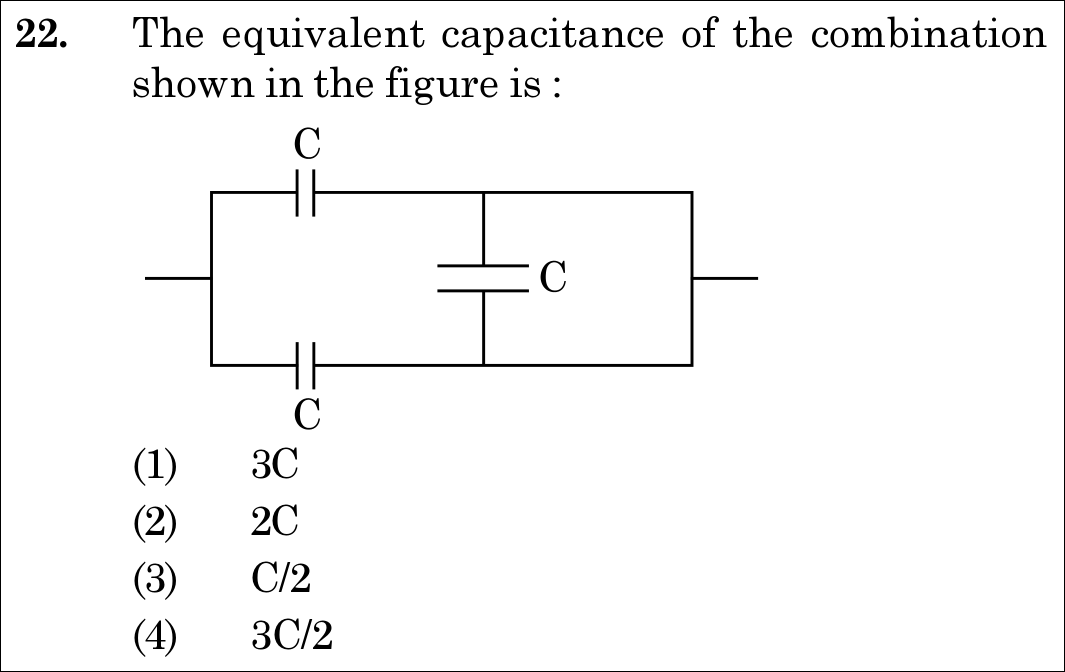
NEET 2021 Physics Question 22: Capacitor Networks: Identifying Short-Circuited Bridge Capacitors

Question

The equivalent capacitance of the combination shown in the figure is:

✓
Verified Against NTA Final Answer Key
Option (2) : 2C
📚 Electrostatic Potential and Capacitance Easy
📋 Given Parameters & Problem Setup
Capacitors Three identical capacitors, each of capacitance C
Top & Bottom Branches Capacitors C in series with output line
Bridge Capacitor Vertical capacitor C bridging top and bottom wires
⚡

The 30-Second Exam Hall Shortcut: ⚡ Short-Circuit Detector: Vertical Capacitor has ΔV = 0!

⏱️ Save ~25 seconds

Inspect the right side: both plates of the vertical capacitor are connected directly to the right terminal via zero-resistance wires! Hence, potential difference across the vertical capacitor is zero (it is short-circuited). The top and bottom capacitors are simply in parallel: Ceq=C+C=2CC_{\text{eq}} = C + C = 2C! Match Option (2)!

1 Label input node as A (left) and output node as B (right).
2 Top plate of vertical capacitor connects directly to node B.
3 Bottom plate of vertical capacitor connects directly to node B.
4 ΔV\Delta V across vertical capacitor =VB−VB=0  ⟹  = V_B - V_B = 0 \implies it stores zero charge (short-circuited / redundant).
5 Top capacitor is connected between A and B (C1=CC_1 = C).
6 Bottom capacitor is connected between A and B (C2=CC_2 = C).
7 Equivalent capacitance: Ceq=C1+C2=C+C=2CC_{\text{eq}} = C_1 + C_2 = C + C = 2C.
8 Match Option (2).
🛡️
Why You Can 100% Trust This Shortcut: Canonical nodal analysis and equipotential short-circuit theorems.
📐

Step-by-Step Rigorous Workflow & Mathematical Proof

Step 1

Nodal Voltage Labeling

Assign electrostatic potentials to all wire junctions in the circuit diagram: - Let the input terminal on the left be at potential VAV_A. - Let the output terminal on the right be at potential VBV_B. - The ideal continuous conducting wire on the right connects the top node and bottom node directly to terminal B with zero resistance. Therefore, both nodes are at potential VBV_B.

Step 2

Analyzing the Vertical Bridge Capacitor

The vertical capacitor of capacitance CC has its upper terminal connected to the upper wire (potential VBV_B) and its lower terminal connected to the lower wire (potential VBV_B):

ΔVvertical=VB−VB=0  ⟹  Q=CΔV=0\Delta V_{\text{vertical}} = V_B - V_B = 0 \implies Q = C \Delta V = 0
Step 3

Calculating the Equivalent Capacitance

Since the vertical capacitor carries zero charge and contributes zero capacitance, it can be removed from the circuit. The remaining circuit consists solely of the top capacitor and the bottom capacitor connected in parallel between node A and node B:

Ceq=Ctop+Cbottom=C+C=2CC_{\text{eq}} = C_{\text{top}} + C_{\text{bottom}} = C + C = 2C
⭐

360° Option Elimination Engine Key Feature

Diagnose every choice: Know exactly why the right option works and why distractors fail.

4-Option Deep Scan
1 1
✗ Incorrect
Verdict & Scientific Reason:

Assumes all three capacitors are active in parallel (C+C+C=3CC + C + C = 3C), ignoring that the vertical capacitor is shorted.

⚠️
Student Fallacy (Why candidates pick this trap): Treating all three capacitors as participating equally in parallel.
2 2
✓ 100% Correct
Verdict & Scientific Reason:

Exact equivalent capacitance: vertical capacitor is short-circuited (DeltaV=0Delta V = 0), leaving two parallel capacitors of capacitance CC, yielding 2C2C.

💡
Why this is airtight: None; rigorous nodal potential analysis.
3 3
✗ Incorrect
Verdict & Scientific Reason:

Result of erroneously treating the top and bottom capacitors in series (C/2C/2).

⚠️
Student Fallacy (Why candidates pick this trap): Assuming series connection between top and bottom branches.
4 4
✗ Incorrect
Verdict & Scientific Reason:

Result of treating the vertical capacitor as a series/parallel bridge element.

⚠️
Student Fallacy (Why candidates pick this trap): Misapplying delta-star or bridge formulas without checking equipotential nodes.
⚠️

NTA Trap Alert: The "Ghost Bridge" Visual Trap

The circuit looks visually like a bridge circuit. Students immediately begin calculating Wheatstone bridge ratios or complex series-parallel ladders. Tracing the wire on the right immediately reveals that both ends of the vertical capacitor connect to the same terminal.

🛡️ How to avoid the -1 mark: ALWAYS trace continuous conducting lines! If both plates of a capacitor touch the same node, it is short-circuited and can be erased.
📖

Core NEET Syllabus Standard

NCERT Physics · Electrostatic Potential and Capacitance Standard Benchmark
Core Scientific Principle Tested:

"Capacitors connected across equipotential points carry no charge and do not contribute to equivalent capacitance (Q=CΔV=0Q = C \Delta V = 0)."

Syllabus Focus: Capacitors in Parallel and Series
✓ Core NEET UG Syllabus Anchor Syllabus & Academic Standards ↗

Ready to attempt under real exam pressure?

Test your speed and accuracy in the authentic 200-minute timed NTA simulator.

Launch NEET 2021 CBT Test →

Spotted a mistake in this solution? Report an error (support@mycompetitiveexams.com)

⚖️ Legal & Fair Dealing Notice: Sourced from publicly released NEET 2021 question papers and NEET answer keys for private study, research, and non-commercial educational practice under Fair Dealing (Section 52(1)(a) of the Indian Copyright Act, 1957). Not affiliated with or endorsed by NTA or NMC.

Solve 4 NEET Questions a Day — One per Subject

Cover all 1,140 official NEET questions in 285 days at your own pace. Progress is saved on your device. No login needed.