MyCompetitiveExams Logo MyCompetitiveExams
Search 1,140+ Questions
Chapters, formulas, speed tricks
→
⚡ Brahmastra NEET 2027
720 MARKS

Dynamic 180-question full-length simulator mixed dynamically from all 6 years for 2027 & 2026 aspirants.

Launch Brahmastra 2027 Test →
Start Practice →
100% Free · No Login Required
Q.112 Botany ⭐ 360° Option Elimination Active
Vault ↗

NEET 2021 Botany Question 112 Solution

Topic: Organisms and Populations · Official NTA Booklet Code M1
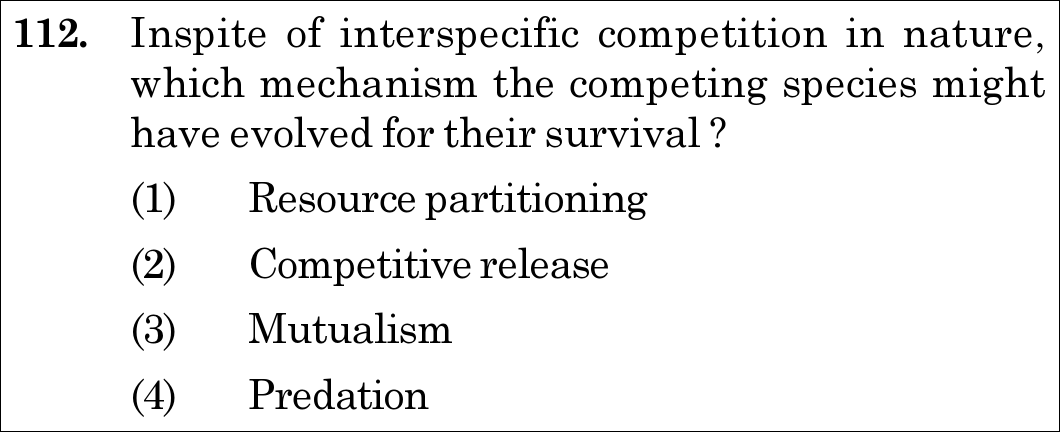
NEET 2021 Botany Question 112: Mechanisms of Coexistence: Resource Partitioning (MacArthur)

Question

Inspite of interspecific competition in nature, which mechanism the competing species might have evolved for their survival?

  1. (1)Resource partitioning
  2. (2)Competitive release
  3. (3)Mutualism
  4. (4)Predation
✓
Verified Against NTA Final Answer Key
Option (1) : Resource partitioning
📚 Organisms and Populations Easy
📋 Given Parameters & Problem Setup
Ecological Force Interspecific competition in nature
Adaptive Outcome Mechanism evolved by competing species for coexistence/survival
⚡

The 30-Second Exam Hall Shortcut: ⚡ Competition Coexistence = Resource Partitioning (Warblers)

⏱️ Save ~15 seconds

Rather than facing competitive exclusion (Gause's Principle), competing species evolve Resource Partitioning—sharing resources by selecting different feeding times, foraging patterns, or microhabitats! Match Option (1)!

1 Gause's competitive exclusion states that two closely related species competing for identical limiting resources cannot coexist indefinitely.
2 However, competing species in nature evolve mechanisms that promote coexistence rather than exclusion.
3 One such primary evolutionary mechanism is Resource partitioning (e.g., MacArthur's five species of warblers).
4 Match Option (1).
🛡️
Why You Can 100% Trust This Shortcut: Canonical NCERT Ecology principles on Population Interactions and Competition.
📐

Step-by-Step Rigorous Workflow & Mathematical Proof

Step 1

Ecological Conflict and Gause's Principle

Gause's Competitive Exclusion Principle dictates that two species competing for the exact same limiting resource cannot coexist at constant population values; the inferior competitor is ultimately eliminated.

Step 2

Evolution of Resource Partitioning for Coexistence

To circumvent competitive exclusion, natural selection favors behavioral and morphological divergence:

Interspecific Competition→Natural SelectionResource Partitioning  ⟹  Coexistence without exclusion\text{Interspecific Competition} \xrightarrow{\text{Natural Selection}} \mathbf{\text{Resource Partitioning}} \implies \text{Coexistence without exclusion}
Step 3

Experimental Evidence (Robert MacArthur)

MacArthur demonstrated that five closely related species of warblers living on the same spruce tree were able to coexist without competitive exclusion by foraging at different heights, exploring different zones of the foliage, and adopting different hunting rhythms.

⭐

360° Option Elimination Engine Key Feature

Diagnose every choice: Know exactly why the right option works and why distractors fail.

4-Option Deep Scan
1 1
✓ 100% Correct
Verdict & Scientific Reason:

Resource partitioning enables competing species to avoid exclusion by choosing different feeding times or foraging patterns, ensuring coexistence.

💡
Why this is airtight: None. Direct textbook concept.
2 2
✗ Incorrect
Verdict & Scientific Reason:

Competitive release describes the dramatic expansion of a species' distributional range when a superior competitor is experimentally removed, not a coexistence adaptation.

⚠️
Student Fallacy (Why candidates pick this trap): Confusing the release phenomenon with the evolutionary adaptation for coexistence.
3 3
✗ Incorrect
Verdict & Scientific Reason:

Mutualism is an obligate (+, +) cooperation between species, not an evolutionary mechanism arising directly to resolve interspecific competition between ecological rivals.

⚠️
Student Fallacy (Why candidates pick this trap): Assuming any mechanism where species avoid conflict must be "mutualism".
4 4
✗ Incorrect
Verdict & Scientific Reason:

Predation is a trophic consumer-resource interaction (+, -), not a mechanism evolved between competing species at the same trophic guild.

⚠️
Student Fallacy (Why candidates pick this trap): Conflating competitive interactions with predatory interactions.
⚠️

NTA Trap Alert: Resource Partitioning vs Competitive Release

Both terms involve competition. Resource partitioning is what species evolve to coexist; Competitive release is what happens when one competitor is artificially taken away.

🛡️ How to avoid the -1 mark: Remember: "Partition = Divide & Share to Survive"   ⟹  \implies Resource Partitioning.
📖

Core NEET Syllabus Standard

NEET / NCERT Biology · Organisms and Populations Standard Benchmark
Core Scientific Principle Tested:

"If two species compete for the same resource, they could avoid competition by choosing different times for feeding or different foraging patterns (resource partitioning)."

Syllabus Focus: Population Interactions: Competition
✓ Core NEET UG Syllabus Anchor Syllabus & Academic Standards ↗

Ready to attempt under real exam pressure?

Test your speed and accuracy in the authentic 200-minute timed NTA simulator.

Launch NEET 2021 CBT Test →

Spotted a mistake in this solution? Report an error (support@mycompetitiveexams.com)

⚖️ Legal & Fair Dealing Notice: Sourced from publicly released NEET 2021 question papers and NEET answer keys for private study, research, and non-commercial educational practice under Fair Dealing (Section 52(1)(a) of the Indian Copyright Act, 1957). Not affiliated with or endorsed by NTA or NMC.

Solve 4 NEET Questions a Day — One per Subject

Cover all 1,140 official NEET questions in 285 days at your own pace. Progress is saved on your device. No login needed.