MyCompetitiveExams Logo MyCompetitiveExams
Search 1,140+ Questions
Chapters, formulas, speed tricks
→
⚡ Brahmastra NEET 2027
720 MARKS

Dynamic 180-question full-length simulator mixed dynamically from all 6 years for 2027 & 2026 aspirants.

Launch Brahmastra 2027 Test →
Start Practice →
100% Free · No Login Required
Q.42 Physics ⭐ 360° Option Elimination Active
Vault ↗

NEET 2025 Physics Question 42 Solution

Topic: Units and Measurements · Official NTA Booklet Code 45
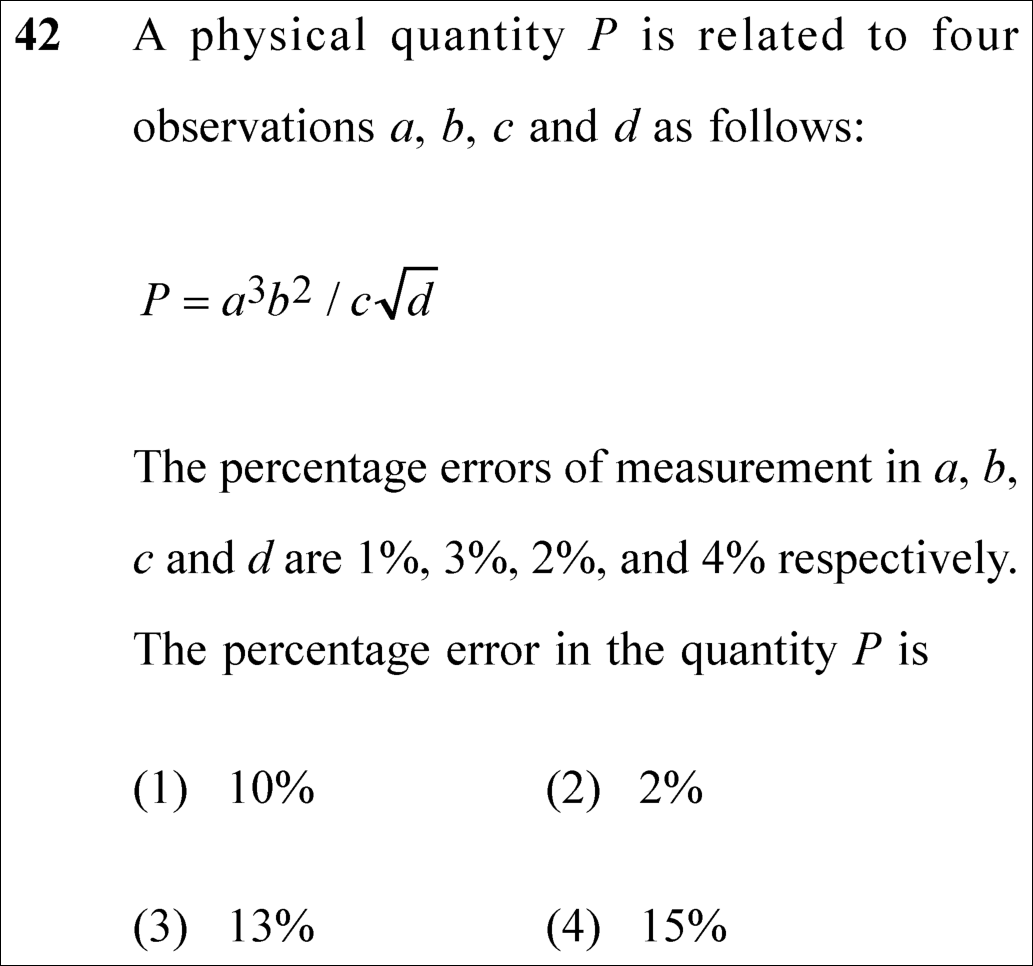
NEET 2025 Physics Question 42: Percentage Error in Physical Quantity P = a³ b² / (c √d)

Question

A physical quantity P is related to four observations a, b, c and d as follows: P = a³b²/(c√d). The percentage errors of measurement in a, b, c and d are 1%, 3%, 2%, and 4% respectively. The percentage error in the quantity P is

✓
Verified Against NTA Final Answer Key
Option (3) : 13%
📚 Units and Measurements Easy
📋 Given Parameters & Problem Setup
Functional Relation P = a³ b² / (c √d) = a³ b² c⁻¹ d⁻¹/²
Percentage Error in a (Δa/a × 100) 1%
Percentage Error in b (Δb/b × 100) 3%
Percentage Error in c (Δc/c × 100) 2%
Percentage Error in d (Δd/d × 100) 4%
⚡

The 30-Second Exam Hall Shortcut: ⚡ Power Multiplier Error Rule

⏱️ Save ~25 seconds

ΔP/P = 3(%a) + 2(%b) + 1(%c) + (1/2)(%d) = 3(1%) + 2(3%) + 1(2%) + 0.5(4%) = 3 + 6 + 2 + 2 = 13%!

1 In error analysis, errors always add in the worst-case scenario: fractional error equals sum of powers times fractional errors.
2 Multiply percentage error of each variable by the absolute value of its exponent:
3 Contribution of a³: 3 × 1% = 3%.
4 Contribution of b²: 2 × 3% = 6%.
5 Contribution of c⁻¹: 1 × 2% = 2%.
6 Contribution of √d (d^(1/2)): (1/2) × 4% = 2%.
7 Sum all contributions: 3% + 6% + 2% + 2% = 13%.
8 Match Option (3) in under 10 seconds!
🛡️
Why You Can 100% Trust This Shortcut: Propagation of Fractional Errors (NCERT Physics · Units and Measurements: ΔX/X = Σ a_i (ΔA_i/A_i)).
📐

Step-by-Step Rigorous Workflow & Mathematical Proof

Step 1

Formula for Maximum Fractional Error in a Power Product

For a physical quantity defined by P = a^p b^q c^r d^s, logarithmic differentiation gives the maximum fractional error:

ΔPP=∣p∣Δaa+∣q∣Δbb+∣r∣Δcc+∣s∣Δdd\frac{\Delta P}{P} = |p| \frac{\Delta a}{a} + |q| \frac{\Delta b}{b} + |r| \frac{\Delta c}{c} + |s| \frac{\Delta d}{d}
  • • Here p = 3, q = 2, r = -1, s = -1/2.
  • • The negative signs become positive because errors compound in the worst-case direction.
Step 2

Substitute Numerical Percentage Errors

Multiply both sides by 100 to convert to percentage errors:

(ΔPP×100)=3(Δaa%)+2(Δbb%)+1(Δcc%)+12(Δdd%)\left(\frac{\Delta P}{P} \times 100\right) = 3 \left(\frac{\Delta a}{a}\%\right) + 2 \left(\frac{\Delta b}{b}\%\right) + 1 \left(\frac{\Delta c}{c}\%\right) + \frac{1}{2} \left(\frac{\Delta d}{d}\%\right)
  • • Substitute given values: a = 1%, b = 3%, c = 2%, d = 4%.
Step 3

Calculate Total Percentage Error

Compute the algebraic sum:

% error in P=3(1%)+2(3%)+1(2%)+12(4%)=3%+6%+2%+2%=13%\%\text{ error in } P = 3(1\%) + 2(3\%) + 1(2\%) + \frac{1}{2}(4\%) = 3\% + 6\% + 2\% + 2\% = 13\%
  • • Matches Option (3) exactly.
⭐

360° Option Elimination Engine Key Feature

Diagnose every choice: Know exactly why the right option works and why distractors fail.

4-Option Deep Scan
1 A
✗ Incorrect
Verdict & Scientific Reason:

Incorrect. Omits contribution from c or miscalculates powers.

⚠️
Student Fallacy (Why candidates pick this trap): Subtracting errors instead of adding.
2 B
✗ Incorrect
Verdict & Scientific Reason:

Incorrect. Forgetting to multiply by exponents.

⚠️
Student Fallacy (Why candidates pick this trap): Subtracting denominator errors: (3+6) - (2+2) = 5% or similar.
3 C
✓ 100% Correct
Verdict & Scientific Reason:

100% correct. 3(1) + 2(3) + 1(2) + 0.5(4) = 3 + 6 + 2 + 2 = 13%.

💡
Why this is airtight: None; standard error propagation.
4 D
✗ Incorrect
Verdict & Scientific Reason:

Incorrect. Using power 1 for d instead of 1/2 (giving 4% instead of 2% ⟹ 15%).

⚠️
Student Fallacy (Why candidates pick this trap): Forgetting that √d has power 1/2, multiplying by 4% directly.
⚠️

NTA Trap Alert: Treating √d as Having Exponent 1

A very common slip is taking the error of √d as 4% instead of (1/2) × 4% = 2%. Doing so yields 3 + 6 + 2 + 4 = 15% (Option 4)!

🛡️ How to avoid the -1 mark: Always rewrite roots as fractional powers: √d = d^(1/2) ⟹ multiply error by 1/2.
📖

Core NEET Syllabus Standard

NEET Physics Core Syllabus · Units and Measurements Standard Benchmark
Core Scientific Principle Tested:

"Relative error in a quantity raised to the power n is n times the relative error in the individual quantity."

Syllabus Focus: Propagation of Errors in Powers of Quantities
✓ Core NEET UG Syllabus Anchor Syllabus & Academic Standards ↗
Powers multiply: 3(1) + 2(3) + 1(2) + 0.5(4) = 3 + 6 + 2 + 2 = 13%!

Ready to attempt under real exam pressure?

Test your speed and accuracy in the authentic 180-minute timed NTA simulator.

Launch NEET 2025 CBT Test →

Spotted a mistake in this solution? Report an error (support@mycompetitiveexams.com)

⚖️ Legal & Fair Dealing Notice: Sourced from publicly released NEET 2025 question papers and NEET answer keys for private study, research, and non-commercial educational practice under Fair Dealing (Section 52(1)(a) of the Indian Copyright Act, 1957). Not affiliated with or endorsed by NTA or NMC.

Solve 4 NEET Questions a Day — One per Subject

Cover all 1,140 official NEET questions in 285 days at your own pace. Progress is saved on your device. No login needed.