MyCompetitiveExams Logo MyCompetitiveExams
Search 1,140+ Questions
Chapters, formulas, speed tricks
→
⚡ Brahmastra NEET 2027
720 MARKS

Dynamic 180-question full-length simulator mixed dynamically from all 6 years for 2027 & 2026 aspirants.

Launch Brahmastra 2027 Test →
Start Practice →
100% Free · No Login Required
Q.194 Zoology ⭐ 360° Option Elimination Active
Vault ↗

NEET 2021 Zoology Question 194 Solution

Topic: Structural Organisation in Animals · Official NTA Booklet Code M1
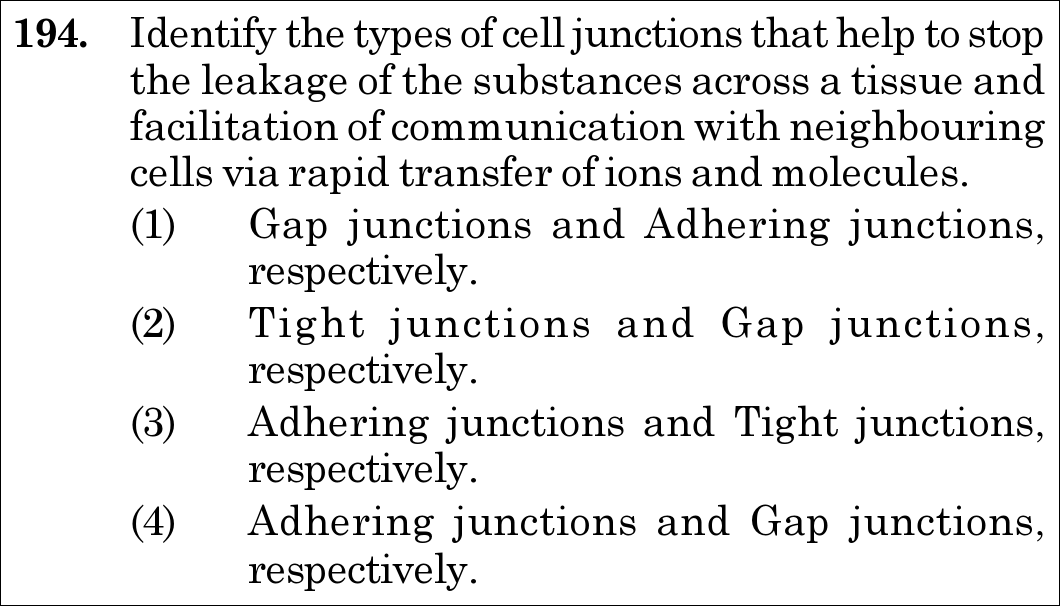
NEET 2021 Zoology Question 194: Classification and Physiological Roles of Epithelial Cell Junctions

Question

Identify the types of cell junctions that help to stop the leakage of the substances across a tissue and facilitation of communication with neighbouring cells via rapid transfer of ions and molecules.

  1. (1)Gap junctions and Adhering junctions, respectively.
  2. (2)Tight junctions and Gap junctions, respectively.
  3. (3)Adhering junctions and Tight junctions, respectively.
  4. (4)Adhering junctions and Gap junctions, respectively.
✓
Verified Against NTA Final Answer Key
Option (2) : Tight junctions and Gap junctions, respectively.
📚 Structural Organisation in Animals Easy
📋 Given Parameters & Problem Setup
Function 1 Stop leakage of substances across a tissue
Function 2 Facilitate communication with neighbouring cells via rapid transfer of ions and small molecules
Question Objective Identify the respective cell junction types
⚡

The 30-Second Exam Hall Shortcut: ⚡ "Stop Leakage = TIGHT Junctions; Rapid Transfer = GAP Junctions"

⏱️ Save ~20 seconds

Tight junctions create a leak-proof barrier stopping paracellular leakage across epithelial sheets. Gap junctions form hydrophilic transmembrane channels (connexons) facilitating rapid transfer of ions and small molecules. In chronological order: Tight junctions and Gap junctions! Select Option (2).

1 Recall NCERT 3 epithelial cell junctions: - Tight junctions: Help stop substances from leaking across a tissue. - Adhering junctions: Perform cementing to keep neighbouring cells together. - Gap junctions: Facilitate the cells to communicate with each other by connecting the cytoplasm for rapid transfer of ions, small molecules, and sometimes big molecules.
2 Match Function 1 ("stop leakage"): Tight junctions.
3 Match Function 2 ("facilitation of communication"): Gap junctions.
4 Sequence required: Tight junctions and Gap junctions, respectively -> Option (2).
🛡️
Why You Can 100% Trust This Shortcut: NCERT Biology · Structural Organisation in Animals (Epithelial Tissue: Tight junctions help to stop substances from leaking across a tissue. Adhering junctions perform cementing to keep neighbouring cells together. Gap junctions facilitate the cells to communicate with each other by connecting the cytoplasm of adjoining cells, for rapid transfer of ions, small molecules and sometimes big molecules).
📐

Step-by-Step Rigorous Workflow & Mathematical Proof

Step 1

Morphological and Molecular Profiles of Epithelial Junctions

Epithelial tissues line body surfaces, cavities, and tubules, providing protective and barrier functions. Adjacent epithelial cells are interlinked by three specialized junctional complexes: - 1. Tight Junctions (Zonula Occludens): Transmembrane claudin and occludin proteins fuse adjacent plasma membranes into a continuous impermeable belt, preventing the paracellular leakage of luminal fluids, ions, and solutes across the tissue. - 2. Adhering Junctions (Zonula Adherens / Desmosomes): Cadherin adhesion molecules anchored to actin microfilaments or intermediate keratin filaments cement adjacent cells together, providing mechanical tensile strength. - 3. Gap Junctions (Nexus): Hexameric rings of connexin proteins form hollow cylindrical channels (connexons) spanning the intercellular gap, directly coupling the cytoplasms of adjacent cells to permit the rapid, unhindered transfer of inorganic ions, second messengers (cAMP, IP₃), metabolites, and small molecules.

Stop Leakage  ⟺  Tight JunctionsRapid Communication  ⟺  Gap JunctionsMechanical Cementing  ⟺  Adhering Junctions\begin{aligned} \textbf{Stop Leakage} &\iff \mathbf{Tight\,Junctions} \\[4pt] \textbf{Rapid Communication} &\iff \mathbf{Gap\,Junctions} \\[4pt] \textbf{Mechanical Cementing} &\iff \mathbf{Adhering\,Junctions} \end{aligned}
Step 2

Positional and Sequential Alignment

The question specifically requires the respective pairing for (1) stopping leakage and (2) communicating via ion transfer. This corresponds strictly to "Tight junctions and Gap junctions, respectively" (Option 2).

⭐

360° Option Elimination Engine Key Feature

Diagnose every choice: Know exactly why the right option works and why distractors fail.

4-Option Deep Scan
1 1
✗ Incorrect
Verdict & Scientific Reason:

Incorrect. Assigns gap junctions to stopping leakage and adhering junctions to communication, which is entirely backwards.

⚠️
Student Fallacy (Why candidates pick this trap): Reversing the physiological functions of junctions.
2 2
✓ 100% Correct
Verdict & Scientific Reason:

Correct. Accurately pairs stopping leakage with tight junctions and ionic communication with gap junctions in the exact requested order.

💡
Why this is airtight: None. Candidate recognizes verbatim NCERT functional definitions.
3 3
✗ Incorrect
Verdict & Scientific Reason:

Incorrect. Adhering junctions perform mechanical cementing, not leakage prevention, and tight junctions do not facilitate intercellular communication.

⚠️
Student Fallacy (Why candidates pick this trap): Confusing mechanical adhering with sealing barriers.
4 4
✗ Incorrect
Verdict & Scientific Reason:

Incorrect because the first function (stopping leakage) is performed by tight junctions, not adhering junctions.

⚠️
Student Fallacy (Why candidates pick this trap): Assuming adhering junctions prevent fluid leakage.
⚠️

NTA Trap Alert: Order and Function Transposition Trap

Candidates sometimes remember the three types of junctions but overlook the order ("respectively") or confuse "cementing" (adhering) with "sealing/stopping leakage" (tight).

🛡️ How to avoid the -1 mark: Use keyword association: "Tight = Leak-proof Seal", "Adhering = Glue/Cement", "Gap = Communicating Bridge".
📖

Core NEET Syllabus Standard

NEET / NCERT Biology · Structural Organisation in Animals Standard Benchmark
Core Scientific Principle Tested:

"Tight junctions prevent substance leakage; gap junctions facilitate rapid ion/molecule transfer between neighbouring cells."

Syllabus Focus: Epithelial Tissue Cell Junctions
✓ Core NEET UG Syllabus Anchor Syllabus & Academic Standards ↗

Ready to attempt under real exam pressure?

Test your speed and accuracy in the authentic 200-minute timed NTA simulator.

Launch NEET 2021 CBT Test →

Spotted a mistake in this solution? Report an error (support@mycompetitiveexams.com)

⚖️ Legal & Fair Dealing Notice: Sourced from publicly released NEET 2021 question papers and NEET answer keys for private study, research, and non-commercial educational practice under Fair Dealing (Section 52(1)(a) of the Indian Copyright Act, 1957). Not affiliated with or endorsed by NTA or NMC.

Solve 4 NEET Questions a Day — One per Subject

Cover all 1,140 official NEET questions in 285 days at your own pace. Progress is saved on your device. No login needed.