MyCompetitiveExams Logo MyCompetitiveExams
Search 1,140+ Questions
Chapters, formulas, speed tricks
→
⚡ Brahmastra NEET 2027
720 MARKS

Dynamic 180-question full-length simulator mixed dynamically from all 6 years for 2027 & 2026 aspirants.

Launch Brahmastra 2027 Test →
Start Practice →
100% Free · No Login Required
Q.152 Zoology ⭐ 360° Option Elimination Active
Vault ↗

NEET 2021 Zoology Question 152 Solution

Topic: Cell Cycle and Cell Division · Official NTA Booklet Code M1
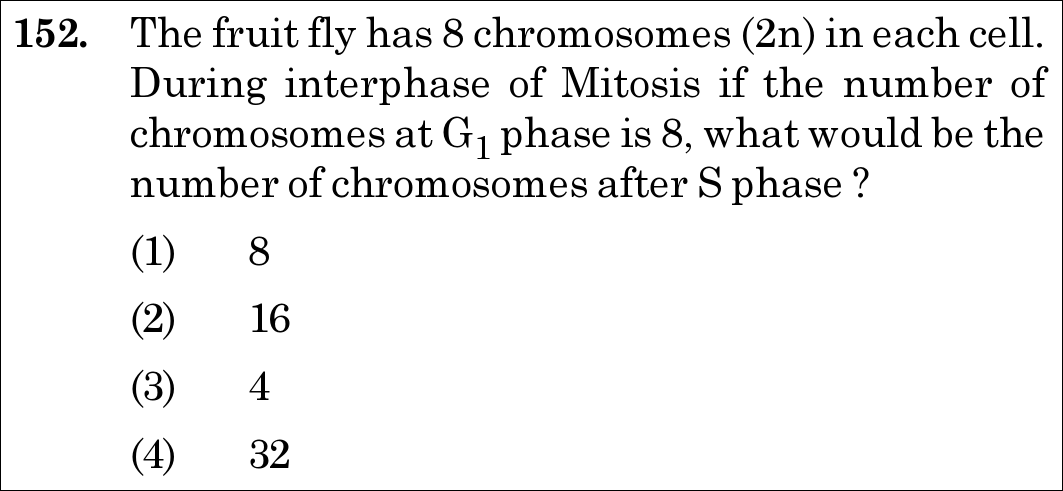
NEET 2021 Zoology Question 152: Chromosome Number vs DNA Content During S-Phase of Cell Cycle

Question

The fruit fly has 8 chromosomes (2n) in each cell. During interphase of Mitosis if the number of chromosomes at G1 phase is 8, what would be the number of chromosomes after S phase?

✓
Verified Against NTA Final Answer Key
Option (1) : 8
📚 Cell Cycle and Cell Division Easy
📋 Given Parameters & Problem Setup
Organism Fruit fly (Drosophila melanogaster)
Diploid chromosome number (2n) 8 chromosomes at G1 phase
Target Stage After S phase of interphase
⚡

The 30-Second Exam Hall Shortcut: ⚡ "DNA Doubles (2C → 4C), Chromosome Number Never Changes (2n → 2n)"

⏱️ Save ~30 seconds

During the synthesis (S) phase of interphase, DNA replication doubles the amount of DNA per cell from 2C to 4C, but the chromosome number remains unchanged at 2n. If G1 has 8 chromosomes, after S phase it still has 8 chromosomes. Match Option (1) in 5 seconds!

1 Recall the golden cell cycle rule: S-phase duplicates DNA strands into sister chromatids joined at a single centromere.
2 Chromosome count equals the number of centromeres: 1 centromere = 1 chromosome.
3 Chromosomes at G1 = 8 (2n) → Chromosomes after S phase = 8 (2n).
4 Match Option (1).
🛡️
Why You Can 100% Trust This Shortcut: NCERT Biology · Cell Cycle and Cell Division (Interphase S-phase: DNA content doubles from 2C to 4C, but chromosome number remains 2n).
📐

Step-by-Step Rigorous Workflow & Mathematical Proof

Step 1

Distinction Between DNA Content and Chromosome Number

During interphase of the mitotic cell cycle, the cell transitions through G1G_1, SS, and G2G_2 phases: - In G1G_1 phase: The chromosome number is diploid (2n=82n = 8) and the DNA content is 2C2C. - In SS phase (Synthesis phase): Semi-conservative replication of nuclear DNA occurs. The DNA quantity doubles from 2C2C to 4C4C. - However, the newly formed sister chromatids remain attached to each other at the same centromere. Because chromosome count is defined strictly by the number of functional centromeres, the chromosome number does not increase.

At G1 phase:2n=8,DNA content=2CAfter S phase:2n=8,DNA content=4C\begin{aligned} \text{At } G_1 \text{ phase:} & \quad 2n = 8, \quad \text{DNA content} = 2C \\[4pt] \text{After } S \text{ phase:} & \quad \mathbf{2n = 8}, \quad \text{DNA content} = 4C \end{aligned}
Step 2

Application to Drosophila melanogaster

For Drosophila melanogaster with 2n=82n = 8: - Chromosomes in G1G_1: 8 - Chromosomes in SS: 8 (each consisting of two identical sister chromatids) - Chromosomes in G2G_2: 8 - The physical separation of sister chromatids into individual daughter chromosomes only occurs later during mitotic Anaphase.

⭐

360° Option Elimination Engine Key Feature

Diagnose every choice: Know exactly why the right option works and why distractors fail.

4-Option Deep Scan
1 1
✓ 100% Correct
Verdict & Scientific Reason:

Correct. S phase duplicates the DNA content (2C to 4C) but preserves the total chromosome number (2n = 8) because sister chromatids remain bound at the common centromere.

💡
Why this is airtight: None. This demonstrates clear understanding of the centromere-based definition of chromosomes.
2 2
✗ Incorrect
Verdict & Scientific Reason:

Incorrect. 16 would represent the number of chromatids, not chromosomes. The chromosome number doubles only transiently in anaphase after centromeric fission.

⚠️
Student Fallacy (Why candidates pick this trap): The classic trap: students know DNA doubles, so they naively assume the chromosome number also doubles from 8 to 16.
3 3
✗ Incorrect
Verdict & Scientific Reason:

Incorrect. A reduction from 8 to 4 occurs only during Meiosis I (reductional division), never during mitotic interphase.

⚠️
Student Fallacy (Why candidates pick this trap): Aspirants confuse mitotic interphase with meiotic reduction, mistakenly halving the chromosome number to n = 4.
4 4
✗ Incorrect
Verdict & Scientific Reason:

Incorrect. There is no biological mechanism during interphase that quadruples chromosome number to 32.

⚠️
Student Fallacy (Why candidates pick this trap): Students perform arbitrary doubling calculations (8×2×2=328 \times 2 \times 2 = 32) without conceptual grounding.
⚠️

NTA Trap Alert: DNA Doubling vs Chromosome Doubling Equivocation

Students habitually confuse DNA mass (which doubles from 2C to 4C during S phase) with chromosome number (which remains strictly 2n until anaphase separation).

🛡️ How to avoid the -1 mark: Count centromeres! One centromere = one chromosome, regardless of whether it consists of one monad or two sister chromatids.
📖

Core NEET Syllabus Standard

NEET / NCERT Biology · Cell Cycle and Cell Division Standard Benchmark
Core Scientific Principle Tested:

"In S-phase, DNA replication doubles DNA mass from 2C to 4C without changing chromosome count (remains 2n)."

Syllabus Focus: Interphase and S-Phase Molecular Events
✓ Core NEET UG Syllabus Anchor Syllabus & Academic Standards ↗

Ready to attempt under real exam pressure?

Test your speed and accuracy in the authentic 200-minute timed NTA simulator.

Launch NEET 2021 CBT Test →

Spotted a mistake in this solution? Report an error (support@mycompetitiveexams.com)

⚖️ Legal & Fair Dealing Notice: Sourced from publicly released NEET 2021 question papers and NEET answer keys for private study, research, and non-commercial educational practice under Fair Dealing (Section 52(1)(a) of the Indian Copyright Act, 1957). Not affiliated with or endorsed by NTA or NMC.

Solve 4 NEET Questions a Day — One per Subject

Cover all 1,140 official NEET questions in 285 days at your own pace. Progress is saved on your device. No login needed.