MyCompetitiveExams Logo MyCompetitiveExams
Search 1,140+ Questions
Chapters, formulas, speed tricks
→
⚡ Brahmastra NEET 2027
720 MARKS

Dynamic 180-question full-length simulator mixed dynamically from all 6 years for 2027 & 2026 aspirants.

Launch Brahmastra 2027 Test →
Start Practice →
100% Free · No Login Required
Q.48 Physics ⭐ 360° Option Elimination Active
Vault ↗

NEET 2021 Physics Question 48 Solution

Topic: System of Particles and Rotational Motion · Official NTA Booklet Code M1
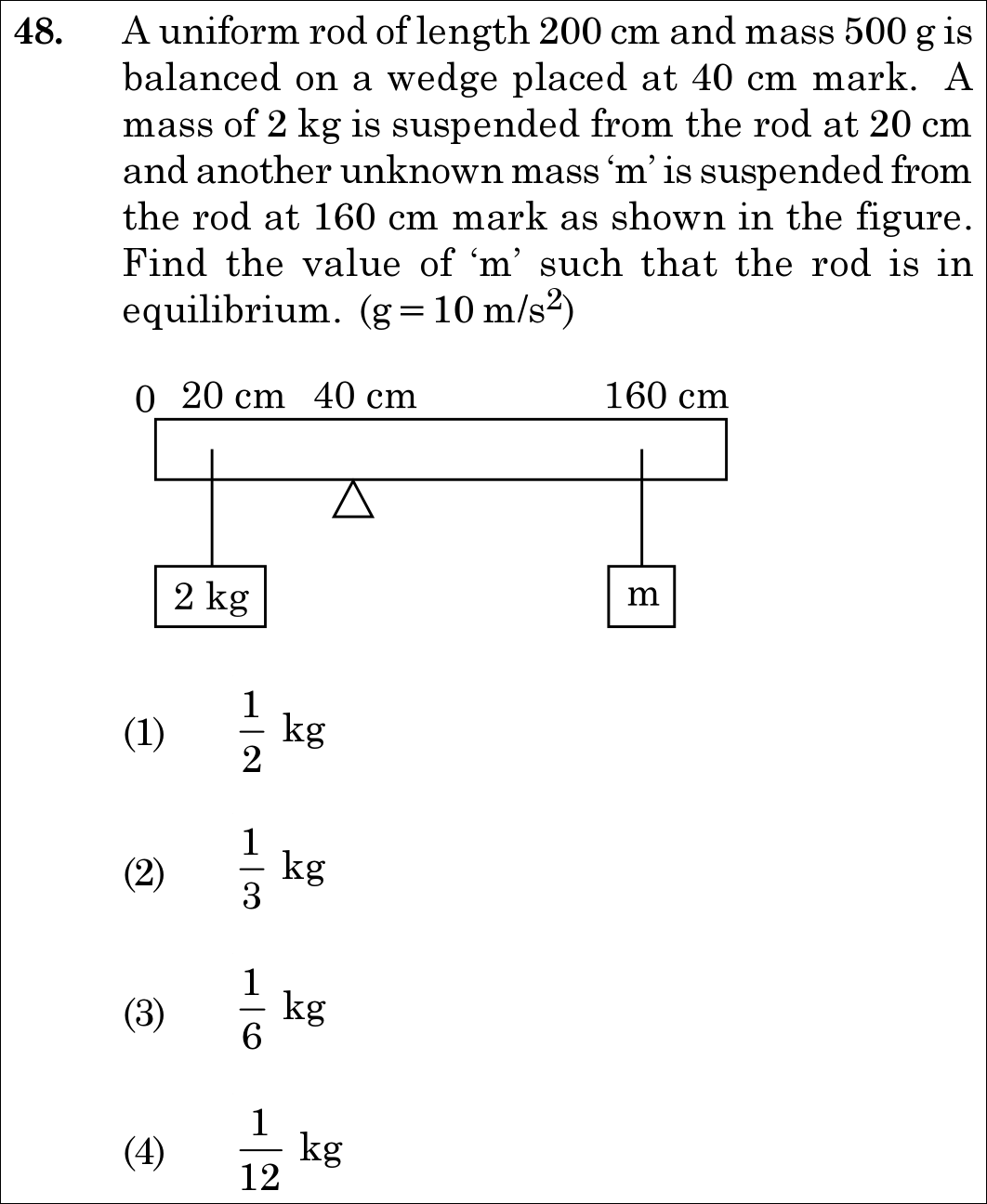
NEET 2021 Physics Question 48: Rotational Equilibrium of a Heavy Meter Rod Balanced on a Wedge

Question

A uniform rod of length 200 cm and mass 500 g is balanced on a wedge placed at 40 cm mark. A mass of 2 kg is suspended from the rod at 20 cm and another unknown mass 'm' is suspended from the rod at 160 cm mark as shown in the figure. Find the value of 'm' such that the rod is in equilibrium. (g = 10 m/s²)

✓
Verified Against NTA Final Answer Key
Option (4) : 1/12 kg
📚 System of Particles and Rotational Motion Medium
📋 Given Parameters & Problem Setup
Length of Uniform Rod (L) 200 cm
Mass of Rod (M_rod) 500 g = 0.5 kg
Fulcrum (Wedge) Position 40 cm mark
Known Mass (m_1) 2 kg at 20 cm mark
Unknown Mass (m) Suspended at 160 cm mark
⚡

The 30-Second Exam Hall Shortcut: ⚡ Torque Balance about Wedge at 40 cm

⏱️ Save ~25 seconds

Fulcrum is at 40 cm40\text{ cm}. Center of mass of the 200 cm rod is at 100 cm100\text{ cm} (distance =60 cm= 60\text{ cm} to right, mass =0.5 kg= 0.5\text{ kg}). Counter-clockwise torque: 2 kg×(40−20)=40 kg⋅cm2\text{ kg} \times (40 - 20) = 40\text{ kg}\cdot\text{cm}. Clockwise torque: (0.5×60)+m×(160−40)=30+120m(0.5 \times 60) + m \times (160 - 40) = 30 + 120m. Equate: 40=30+120m  ⟹  120m=10  ⟹  m=1/12 kg40 = 30 + 120m \implies 120m = 10 \implies m = 1/12\text{ kg}! Match Option (4)!

1 Locate the center of mass of uniform 200 cm rod: at 100 cm100\text{ cm} mark. Weight of rod is 0.5g0.5 g.
2 Fulcrum is at 40 cm40\text{ cm} mark.
3 Lever arms from fulcrum: - 2 kg mass at 20 cm: arm =40−20=20 cm= 40 - 20 = 20\text{ cm} (left, counter-clockwise). - Rod weight (0.5 kg) at 100 cm: arm =100−40=60 cm= 100 - 40 = 60\text{ cm} (right, clockwise). - Unknown mass mm at 160 cm: arm =160−40=120 cm= 160 - 40 = 120\text{ cm} (right, clockwise).
4 Balance torques: 2×20=(0.5×60)+(m×120)2 \times 20 = (0.5 \times 60) + (m \times 120).
5 40=30+120m  ⟹  120m=10  ⟹  m=10120=112 kg40 = 30 + 120m \implies 120m = 10 \implies m = \frac{10}{120} = \frac{1}{12}\text{ kg}.
6 Match Option (4).
🛡️
Why You Can 100% Trust This Shortcut: Canonical principle of moments for static equilibrium of a rigid body.
📐

Step-by-Step Rigorous Workflow & Mathematical Proof

Step 1

Identifying Forces and Points of Action

For a uniform rod of length L=200 cmL = 200\text{ cm} and mass M=500 g=0.5 kgM = 500\text{ g} = 0.5\text{ kg}: - Center of mass of the rod is at its geometric center: xcm=100 cmx_{\text{cm}} = 100\text{ cm}. The gravitational force of the rod Mg=0.5gM g = 0.5 g acts downward at this point. - The wedge (fulcrum) is located at xw=40 cmx_w = 40\text{ cm}. - A mass m1=2 kgm_1 = 2\text{ kg} is suspended at x1=20 cmx_1 = 20\text{ cm}. - An unknown mass mm is suspended at x2=160 cmx_2 = 160\text{ cm}.

Step 2

Calculating Lever Arms with Respect to the Fulcrum

Measuring perpendicular distances from the fulcrum (xw=40 cmx_w = 40\text{ cm}): - For m1=2 kgm_1 = 2\text{ kg}: d1=40−20=20 cmd_1 = 40 - 20 = 20\text{ cm} (to the left, producing CCW torque) - For the rod weight: drod=100−40=60 cmd_{\text{rod}} = 100 - 40 = 60\text{ cm} (to the right, producing CW torque) - For unknown mass mm: d2=160−40=120 cmd_2 = 160 - 40 = 120\text{ cm} (to the right, producing CW torque)

Step 3

Applying the Principle of Moments (Rotational Equilibrium)

For the rod to remain in rotational equilibrium, the sum of counter-clockwise moments must equal the sum of clockwise moments about the wedge:

Στ=0  ⟹  m1gd1=Mgdrod+mgd2\Sigma \tau = 0 \implies m_1 g d_1 = M g d_{\text{rod}} + m g d_2
Step 4

Solving for Unknown Mass m

Cancel gg and substitute numerical values:

2×20=(0.5×60)+(m×120)  ⟹  40=30+120m  ⟹  120m=10  ⟹  m=10120=112 kg2 \times 20 = (0.5 \times 60) + (m \times 120) \implies 40 = 30 + 120 m \implies 120 m = 10 \implies m = \frac{10}{120} = \frac{1}{12}\text{ kg}
⭐

360° Option Elimination Engine Key Feature

Diagnose every choice: Know exactly why the right option works and why distractors fail.

4-Option Deep Scan
1 1
✗ Incorrect
Verdict & Scientific Reason:

Result of neglecting the weight of the rod entirely (2×20=m×120  ⟹  m=40/120=1/32 \times 20 = m \times 120 \implies m = 40/120 = 1/3, or other algebraic error).

⚠️
Student Fallacy (Why candidates pick this trap): Ignoring the mass of the rod.
2 2
✗ Incorrect
Verdict & Scientific Reason:

Result of treating the rod as massless (40=120m  ⟹  m=1/3 kg40 = 120m \implies m = 1/3\text{ kg}).

⚠️
Student Fallacy (Why candidates pick this trap): Assuming a massless meter stick.
3 3
✗ Incorrect
Verdict & Scientific Reason:

Placing center of mass of the rod at 50 cm instead of 100 cm (assuming 100 cm total rod length instead of 200 cm).

⚠️
Student Fallacy (Why candidates pick this trap): Assuming rod length is 100 cm instead of reading 200 cm.
4 4
✓ 100% Correct
Verdict & Scientific Reason:

Exact mass required for equilibrium: m=40−30120=112 kgm = \frac{40 - 30}{120} = \frac{1}{12}\text{ kg}.

💡
Why this is airtight: None; rigorous rigid body torque balance.
⚠️

NTA Trap Alert: Rod Length (200 cm vs. 100 cm) Trap

Students automatically think "meter rule" and place the center of mass at 50 cm50\text{ cm}. The problem explicitly states the rod length is 200 cm200\text{ cm}, placing the center of mass at 100 cm100\text{ cm} mark (60 cm60\text{ cm} from the wedge).

🛡️ How to avoid the -1 mark: Read the prompt carefully: Length is 200 cm  ⟹  200\text{ cm} \implies Center of mass is at 100 cm100\text{ cm}.
📖

Core NEET Syllabus Standard

NCERT Physics · System of Particles and Rotational Motion Standard Benchmark
Core Scientific Principle Tested:

"A rigid body is in mechanical equilibrium when both net external force and net external torque about any pivot point are zero (Στ=0\Sigma \tau = 0)."

Syllabus Focus: Equilibrium of a Rigid Body (Principle of Moments)
✓ Core NEET UG Syllabus Anchor Syllabus & Academic Standards ↗

Ready to attempt under real exam pressure?

Test your speed and accuracy in the authentic 200-minute timed NTA simulator.

Launch NEET 2021 CBT Test →

Spotted a mistake in this solution? Report an error (support@mycompetitiveexams.com)

⚖️ Legal & Fair Dealing Notice: Sourced from publicly released NEET 2021 question papers and NEET answer keys for private study, research, and non-commercial educational practice under Fair Dealing (Section 52(1)(a) of the Indian Copyright Act, 1957). Not affiliated with or endorsed by NTA or NMC.

Solve 4 NEET Questions a Day — One per Subject

Cover all 1,140 official NEET questions in 285 days at your own pace. Progress is saved on your device. No login needed.