MyCompetitiveExams Logo MyCompetitiveExams
Search 1,140+ Questions
Chapters, formulas, speed tricks
→
⚡ Brahmastra NEET 2027
720 MARKS

Dynamic 180-question full-length simulator mixed dynamically from all 6 years for 2027 & 2026 aspirants.

Launch Brahmastra 2027 Test →
Start Practice →
100% Free · No Login Required
Q.45 Physics ⭐ 360° Option Elimination Active
Vault ↗

NEET 2021 Physics Question 45 Solution

Topic: Laws of Motion · Official NTA Booklet Code M1
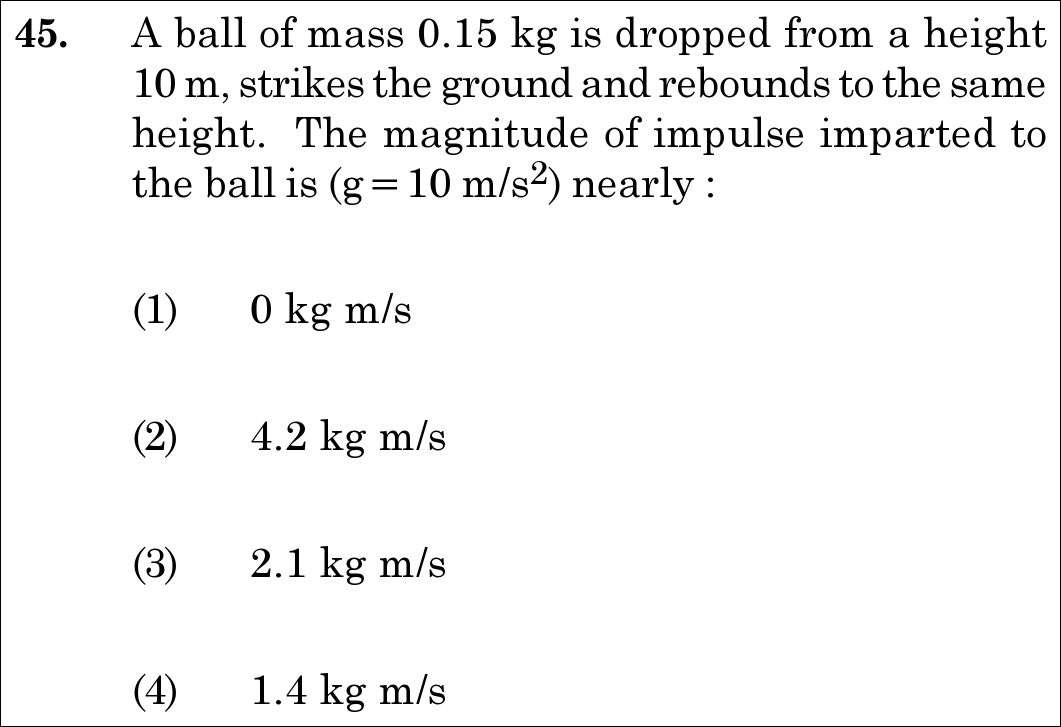
NEET 2021 Physics Question 45: Impulse Imparted During Elastic Bounce from Ground

Question

A ball of mass 0.15 kg is dropped from a height 10 m, strikes the ground and rebounds to the same height. The magnitude of impulse imparted to the ball is (g = 10 m/s²) nearly:

✓
Verified Against NTA Final Answer Key
Option (2) : 4.2 kg m/s
📚 Laws of Motion Easy
📋 Given Parameters & Problem Setup
Mass of Ball (m) 0.15 kg
Drop Height (h) 10 m
Rebound Height (h) 10 m (same height)
Acceleration Due to Gravity (g) 10 m/s^2
⚡

The 30-Second Exam Hall Shortcut: ⚡ Rebound Impulse: J = 2 m √(2gh)

⏱️ Save ~20 seconds

Impact speed v=2gh=2×10×10=102 m/sv = \sqrt{2gh} = \sqrt{2 \times 10 \times 10} = 10\sqrt{2}\text{ m/s}. Since it rebounds to the same height, velocity reverses (+v+v upward, −v-v downward). Magnitude of impulse J=∣Δp∣=2mv=2×0.15×102=32=3×1.414=4.24 kg m/s≈4.2 kg m/sJ = |\Delta p| = 2mv = 2 \times 0.15 \times 10\sqrt{2} = 3\sqrt{2} = 3 \times 1.414 = 4.24\text{ kg m/s} \approx 4.2\text{ kg m/s}! Match Option (2)!

1 Downward velocity just before impact: v1=−2gh=−2(10)(10)=−102 m/sv_1 = -\sqrt{2gh} = -\sqrt{2(10)(10)} = -10\sqrt{2}\text{ m/s}.
2 Upward velocity after rebound: v2=+2gh=+102 m/sv_2 = +\sqrt{2gh} = +10\sqrt{2}\text{ m/s}.
3 Impulse is change in linear momentum: J=m(v2−v1)=m(102−(−102))=2m(102)J = m (v_2 - v_1) = m (10\sqrt{2} - (-10\sqrt{2})) = 2 m (10\sqrt{2}).
4 Substitute m=0.15 kgm = 0.15\text{ kg}: J=2(0.15)(102)=32 kg m/sJ = 2(0.15)(10\sqrt{2}) = 3\sqrt{2}\text{ kg m/s}.
5 3×1.414=4.242 kg m/s≈4.2 kg m/s3 \times 1.414 = 4.242\text{ kg m/s} \approx 4.2\text{ kg m/s}.
6 Match Option (2).
🛡️
Why You Can 100% Trust This Shortcut: Canonical impulse-momentum theorem and kinematics of free fall.
📐

Step-by-Step Rigorous Workflow & Mathematical Proof

Step 1

Calculating Velocity Just Before Striking the Ground

For a body falling freely from rest from height h=10 mh = 10\text{ m} under gravity g=10 m/s2g = 10\text{ m/s}^2, taking upward as positive:

v1=−2gh=−2×10 m/s2×10 m=−200=−102 m/sv_1 = -\sqrt{2gh} = -\sqrt{2 \times 10\text{ m/s}^2 \times 10\text{ m}} = -\sqrt{200} = -10\sqrt{2}\text{ m/s}
Step 2

Calculating Velocity Just After Rebound

The ball rebounds back to the same height h=10 mh = 10\text{ m}. To reach height hh, its initial upward velocity must be:

v2=+2gh=+102 m/sv_2 = +\sqrt{2gh} = +10\sqrt{2}\text{ m/s}
Step 3

Applying the Impulse-Momentum Theorem

Impulse imparted by the ground to the ball is defined as the change in its linear momentum vector:

J=Δp=mv2−mv1=m(v2−v1)=m[102−(−102)]=2m(102)J = \Delta p = m v_2 - m v_1 = m \left(v_2 - v_1\right) = m \left[10\sqrt{2} - (-10\sqrt{2})\right] = 2 m (10\sqrt{2})
Step 4

Numerical Evaluation

Substitute m=0.15 kgm = 0.15\text{ kg} and 2≈1.414\sqrt{2} \approx 1.414:

J=2×0.15 kg×102 m/s=32=3×1.414=4.242 kg m/s≈4.2 kg m/sJ = 2 \times 0.15\text{ kg} \times 10\sqrt{2}\text{ m/s} = 3\sqrt{2} = 3 \times 1.414 = 4.242\text{ kg m/s} \approx 4.2\text{ kg m/s}
⭐

360° Option Elimination Engine Key Feature

Diagnose every choice: Know exactly why the right option works and why distractors fail.

4-Option Deep Scan
1 1
✗ Incorrect
Verdict & Scientific Reason:

Assumes scalar momentum difference (mv−mv=0mv - mv = 0), completely ignoring that velocity reverses direction.

⚠️
Student Fallacy (Why candidates pick this trap): Subtracting momentum magnitudes instead of vectors (v−v=0v - v = 0).
2 2
✓ 100% Correct
Verdict & Scientific Reason:

Exact magnitude of impulse: J=2mv=32≈4.2 kg m/sJ = 2mv = 3\sqrt{2} \approx 4.2\text{ kg m/s}.

💡
Why this is airtight: None; textbook impulse-momentum theorem.
3 3
✗ Incorrect
Verdict & Scientific Reason:

Calculates only single momentum mv=0.15×14.14≈2.1 kg m/smv = 0.15 \times 14.14 \approx 2.1\text{ kg m/s}, forgetting to double for rebound.

⚠️
Student Fallacy (Why candidates pick this trap): Assuming impulse equals initial momentum without rebound reflection.
4 4
✗ Incorrect
Verdict & Scientific Reason:

Arithmetic approximation error.

⚠️
Student Fallacy (Why candidates pick this trap): Dividing by 3 or miscalculating 2\sqrt{2}.
⚠️

NTA Trap Alert: Vector Reversal vs. Scalar Cancellation Trap

Impulse is a vector quantity: J⃗=mv⃗f−mv⃗i\vec{J} = m\vec{v}_f - m\vec{v}_i. Because v⃗f\vec{v}_f is upward and v⃗i\vec{v}_i is downward, the two terms ADD together: m(v−(−v))=2mvm(v - (-v)) = 2mv. Treating velocity as a scalar yields mv−mv=0mv - mv = 0 (Option 1).

🛡️ How to avoid the -1 mark: Whenever an object rebounds, change in momentum is 2mv2mv, NOT zero!
📖

Core NEET Syllabus Standard

NCERT Physics · Laws of Motion Standard Benchmark
Core Scientific Principle Tested:

"Impulse is the change in linear momentum: J⃗=Δp⃗=mv⃗2−mv⃗1\vec{J} = \Delta\vec{p} = m\vec{v}_2 - m\vec{v}_1. For complete rebound, ∣J∣=2mv|J| = 2mv."

Syllabus Focus: Impulse and Momentum
✓ Core NEET UG Syllabus Anchor Syllabus & Academic Standards ↗

Ready to attempt under real exam pressure?

Test your speed and accuracy in the authentic 200-minute timed NTA simulator.

Launch NEET 2021 CBT Test →

Spotted a mistake in this solution? Report an error (support@mycompetitiveexams.com)

⚖️ Legal & Fair Dealing Notice: Sourced from publicly released NEET 2021 question papers and NEET answer keys for private study, research, and non-commercial educational practice under Fair Dealing (Section 52(1)(a) of the Indian Copyright Act, 1957). Not affiliated with or endorsed by NTA or NMC.

Solve 4 NEET Questions a Day — One per Subject

Cover all 1,140 official NEET questions in 285 days at your own pace. Progress is saved on your device. No login needed.