MyCompetitiveExams Logo MyCompetitiveExams
Search 1,140+ Questions
Chapters, formulas, speed tricks
→
⚡ Brahmastra NEET 2027
720 MARKS

Dynamic 180-question full-length simulator mixed dynamically from all 6 years for 2027 & 2026 aspirants.

Launch Brahmastra 2027 Test →
Start Practice →
100% Free · No Login Required
Q.12 Physics ⭐ 360° Option Elimination Active
Vault ↗

NEET 2021 Physics Question 12 Solution

Topic: Current Electricity · Official NTA Booklet Code M1
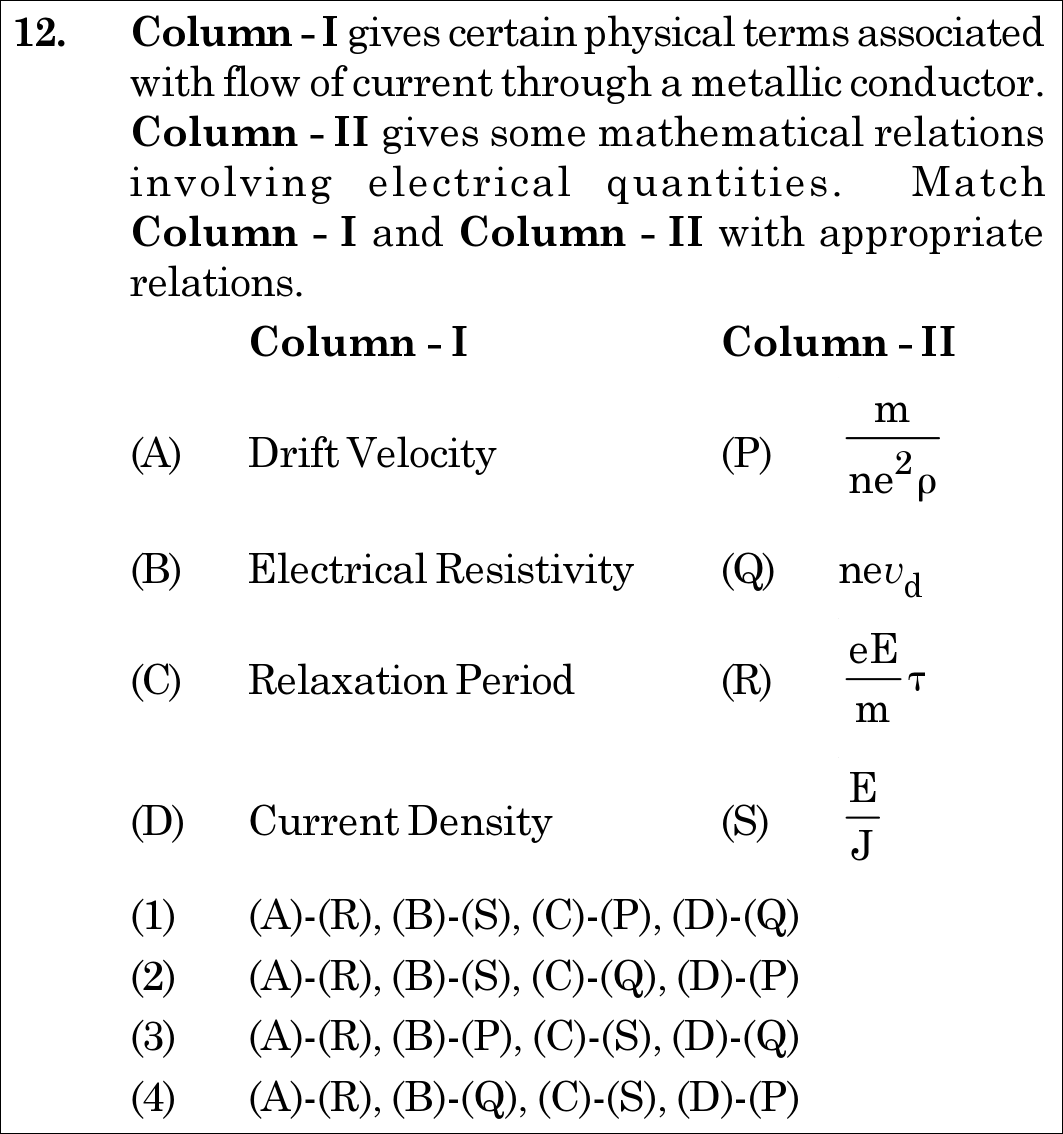
NEET 2021 Physics Question 12: Microscopic Model of Current: Drift Velocity, Resistivity, Relaxation Time, and Current Density

Question

Column - I gives certain physical terms associated with flow of current through a metallic conductor. Column - II gives some mathematical relations involving electrical quantities. Match Column - I and Column - II with appropriate relations. Column - I: (A) Drift Velocity (B) Electrical Resistivity (C) Relaxation Period (D) Current Density. Column - II: (P) m/(ne²ρ) (Q) nevd (R) (eE/m)τ (S) E/J

✓
Verified Against NTA Final Answer Key
Option (1) : (A)-(R), (B)-(S), (C)-(P), (D)-(Q)
📚 Current Electricity Easy
📋 Given Parameters & Problem Setup
Column I (A) Drift Velocity, (B) Electrical Resistivity, (C) Relaxation Period, (D) Current Density
Column II (P) m / (n e^2 ρ), (Q) n e v_d, (R) e E τ / m, (S) E / J
⚡

The 30-Second Exam Hall Shortcut: ⚡ Microscopic Formula Matcher

⏱️ Save ~25 seconds

Match standard NCERT microscopic expressions: Drift velocity vd=eEmτv_d = \frac{eE}{m}\tau (R); Resistivity ρ=EJ\rho = \frac{E}{J} (S); Current density J=nevdJ = n e v_d (Q); Relaxation time τ=mne2ρ\tau = \frac{m}{n e^2 \rho} (P)! Instant 10-second match to Option (1)!

1 Drift velocity formula: vd=eEmτ  ⟹  (A)−(R)v_d = \frac{eE}{m}\tau \implies (A)-(R).
2 Ohm's law in microscopic form: E=ρJ  ⟹  ρ=EJ  ⟹  (B)−(S)E = \rho J \implies \rho = \frac{E}{J} \implies (B)-(S).
3 Current density formula: J=IA=nevd  ⟹  (D)−(Q)J = \frac{I}{A} = n e v_d \implies (D)-(Q).
4 Relaxation time: from ρ=mne2τ  ⟹  τ=mne2ρ  ⟹  (C)−(P)\rho = \frac{m}{n e^2 \tau} \implies \tau = \frac{m}{n e^2 \rho} \implies (C)-(P).
5 Match combination: (A)-(R), (B)-(S), (C)-(P), (D)-(Q) -> Option (1).
🛡️
Why You Can 100% Trust This Shortcut: Canonical Drude-Lorentz free electron theory and microscopic Ohm's law.
📐

Step-by-Step Rigorous Workflow & Mathematical Proof

Step 1

Formula for Drift Velocity (A)

Under an applied electric field E⃗\vec{E}, the electric force on an electron is −eE⃗-e\vec{E}, imparting acceleration a⃗=−eE⃗/m\vec{a} = -e\vec{E}/m. The average velocity acquired over relaxation time τ\tau is:

vd=aτ=eEmτ  ⟹  (A)−(R)v_d = a\tau = \frac{eE}{m}\tau \implies \mathbf{(A)-(R)}
Step 2

Formula for Electrical Resistivity (B)

In vector microscopic notation, Ohm's law states J⃗=σE⃗=1ρE⃗\vec{J} = \sigma \vec{E} = \frac{1}{\rho}\vec{E}. Rearranging gives electrical resistivity:

ρ=EJ  ⟹  (B)−(S)\rho = \frac{E}{J} \implies \mathbf{(B)-(S)}
Step 3

Formula for Current Density (D)

Electric current is I=neAvdI = n e A v_d. Dividing by cross-sectional area AA gives the current density:

J=IA=nevd  ⟹  (D)−(Q)J = \frac{I}{A} = n e v_d \implies \mathbf{(D)-(Q)}
Step 4

Formula for Relaxation Period (C)

Microscopic resistivity in terms of electron mass mm, charge ee, number density nn, and relaxation time τ\tau is ρ=mne2τ\rho = \frac{m}{n e^2 \tau}. Solving for τ\tau gives:

τ=mne2ρ  ⟹  (C)−(P)\tau = \frac{m}{n e^2 \rho} \implies \mathbf{(C)-(P)}
⭐

360° Option Elimination Engine Key Feature

Diagnose every choice: Know exactly why the right option works and why distractors fail.

4-Option Deep Scan
1 1
✓ 100% Correct
Verdict & Scientific Reason:

Flawless 1-to-1 correspondence with the canonical NCERT microscopic current equations.

💡
Why this is airtight: None; textbook verbatim matching.
2 2
✗ Incorrect
Verdict & Scientific Reason:

Swaps relaxation period (C) and current density (D).

⚠️
Student Fallacy (Why candidates pick this trap): Mismatched (C) and (D).
3 3
✗ Incorrect
Verdict & Scientific Reason:

Mismatches resistivity (B) with formula for relaxation period.

⚠️
Student Fallacy (Why candidates pick this trap): Confusing ρ\rho and τ\tau.
4 4
✗ Incorrect
Verdict & Scientific Reason:

Scrambles multiple associations.

⚠️
Student Fallacy (Why candidates pick this trap): Random pairing.
⚠️

NTA Trap Alert: Relaxation Time Inversion Trap

Students frequently remember ρ=mne2τ\rho = \frac{m}{n e^2 \tau} and get confused when Column II presents τ=mne2ρ\tau = \frac{m}{n e^2 \rho}, mistaking it for resistivity.

🛡️ How to avoid the -1 mark: Cross-multiply: τ=mne2ρ\tau = \frac{m}{n e^2 \rho}. It matches Relaxation Period directly.
📖

Core NEET Syllabus Standard

NCERT Physics · Current Electricity Standard Benchmark
Core Scientific Principle Tested:

"Drift velocity is vd=eEmτv_d = \frac{eE}{m}\tau, current density is J=nevdJ = n e v_d, and resistivity is ρ=EJ=mne2τ\rho = \frac{E}{J} = \frac{m}{n e^2 \tau}."

Syllabus Focus: Drift of Electrons and the Origin of Resistivity
✓ Core NEET UG Syllabus Anchor Syllabus & Academic Standards ↗

Ready to attempt under real exam pressure?

Test your speed and accuracy in the authentic 200-minute timed NTA simulator.

Launch NEET 2021 CBT Test →

Spotted a mistake in this solution? Report an error (support@mycompetitiveexams.com)

⚖️ Legal & Fair Dealing Notice: Sourced from publicly released NEET 2021 question papers and NEET answer keys for private study, research, and non-commercial educational practice under Fair Dealing (Section 52(1)(a) of the Indian Copyright Act, 1957). Not affiliated with or endorsed by NTA or NMC.

Solve 4 NEET Questions a Day — One per Subject

Cover all 1,140 official NEET questions in 285 days at your own pace. Progress is saved on your device. No login needed.