NEET 2021 Botany Question 146 Solution
Question
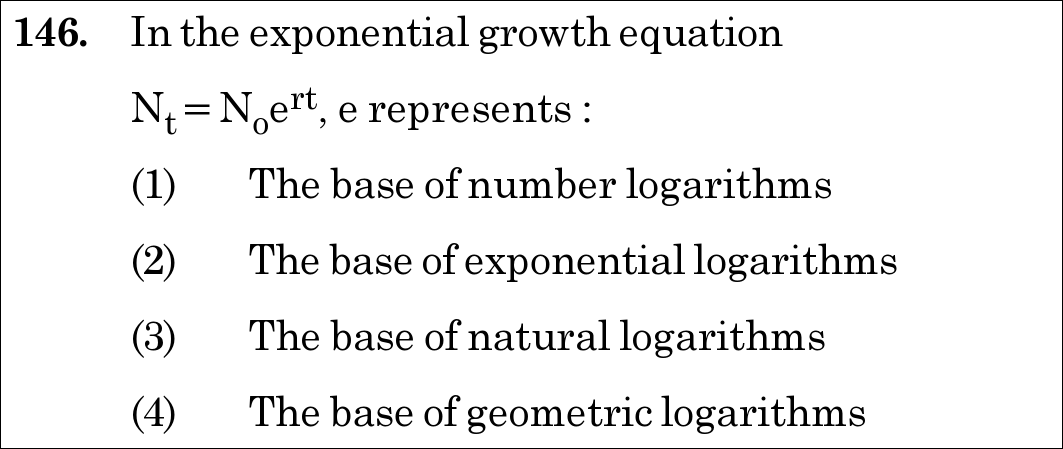
In the exponential growth equation Nt=Noert, e represents:
- (1)The base of number logarithms
- (2)The base of exponential logarithms
- (3)The base of natural logarithms
- (4)The base of geometric logarithms
Dynamic 180-question full-length simulator mixed dynamically from all 6 years for 2027 & 2026 aspirants.
In the exponential growth equation Nt=Noert, e represents:
In the integrated exponential growth equation , represents Euler's constant (), which is the base of natural logarithms ()! Match Option (3)!
When resources in the habitat are unlimited, the rate of increase of population density is given by the differential equation:
Integrating between limits and over time duration yields the exponential form:
The NCERT textbook explicitly lists the legend for this formula: - = Population density after time - = Population density at time zero - = Intrinsic rate of natural increase - = The base of natural logarithms ()
Diagnose every choice: Know exactly why the right option works and why distractors fail.
Fictitious mathematical phrasing; common logarithms use base 10.
Incorrect non-standard mathematical terminology.
Exact mathematical and textbook definition of constant e (, base of Napierian/natural logarithm ln).
Fabricated distractor term.
Students who remember logarithms recall base 10 (common logs) rather than base e (natural logs, ln).
"The integral form of exponential growth is Nt = N0 e^(rt), where e is the base of natural logarithms (2.71828)."
Test your speed and accuracy in the authentic 200-minute timed NTA simulator.
Spotted a mistake in this solution? Report an error (support@mycompetitiveexams.com)
Cover all 1,140 official NEET questions in 285 days at your own pace. Progress is saved on your device. No login needed.