MyCompetitiveExams Logo MyCompetitiveExams
Search 1,140+ Questions
Chapters, formulas, speed tricks
→
⚡ Brahmastra NEET 2027
720 MARKS

Dynamic 180-question full-length simulator mixed dynamically from all 6 years for 2027 & 2026 aspirants.

Launch Brahmastra 2027 Test →
Start Practice →
100% Free · No Login Required
Q.134 Botany ⭐ 360° Option Elimination Active
Vault ↗

NEET 2021 Botany Question 134 Solution

Topic: Anatomy of Flowering Plants · Official NTA Booklet Code M1
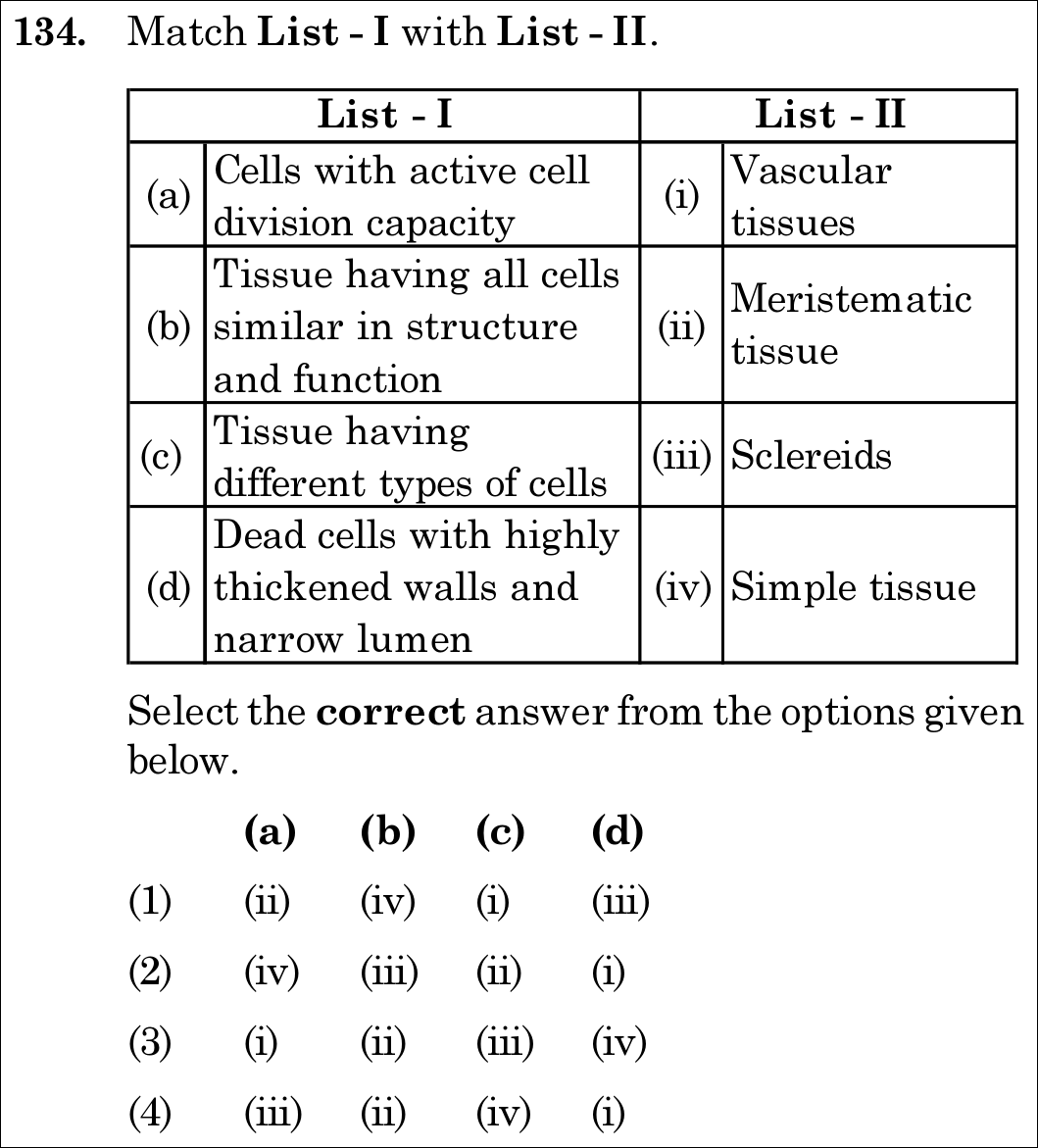
NEET 2021 Botany Question 134: Classification and Histological Features of Plant Tissues

Question

Match List - I with List - II. (a) Cells with active cell division capacity (i) Vascular tissues (b) Tissue having all cells similar in structure and function (ii) Meristematic tissue (c) Tissue having different types of cells (iii) Sclereids (d) Dead cells with highly thickened walls and narrow lumen (iv) Simple tissue List - I List - II Select the correct answer from the options given below. (a) (b) (c) (d)

  1. (1)(ii) (iv) (i) (iii)
  2. (2)(iv) (iii) (ii) (i)
  3. (3)(i) (ii) (iii) (iv)
  4. (4)(iii) (ii) (iv) (i)
✓
Verified Against NTA Final Answer Key
Option (1) : (a)-(ii), (b)-(iv), (c)-(i), (d)-(iii)
📚 Anatomy of Flowering Plants Easy
📋 Given Parameters & Problem Setup
List I (a) Cells with active cell division capacity, (b) Tissue having all cells similar in structure and function, (c) Tissue having different types of cells, (d) Dead cells with highly thickened walls and narrow lumen
List II (i) Vascular tissues, (ii) Meristematic tissue, (iii) Sclereids, (iv) Simple tissue
⚡

The 30-Second Exam Hall Shortcut: ⚡ Fast Pairing: Active Division = Meristem (ii) & Dead Thick Lumen = Sclereids (iii)

⏱️ Save ~20 seconds

Active cell division = Meristematic tissue (a-ii); Homogeneous cells similar in structure = Simple tissue (b-iv); Heterogeneous complex cells = Vascular tissue (c-i); Highly thickened dead cells with narrow lumen = Sclereids (d-iii). Matches Option (1)!

1 (a) Active cell division capacity   ⟹  \implies (ii) Meristematic tissue.
2 (b) All cells similar in structure and function   ⟹  \implies (iv) Simple tissue (parenchyma, collenchyma, sclerenchyma).
3 (c) Tissue composed of different cell types   ⟹  \implies (i) Vascular tissues (complex tissues: xylem and phloem).
4 (d) Dead cells with thick lignified walls and narrow lumen   ⟹  \implies (iii) Sclereids (sclerenchyma).
5 Match Option (1).
🛡️
Why You Can 100% Trust This Shortcut: Canonical NCERT Anatomy of Flowering Plants on Meristems and Permanent Tissues.
📐

Step-by-Step Rigorous Workflow & Mathematical Proof

Step 1

Histological Classification of Plant Tissues

Plant tissues are systematically organized into meristematic and permanent tissues based on division capability and cellular uniformity:

(a) Cells with active mitotic division⟷(ii) Meristematic tissue(b) All cells identical in structure and function⟷(iv) Simple tissue (e.g., parenchyma)(c) Multiple distinct cell types working as a unit⟷(i) Vascular tissues (complex xylem/phloem)(d) Dead cells with lignified walls and narrow lumen⟷(iii) Sclereids (stone cells/grit cells)\begin{aligned} \text{(a) Cells with active mitotic division} & \longleftrightarrow \text{(ii) Meristematic tissue} \\[3pt] \text{(b) All cells identical in structure and function} & \longleftrightarrow \text{(iv) Simple tissue (e.g., parenchyma)} \\[3pt] \text{(c) Multiple distinct cell types working as a unit} & \longleftrightarrow \text{(i) Vascular tissues (complex xylem/phloem)} \\[3pt] \text{(d) Dead cells with lignified walls and narrow lumen} & \longleftrightarrow \text{(iii) Sclereids (stone cells/grit cells)} \end{aligned}
Step 2

Option Alignment and Verification

Checking (a)-(ii) narrows down candidates to Option (1). Verifying (b)-(iv), (c)-(i), and (d)-(iii) confirms complete 100% agreement with Option (1).

⭐

360° Option Elimination Engine Key Feature

Diagnose every choice: Know exactly why the right option works and why distractors fail.

4-Option Deep Scan
1 1
✓ 100% Correct
Verdict & Scientific Reason:

Flawless correspondence according to canonical plant histology definitions.

💡
Why this is airtight: None. Clean first-principles match.
2 2
✗ Incorrect
Verdict & Scientific Reason:

Mismatches active division with simple tissue and dead cells with vascular tissue.

⚠️
Student Fallacy (Why candidates pick this trap): Confusing meristematic division with simple tissue.
3 3
✗ Incorrect
Verdict & Scientific Reason:

Mismatches dividing cells with vascular tissues.

⚠️
Student Fallacy (Why candidates pick this trap): Conflating active growth with vascular sap conduction.
4 4
✗ Incorrect
Verdict & Scientific Reason:

Inverts dividing cells with sclereids.

⚠️
Student Fallacy (Why candidates pick this trap): Swapping meristematic tissue with dead sclereids.
⚠️

NTA Trap Alert: Simple Tissue vs Complex Vascular Tissue Definitions

NCERT defines Simple Tissue as "made of only one type of cells" and Complex Tissue as "made of more than one type of cells" (vascular tissues).

🛡️ How to avoid the -1 mark: One type = Simple; Multiple types = Complex / Vascular.
📖

Core NEET Syllabus Standard

NEET / NCERT Biology · Anatomy of Flowering Plants Standard Benchmark
Core Scientific Principle Tested:

"Meristems possess active dividing capacity; simple tissues have similar cells; complex/vascular tissues have heterogeneous cells; sclereids are thick-walled dead cells with narrow lumen."

Syllabus Focus: The Tissues: Meristematic, Simple, and Complex Permanent Tissues
✓ Core NEET UG Syllabus Anchor Syllabus & Academic Standards ↗

Ready to attempt under real exam pressure?

Test your speed and accuracy in the authentic 200-minute timed NTA simulator.

Launch NEET 2021 CBT Test →

Spotted a mistake in this solution? Report an error (support@mycompetitiveexams.com)

⚖️ Legal & Fair Dealing Notice: Sourced from publicly released NEET 2021 question papers and NEET answer keys for private study, research, and non-commercial educational practice under Fair Dealing (Section 52(1)(a) of the Indian Copyright Act, 1957). Not affiliated with or endorsed by NTA or NMC.

Solve 4 NEET Questions a Day — One per Subject

Cover all 1,140 official NEET questions in 285 days at your own pace. Progress is saved on your device. No login needed.