MyCompetitiveExams Logo MyCompetitiveExams
Search 1,140+ Questions
Chapters, formulas, speed tricks
→
⚡ Brahmastra NEET 2027
720 MARKS

Dynamic 180-question full-length simulator mixed dynamically from all 6 years for 2027 & 2026 aspirants.

Launch Brahmastra 2027 Test →
Start Practice →
100% Free · No Login Required
Q.20 Physics ⭐ 360° Option Elimination Active
Vault ↗

NEET 2026 Physics Question 20 Solution

Topic: Experimental Skills & Optics · Official NTA Booklet Code 50
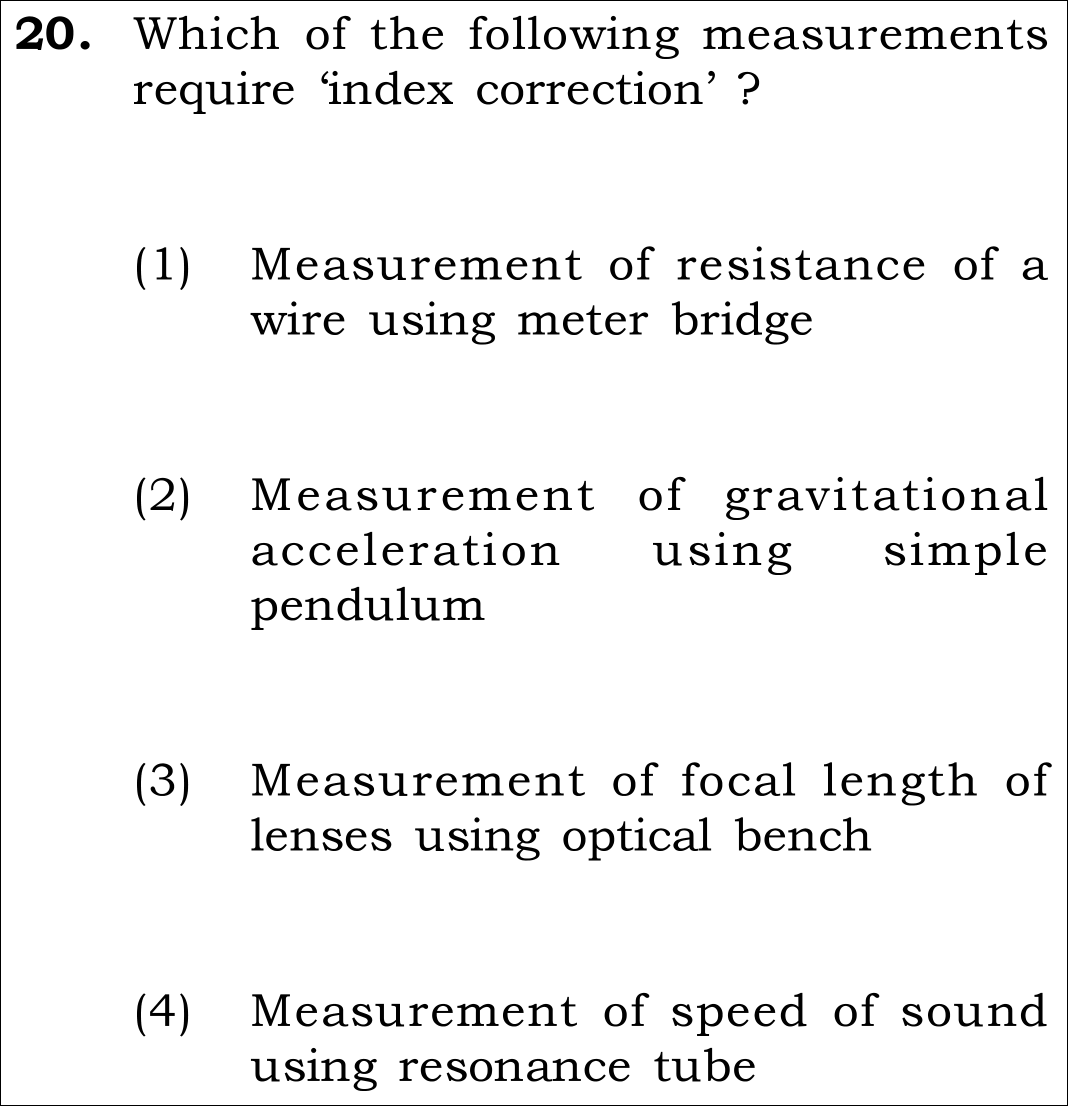
NEET 2026 Physics Question 20: Identification of Experimental Measurements Requiring Index Correction

Question

Which of the following measurements require "index correction"?

✓
Verified Against NTA Final Answer Key
Option (3) : Measurement of focal length of lenses using optical bench
📚 Experimental Skills & Optics Easy
📋 Given Parameters & Problem Setup
Method 1 Measurement of resistance of a wire using meter bridge
Method 2 Measurement of gravitational acceleration using simple pendulum
Method 3 Measurement of focal length of lenses using optical bench
Method 4 Measurement of speed of sound using resonance tube
Target Concept Experimental procedure requiring 'index correction'
⚡

The 30-Second Exam Hall Shortcut: ⚡ Practical Physics Terminology Matcher

⏱️ Instant recall.

Differentiate between "End Correction" and "Index Correction"

1 Meter Bridge ==> Requires END CORRECTION (due to non-zero contact resistance of copper end strips).
2 Resonance Tube ==> Requires END CORRECTION (e = 0.6*r, because antinode forms slightly above open tube rim).
3 Simple Pendulum ==> Requires spherical radius correction via vernier callipers (effective length L = l + r + e/2).
4 Optical Bench ==> Requires INDEX CORRECTION (bench error: distance between uprights on bench scale does not match true physical distance between lens pole and pin tip due to upright thickness/offsets).
5 Instant identification: Optical bench is the ONLY apparatus that uses Index Correction! Solved in 5 seconds!
🛡️
Why You Can 100% Trust This Shortcut: Index correction is formally defined in NCERT Practical Physics Laboratory Manual: Index Correction = Actual distance (measured by knitting needle) - Observed distance (reading difference between uprights).
📐

Step-by-Step Rigorous Workflow & Mathematical Proof

Step 1

Define Index Correction in Experimental Physics

In an optical bench experiment, uprights supporting the lens and object/image pins slide along a graduated wooden/metallic bed:

Index Correction (e)=Actual Distance (dactual)−Observed Distance (dobserved)\text{Index Correction } (e) = \text{Actual Distance } (d_{\text{actual}}) - \text{Observed Distance } (d_{\text{observed}})
  • • Because the optical center of the thick lens and the sharp tips of the needles do not lie exactly above the reference fiducial marks on the upright bases, observed scale readings differ from true physical separation.
  • • This systematic discrepancy is determined using a thin knitting needle of known length and is called the Index Correction.
Step 2

Analyze Other Laboratory Measurements

Examine the systematic corrections required in the other three experiments:

Meter bridge / Resonance tube: End Correction\text{Meter bridge / Resonance tube: } \text{End Correction}
  • • Meter bridge: Resistance of end copper strips and solder joints requires "End Correction".
  • • Resonance tube: Displacement antinode lies at a distance e = 0.6 * r outside the open tube end; this is called "End Correction".
  • • Simple pendulum: Uses vernier callipers to measure bob radius; no index correction is involved.
Step 3

Match with the Given Options

Confirm the experimental pairing:

Measurement of focal length of lenses using optical bench   ⟹  Index Correction\text{Measurement of focal length of lenses using optical bench } \implies \text{Index Correction}
  • • Matches Option (3) exactly.
⭐

360° Option Elimination Engine Key Feature

Diagnose every choice: Know exactly why the right option works and why distractors fail.

4-Option Deep Scan
1 Option (1)
✗ Incorrect
Verdict & Scientific Reason:

Requires End Correction, not Index Correction.

⚠️
Student Fallacy (Why candidates pick this trap): Confuses "end correction" for copper strips with "index correction".
Note: Meter bridge uses end correction.
2 Option (2)
✗ Incorrect
Verdict & Scientific Reason:

Does not require index correction.

⚠️
Student Fallacy (Why candidates pick this trap): Confuses bob radius adjustment with index correction.
Note: Effective length L = length of string + bob radius.
3 Option (3)
✓ 100% Correct
Verdict & Scientific Reason:

Canonical definition in NCERT Practical Physics manual; confirmed by Official NTA Key.

💡
Why this is airtight: Accurate knowledge of optical bench bench-error terminology.
Note: Exact syllabus standard.
4 Option (4)
✗ Incorrect
Verdict & Scientific Reason:

Requires End Correction (e = 0.6r).

⚠️
Student Fallacy (Why candidates pick this trap): Confuses open-tube antinode displacement with index correction.
Note: Resonance tube correction is strictly called "End Correction".
⚠️

NTA Trap Alert: The "End Correction" vs "Index Correction" Synonym Confusion

Students frequently conflate "end correction" (used in acoustic pipes and resistance wires) with "index correction" (used exclusively in optical bench needle alignment).

🛡️ How to avoid the -1 mark: Remember: "Index" refers to the fiducial index mark on optical bench uprights. It belongs strictly to optics!
📖

Core NEET Syllabus Standard

NEET UG Physics Core Standards · Experimental Skills / Practical Physics Standard Benchmark
Core Scientific Principle Tested:

"Index correction accounts for the difference between the distance measured between upright reference marks and the true optical distance: True distance = Observed distance + Index correction."

Syllabus Focus: Focal Length Measurement of Spherical Lenses on an Optical Bench
✓ Core NEET UG Syllabus Anchor Syllabus & Academic Standards ↗

Ready to attempt under real exam pressure?

Test your speed and accuracy in the authentic 180-minute timed NTA simulator.

Launch NEET 2026 CBT Test →

Spotted a mistake in this solution? Report an error (support@mycompetitiveexams.com)

⚖️ Legal & Fair Dealing Notice: Sourced from publicly released NEET 2026 question papers and NEET answer keys for private study, research, and non-commercial educational practice under Fair Dealing (Section 52(1)(a) of the Indian Copyright Act, 1957). Not affiliated with or endorsed by NTA or NMC.

Solve 4 NEET Questions a Day — One per Subject

Cover all 1,140 official NEET questions in 285 days at your own pace. Progress is saved on your device. No login needed.