MyCompetitiveExams Logo MyCompetitiveExams
Search 1,140+ Questions
Chapters, formulas, speed tricks
→
⚡ Brahmastra NEET 2027
720 MARKS

Dynamic 180-question full-length simulator mixed dynamically from all 6 years for 2027 & 2026 aspirants.

Launch Brahmastra 2027 Test →
Start Practice →
100% Free · No Login Required
Q.84 Chemistry ⭐ 360° Option Elimination Active
Vault ↗

NEET 2026 Chemistry Question 84 Solution

Topic: Organic Compounds Containing Nitrogen & Carboxylic Acids · Official NTA Booklet Code 50
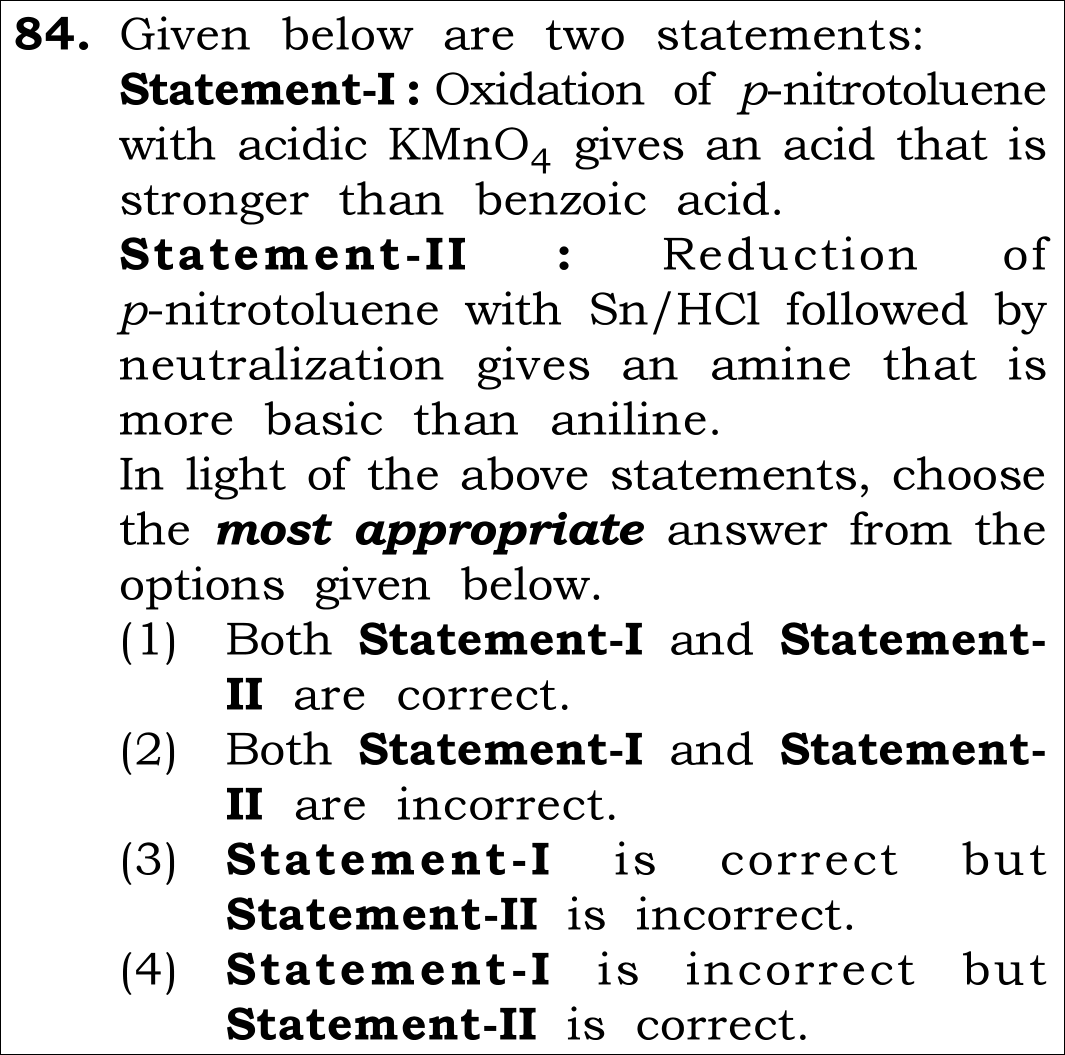
NEET 2026 Chemistry Question 84: Electronic Effects on Acidity of Benzoic Acids & Basicity of Anilines

Question

Given below are two statements: Statement-I: Oxidation of p-nitrotoluene with acidic KMnO₄ gives an acid that is stronger than benzoic acid. Statement-II: Reduction of p-nitrotoluene with Sn/HCl followed by neutralization gives an amine that is more basic than aniline. In light of the above statements, choose the most appropriate answer from the options given below.

✓
Verified Against NTA Final Answer Key
Option (1) : Both Statement-I and Statement-II are correct.
📚 Organic Compounds Containing Nitrogen & Carboxylic Acids Medium
📋 Given Parameters & Problem Setup
Statement-I Oxidation of p-nitrotoluene with acidic KMnO₄ gives an acid that is stronger than benzoic acid.
Statement-II Reduction of p-nitrotoluene with Sn/HCl followed by neutralization gives an amine that is more basic than aniline.
⚡

The 30-Second Exam Hall Shortcut: ⚡ Acid/Base Substituent Effects

⏱️ Save ~60 seconds

-NO₂ withdraws electrons (increases acidity); -CH₃ donates electrons (increases basicity)!

1 Statement-I: Oxidation of p-nitrotoluene oxidizes -CH₃ to -COOH, forming p-nitrobenzoic acid. The strong electron-withdrawing nitro group (-I, -M) disperses the carboxylate negative charge, making it STRONGER than benzoic acid (pKa 3.44 vs 4.20) -> TRUE!
2 Statement-II: Reduction with Sn/HCl selectively reduces -NO₂ to -NH₂, leaving -CH₃ intact to give p-toluidine (p-methylaniline). The electron-releasing methyl group (+I and hyperconjugation) increases electron density on the -NH₂ lone pair, making it MORE BASIC than aniline (pKb 8.92 vs 9.38) -> TRUE!
3 Both statements are scientifically correct -> Option (1) in 15 seconds!
🛡️
Why You Can 100% Trust This Shortcut: Canonical organic principles: Electron-withdrawing groups stabilize carboxylate anions (increase acidity); Electron-donating groups increase lone pair availability on nitrogen (increase basicity).
📐

Step-by-Step Rigorous Workflow & Mathematical Proof

Step 1

Analyze Statement-I (Oxidation to p-Nitrobenzoic Acid)

Vigorous oxidation of an alkylbenzene derivative with acidic potassium permanganate (KMnO₄/H⁺) oxidizes the benzylic methyl group to a carboxylic acid group (-COOH), while the nitro group remains inert.

p-NO2−C6H4−CH3→KMnO4,H+p-NO2−C6H4−COOH(p-nitrobenzoic acid)p\text{-NO}_2-\text{C}_6\text{H}_4-\text{CH}_3 \xrightarrow{\text{KMnO}_4, \text{H}^+} p\text{-NO}_2-\text{C}_6\text{H}_4-\text{COOH} \quad (p\text{-nitrobenzoic acid})
  • • The nitro group (-NO₂) is a powerful electron-withdrawing group via inductive (-I) and mesomeric (-M) effects.
  • • By delocalizing and dispersing the negative charge on the conjugate base (p-nitrobenzoate anion), it strongly stabilizes the conjugate base.
  • • Therefore, p-nitrobenzoic acid (pKa = 3.44) is a much stronger acid than unsubstituted benzoic acid (pKa = 4.20).
  • • Statement-I is correct.
Step 2

Analyze Statement-II (Reduction to p-Toluidine)

Reduction of p-nitrotoluene using tin and concentrated hydrochloric acid (Sn/HCl) followed by basic neutralization selectively reduces the aromatic nitro group (-NO₂) to an amino group (-NH₂), leaving the methyl group unaffected.

p-NO2−C6H4−CH3→1. Sn/HCl, 2. NaOHp-CH3−C6H4−NH2(p-toluidine)p\text{-NO}_2-\text{C}_6\text{H}_4-\text{CH}_3 \xrightarrow{\text{1. Sn/HCl, 2. NaOH}} p\text{-CH}_3-\text{C}_6\text{H}_4-\text{NH}_2 \quad (p\text{-toluidine})
  • • The methyl group (-CH₃) is an electron-donating group via positive inductive (+I) and hyperconjugation effects.
  • • Electron donation increases the electron density on the nitrogen atom, enhancing the availability of its lone pair for protonation.
  • • Therefore, p-toluidine (pKb = 8.92) is more basic than unsubstituted aniline (pKb = 9.38).
  • • Statement-II is correct.
Step 3

Formulate Conclusion

Both Statement-I and Statement-II are correct.

Statement-I: True,Statement-II: True  ⟹  Both are correct (Option 1)\text{Statement-I: True}, \quad \text{Statement-II: True} \implies \text{Both are correct (Option 1)}
  • • Matches Option (1).
⭐

360° Option Elimination Engine Key Feature

Diagnose every choice: Know exactly why the right option works and why distractors fail.

4-Option Deep Scan
1 A
✓ 100% Correct
Verdict & Scientific Reason:

Scientifically flawless: -NO₂ strengthens the benzoic acid, and -CH₃ strengthens the basicity of the toluidine.

💡
Why this is airtight: None; perfect understanding of substituent electronic effects.
2 B
✗ Incorrect
Verdict & Scientific Reason:

Incorrect. Both statements represent standard textbook chemistry.

⚠️
Student Fallacy (Why candidates pick this trap): Doubting both standard functional group reactions.
3 C
✗ Incorrect
Verdict & Scientific Reason:

Incorrect. Falsely assumes p-toluidine is less basic than aniline.

⚠️
Student Fallacy (Why candidates pick this trap): Confusing basicity in aromatic amines with steric hindrance of ortho substituents.
4 D
✗ Incorrect
Verdict & Scientific Reason:

Incorrect. Falsely claims p-nitrobenzoic acid is weaker than benzoic acid.

⚠️
Student Fallacy (Why candidates pick this trap): Inverting the effect of electron-withdrawing groups on acid strength.
⚠️

NTA Trap Alert: Confusing the Ortho Effect with Para Substituents

In ortho-substituted benzoic acids and anilines, the ortho-effect can alter expected acidity/basicity. But here, the substituents are strictly PARA (p-nitrotoluene), where electronic effects (+I/+M and -I/-M) govern smoothly without steric inhibition of resonance.

🛡️ How to avoid the -1 mark: Para -NO₂ increases acidity; Para -CH₃ increases basicity. Both statements are TRUE.
📖

Core NEET Syllabus Standard

NEET Chemistry Core Syllabus · Carboxylic Acids & Amines Standard Benchmark
Core Scientific Principle Tested:

"Electron-withdrawing groups enhance carboxylic acidity; electron-donating groups enhance amine basicity."

Syllabus Focus: Acidity of substituted benzoic acids and basicity of substituted anilines
✓ Core NEET UG Syllabus Anchor Syllabus & Academic Standards ↗
NO₂ pulls electrons to make acid strong; CH₃ pushes electrons to make base belong!

Ready to attempt under real exam pressure?

Test your speed and accuracy in the authentic 180-minute timed NTA simulator.

Launch NEET 2026 CBT Test →

Spotted a mistake in this solution? Report an error (support@mycompetitiveexams.com)

⚖️ Legal & Fair Dealing Notice: Sourced from publicly released NEET 2026 question papers and NEET answer keys for private study, research, and non-commercial educational practice under Fair Dealing (Section 52(1)(a) of the Indian Copyright Act, 1957). Not affiliated with or endorsed by NTA or NMC.

Solve 4 NEET Questions a Day — One per Subject

Cover all 1,140 official NEET questions in 285 days at your own pace. Progress is saved on your device. No login needed.