MyCompetitiveExams Logo MyCompetitiveExams
Search 1,140+ Questions
Chapters, formulas, speed tricks
→
⚡ Brahmastra NEET 2027
720 MARKS

Dynamic 180-question full-length simulator mixed dynamically from all 6 years for 2027 & 2026 aspirants.

Launch Brahmastra 2027 Test →
Start Practice →
100% Free · No Login Required
Q.167 Zoology ⭐ 360° Option Elimination Active
Vault ↗

NEET 2021 Zoology Question 167 Solution

Topic: Animal Kingdom · Official NTA Booklet Code M1
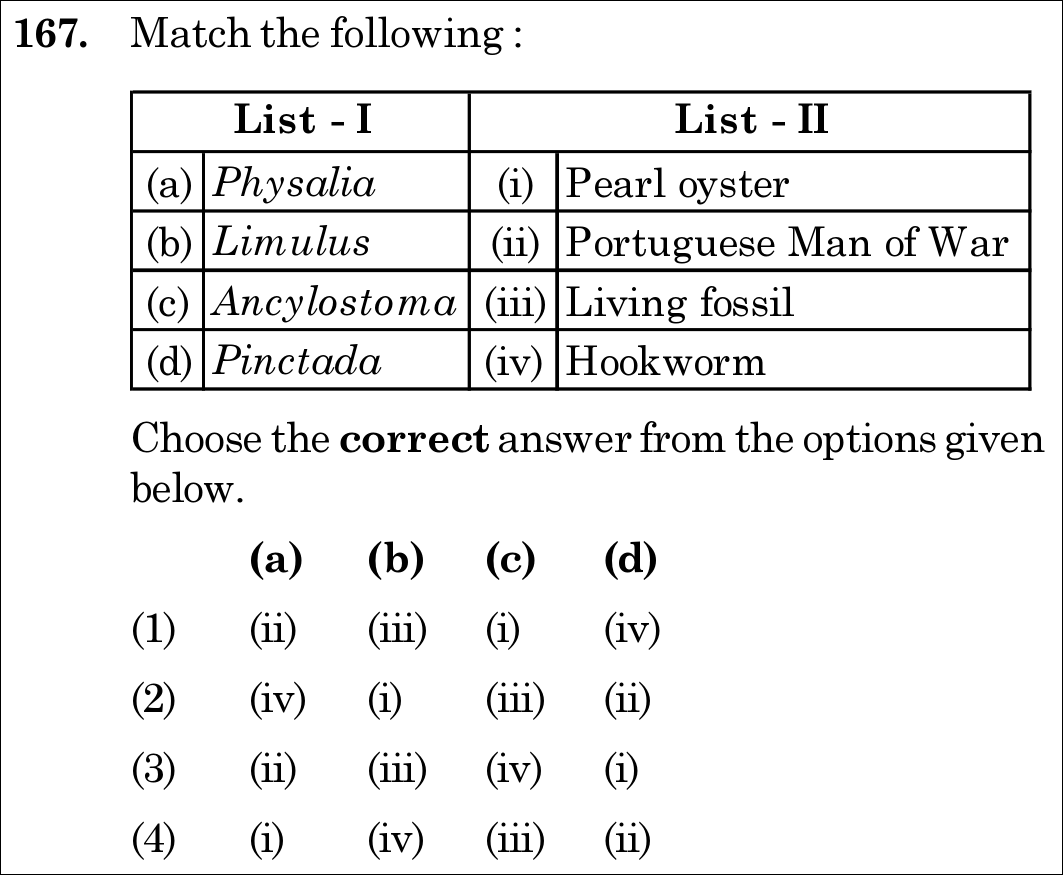
NEET 2021 Zoology Question 167: Common Names and Diagnostic Genera of Invertebrate Phyla

Question

Match the following: (a) Physalia (i) Pearl oyster (b) Limulus (ii) Portuguese Man of War (c) Ancylostoma (iii) Living fossil (d) Pinctada (iv) Hookworm List - I List - II Choose the correct answer from the options given below. (a) (b) (c) (d)

  1. (1)(ii) (iii) (i) (iv)
  2. (2)(iv) (i) (iii) (ii)
  3. (3)(ii) (iii) (iv) (i)
  4. (4)(i) (iv) (iii) (ii)
✓
Verified Against NTA Final Answer Key
Option (3) : (a)-(ii), (b)-(iii), (c)-(iv), (d)-(i)
📚 Animal Kingdom Easy
📋 Given Parameters & Problem Setup
List I (Scientific Names) (a) Physalia, (b) Limulus, (c) Ancylostoma, (d) Pinctada
List II (Common Names / Attributes) (i) Pearl oyster, (ii) Portuguese Man of War, (iii) Living fossil, (iv) Hookworm
⚡

The 30-Second Exam Hall Shortcut: ⚡ "Physalia = Portuguese Man of War, Limulus = Living Fossil Arthropod"

⏱️ Save ~30 seconds

Physalia is Portuguese Man of War ((a)-(ii)) and Limulus is the living fossil King Crab ((b)-(iii)). Looking at options, only Option (3) has (a)-(ii) and (b)-(iii)! Solved in 10 seconds.

1 Match (a) Physalia (Cnidaria) -> (ii) Portuguese Man of War.
2 Inspect options: Option (1) has (a)-(ii), (b)-(iii), but (c)-(i). Option (3) has (a)-(ii), (b)-(iii), (c)-(iv), (d)-(i).
3 Verify (c) Ancylostoma (Aschelminthes) -> (iv) Hookworm.
4 Verify (d) Pinctada (Mollusca) -> (i) Pearl oyster.
5 Confirm Option (3).
🛡️
Why You Can 100% Trust This Shortcut: NCERT Biology · Animal Kingdom (Phylum Cnidaria: Physalia - Portuguese man-of-war; Phylum Arthropoda: Limulus - King crab, living fossil; Phylum Aschelminthes: Ancylostoma - Hookworm; Phylum Mollusca: Pinctada - Pearl oyster).
📐

Step-by-Step Rigorous Workflow & Mathematical Proof

Step 1

Taxonomic Assignment of Genera to Phyla and Common Names

Each genus listed is a classic NCERT type specimen representing distinct invertebrate phyla: - (a) *Physalia* (Phylum Coelenterata / Cnidaria): Colonial siphonophore possessing gas-filled pneumatophore float resembling an 18th-century warship, commonly called Portuguese Man of War. - (b) *Limulus* (Phylum Arthropoda): Commonly known as the King crab or horseshoe crab. Having remained virtually unchanged over hundreds of millions of years, it is universally designated a Living fossil. - (c) *Ancylostoma* (Phylum Aschelminthes): Intestinal nematode parasite commonly named the Hookworm. - (d) *Pinctada* (Phylum Mollusca): Bivalve mollusc commercially cultured for natural and cultured nacre pearls, commonly termed the Pearl oyster.

Physalia  ⟺  Portuguese Man of War[(a)→(ii)]Limulus  ⟺  Living fossil[(b)→(iii)]Ancylostoma  ⟺  Hookworm[(c)→(iv)]Pinctada  ⟺  Pearl oyster[(d)→(i)]\begin{aligned} \text{Physalia} &\iff \text{Portuguese Man of War} \quad [\text{(a)} \to \text{(ii)}] \\ \text{Limulus} &\iff \text{Living fossil} \quad [\text{(b)} \to \text{(iii)}] \\ \text{Ancylostoma} &\iff \text{Hookworm} \quad [\text{(c)} \to \text{(iv)}] \\ \text{Pinctada} &\iff \text{Pearl oyster} \quad [\text{(d)} \to \text{(i)}] \end{aligned}
Step 2

Compilation and Option Verification

Matching sequence: (a) -> (ii), (b) -> (iii), (c) -> (iv), (d) -> (i). This corresponds uniquely and unambiguously to Option (3).

⭐

360° Option Elimination Engine Key Feature

Diagnose every choice: Know exactly why the right option works and why distractors fail.

4-Option Deep Scan
1 1
✗ Incorrect
Verdict & Scientific Reason:

Incorrect because Ancylostoma is a hookworm (iv), not pearl oyster (i), and Pinctada is pearl oyster (i), not hookworm (iv).

⚠️
Student Fallacy (Why candidates pick this trap): Swapping the pairs for Ancylostoma and Pinctada.
2 2
✗ Incorrect
Verdict & Scientific Reason:

Incorrect. Assigns hookworm to Physalia and pearl oyster to Limulus.

⚠️
Student Fallacy (Why candidates pick this trap): Gross misalignment of phyla.
3 3
✓ 100% Correct
Verdict & Scientific Reason:

Correct. Perfectly matches all four genera to their textbook common designations.

💡
Why this is airtight: None. Candidate accurately recalls standard zoological nomenclature.
4 4
✗ Incorrect
Verdict & Scientific Reason:

Incorrect. Misidentifies Physalia as pearl oyster and Limulus as hookworm.

⚠️
Student Fallacy (Why candidates pick this trap): Random guessing without recalling phylum examples.
⚠️

NTA Trap Alert: Inverted Matching Trap (c) vs (d)

Option 1 and Option 3 share the first two matches ((a)-(ii), (b)-(iii)). Careless candidates stop reading after the first two items and erroneously bubble Option 1.

🛡️ How to avoid the -1 mark: Always cross-check all 4 column pairs before finalizing the answer.
📖

Core NEET Syllabus Standard

NEET / NCERT Biology · Animal Kingdom Standard Benchmark
Core Scientific Principle Tested:

"Physalia is Portuguese man-of-war, Limulus is a living fossil, Ancylostoma is hookworm, and Pinctada is pearl oyster."

Syllabus Focus: Classification of Non-Chordates
✓ Core NEET UG Syllabus Anchor Syllabus & Academic Standards ↗

Ready to attempt under real exam pressure?

Test your speed and accuracy in the authentic 200-minute timed NTA simulator.

Launch NEET 2021 CBT Test →

Spotted a mistake in this solution? Report an error (support@mycompetitiveexams.com)

⚖️ Legal & Fair Dealing Notice: Sourced from publicly released NEET 2021 question papers and NEET answer keys for private study, research, and non-commercial educational practice under Fair Dealing (Section 52(1)(a) of the Indian Copyright Act, 1957). Not affiliated with or endorsed by NTA or NMC.

Solve 4 NEET Questions a Day — One per Subject

Cover all 1,140 official NEET questions in 285 days at your own pace. Progress is saved on your device. No login needed.