MyCompetitiveExams Logo MyCompetitiveExams
Search 1,140+ Questions
Chapters, formulas, speed tricks
→
⚡ Brahmastra NEET 2027
720 MARKS

Dynamic 180-question full-length simulator mixed dynamically from all 6 years for 2027 & 2026 aspirants.

Launch Brahmastra 2027 Test →
Start Practice →
100% Free · No Login Required
Q.20 Physics ⭐ 360° Option Elimination Active
Vault ↗

NEET 2021 Physics Question 20 Solution

Topic: Electrostatic Potential and Capacitance · Official NTA Booklet Code M1
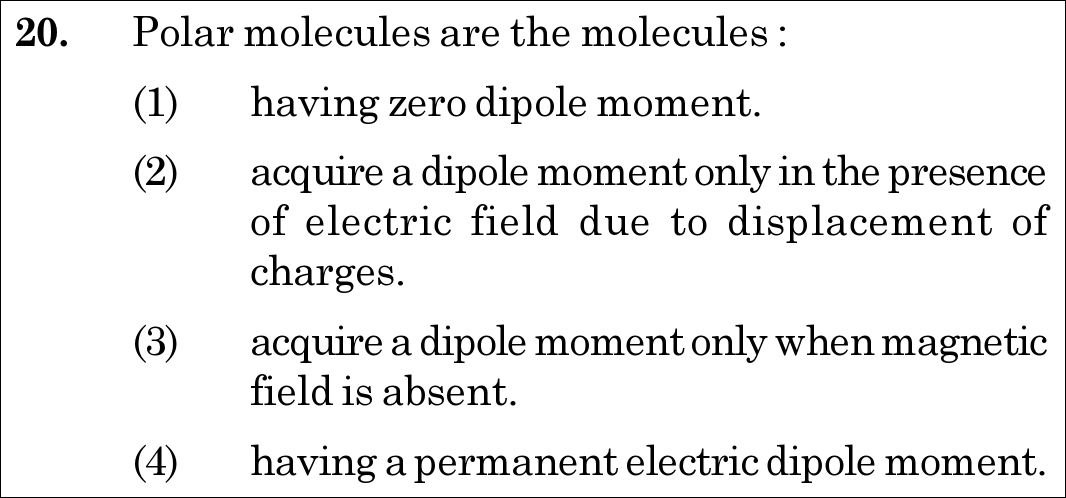
NEET 2021 Physics Question 20: Dielectric Materials: Definition and Nature of Polar Molecules

Question

Polar molecules are the molecules:

  1. (1)having zero dipole moment.
  2. (2)acquire a dipole moment only in the presence of electric field due to displacement of charges.
  3. (3)acquire a dipole moment only when magnetic field is absent.
  4. (4)having a permanent electric dipole moment.
✓
Verified Against NTA Final Answer Key
Option (4) : having a permanent electric dipole moment.
📚 Electrostatic Potential and Capacitance Easy
📋 Given Parameters & Problem Setup
Category Polar molecules (e.g., HCl, H2O, NH3)
⚡

The 30-Second Exam Hall Shortcut: ⚡ Polar = Permanent Dipole Moment

⏱️ Save ~20 seconds

Verbatim NCERT Electrostatics definition: Polar molecules have non-coincident centers of positive and negative charge, hence possessing a PERMANENT electric dipole moment even in zero external field! Non-polar molecules have zero permanent dipole moment. Match Option (4)!

1 Non-polar molecules (e.g., H2,O2,CO2H_2, O_2, CO_2): Center of positive and negative charges coincide   ⟹  \implies permanent dipole moment is ZERO.
2 Polar molecules (e.g., HCl,H2OHCl, H_2O): Due to asymmetric chemical bonding, centers do NOT coincide   ⟹  \implies possess PERMANENT electric dipole moment.
3 External field merely aligns these permanent dipoles against thermal agitation.
4 Match Option (4) having a permanent electric dipole moment.
🛡️
Why You Can 100% Trust This Shortcut: Canonical NCERT Electrostatics chapter section on Dielectrics and Polarisation.
📐

Step-by-Step Rigorous Workflow & Mathematical Proof

Step 1

Microscopic Basis of Molecular Polarity

In a molecule, the effective centers of positive charges (atomic nuclei) and negative charges (electron clouds) determine molecular polarity:

Step 2

Non-Polar vs. Polar Molecules in NCERT

NCERT defines both categories explicitly: - Non-polar molecule: The centers of positive and negative charges coincide. Thus, the molecule has no permanent (or intrinsic) dipole moment (e.g., O2,H2,CO2\text{O}_2, \text{H}_2, \text{CO}_2). - Polar molecule: The centers of positive and negative charges are separated by a finite displacement even when no external field is applied. Therefore, polar molecules possess an intrinsic, permanent electric dipole moment (e.g., HCl,H2O\text{HCl}, \text{H}_2\text{O}).

p⃗polar≠0⃗(even when E⃗ext=0⃗)\vec{p}_{\text{polar}} \neq \vec{0} \quad (\text{even when } \vec{E}_{\text{ext}} = \vec{0})
Step 3

Behavior in an External Field

When placed in an external electric field, the permanent dipoles experience a torque τ⃗=p⃗×E⃗\vec{\tau} = \vec{p} \times \vec{E} that tends to align them parallel to the field direction, creating orientational polarization.

⭐

360° Option Elimination Engine Key Feature

Diagnose every choice: Know exactly why the right option works and why distractors fail.

4-Option Deep Scan
1 1
✗ Incorrect
Verdict & Scientific Reason:

This describes non-polar molecules in the absence of an external electric field.

⚠️
Student Fallacy (Why candidates pick this trap): Confusing polar molecules with non-polar molecules.
2 2
✗ Incorrect
Verdict & Scientific Reason:

This describes induced dipole moments in non-polar molecules, not polar molecules.

⚠️
Student Fallacy (Why candidates pick this trap): Confusing induced polarization of non-polar dielectrics with intrinsic polar dipoles.
3 3
✗ Incorrect
Verdict & Scientific Reason:

Magnetic fields are irrelevant to the electrostatic definition of dielectric molecular polarity.

⚠️
Student Fallacy (Why candidates pick this trap): Conflating electric dipole moments with magnetic moments.
4 4
✓ 100% Correct
Verdict & Scientific Reason:

Verbatim NCERT scientific definition: polar molecules inherently possess a permanent electric dipole moment.

💡
Why this is airtight: None; textbook verbatim precision.
⚠️

NTA Trap Alert: Permanent vs. Induced Dipole Moment Trap

Students frequently confuse polar molecules (which already HAVE permanent dipoles) with non-polar molecules (which ACQUIRE induced dipoles only when an external field is turned on).

🛡️ How to avoid the -1 mark: Polar = Permanent dipole moment. Non-polar = Acquired/induced dipole moment.
📖

Core NEET Syllabus Standard

NCERT Physics · Electrostatic Potential and Capacitance Standard Benchmark
Core Scientific Principle Tested:

"A polar molecule is one in which the centres of positive and negative charges do not coincide, giving it a permanent electric dipole moment."

Syllabus Focus: Dielectrics and Polarisation
✓ Core NEET UG Syllabus Anchor Syllabus & Academic Standards ↗

Ready to attempt under real exam pressure?

Test your speed and accuracy in the authentic 200-minute timed NTA simulator.

Launch NEET 2021 CBT Test →

Spotted a mistake in this solution? Report an error (support@mycompetitiveexams.com)

⚖️ Legal & Fair Dealing Notice: Sourced from publicly released NEET 2021 question papers and NEET answer keys for private study, research, and non-commercial educational practice under Fair Dealing (Section 52(1)(a) of the Indian Copyright Act, 1957). Not affiliated with or endorsed by NTA or NMC.

Solve 4 NEET Questions a Day — One per Subject

Cover all 1,140 official NEET questions in 285 days at your own pace. Progress is saved on your device. No login needed.