MyCompetitiveExams Logo MyCompetitiveExams
Search 1,140+ Questions
Chapters, formulas, speed tricks
→
⚡ Brahmastra NEET 2027
720 MARKS

Dynamic 180-question full-length simulator mixed dynamically from all 6 years for 2027 & 2026 aspirants.

Launch Brahmastra 2027 Test →
Start Practice →
100% Free · No Login Required
Q.87 Chemistry ⭐ 360° Option Elimination Active
Vault ↗

NEET 2021 Chemistry Question 87 Solution

Topic: Amines · Official NTA Booklet Code M1
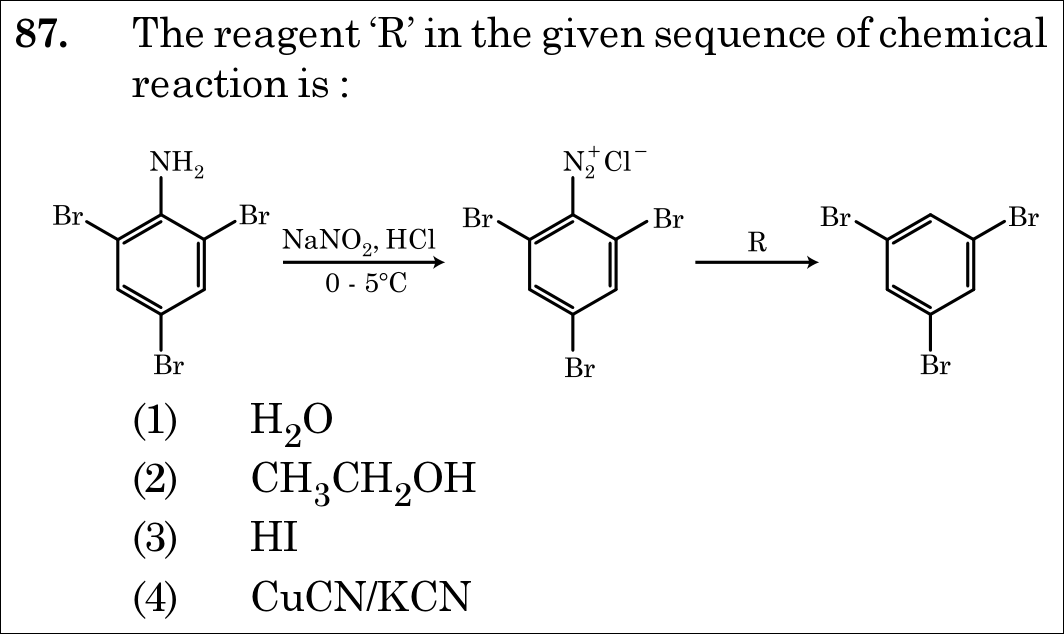
NEET 2021 Chemistry Question 87: Reduction of Arenediazonium Salts: Deamination to Arenes Using Ethanol

Question

The reagent 'R' in the given sequence of chemical reaction is:

  1. (1)H2O
  2. (2)CH3CH2OH
  3. (3)HI
  4. (4)CuCN/KCN
✓
Verified Against NTA Final Answer Key
Option (2) : CH3CH2OH
📚 Amines Easy
📋 Given Parameters & Problem Setup
Substrate 2,4,6-Tribromobenzenediazonium chloride
Reagent R Mild reducing agent for replacement of -N2+Cl- by -H
Product 1,3,5-Tribromobenzene (symmetrical tribromobenzene)
⚡

The 30-Second Exam Hall Shortcut: ⚡ Deamination of -N2⁺Cl⁻ to -H: Use H3PO2 or CH3CH2OH!

⏱️ Save ~20 seconds

Replacement of the diazonium group (−N2+Cl−-N_2^+Cl^-) by hydrogen (−H-H) requires a mild reducing agent. Verbatim NCERT Amines: "Certain mild reducing agents like hypophosphorous acid (H3PO2H_3PO_2) or ethanol (CH3CH2OHCH_3CH_2OH) reduce diazonium salts to arenes and themselves get oxidised to phosphorous acid and ethanal, respectively." Among the choices, the reducing agent is ethanol (CH3CH2OHCH_3CH_2OH)! Match Option (2)!

1 Inspect conversion: The diazonium group (−N2+Cl−-N_2^+Cl^-) at position 1 is replaced by hydrogen (−H-H).
2 This reductive deamination reaction is carried out using mild reducing agents: H3PO2/H2OH_3PO_2 / H_2O or CH3CH2OHCH_3CH_2OH.
3 Ethanol acts as hydride donor, reducing the diazonium arene to the parent hydrocarbon while being oxidized to acetaldehyde (CH3CHOCH_3CHO).
4 Reaction: Ar−N2+Cl−+CH3CH2OH⟶Ar−H+N2↑+HCl+CH3CHOAr-N_2^+Cl^- + CH_3CH_2OH \longrightarrow Ar-H + N_2\uparrow + HCl + CH_3CHO.
5 Match Option (2) CH3CH2OH.
6 Other reagents: H2OH_2O with heat gives phenol; HIHI gives aryl iodide; CuCN/KCNCuCN/KCN gives benzonitrile (Sandmeyer).
🛡️
Why You Can 100% Trust This Shortcut: Canonical NCERT Amines section on Reactions Involving Displacement of Nitrogen (Reduction).
📐

Step-by-Step Rigorous Workflow & Mathematical Proof

Step 1

Identifying the Target Chemical Transformation

The reaction sequence shows: 1. 2,4,6-tribromoaniline undergoes diazotization with nitrous acid (NaNO2+HCl\text{NaNO}_2 + \text{HCl} at 0−5∘C0-5^\circ\text{C}) to form 2,4,6-tribromobenzenediazonium chloride. 2. The diazonium chloride reacts with reagent 'R' to lose the diazonium function, yielding 1,3,5-tribromobenzene. This is a classic reductive deamination where the −N2+Cl−-N_2^+Cl^- group is replaced by a hydrogen atom (−H-H).

Step 2

Evaluating Reducing Agents for Diazonium Salts in NCERT

According to NCERT Chapter on Amines: *"Certain mild reducing agents like hypophosphorous acid (H3PO2H_3PO_2) or ethanol (CH3CH2OHCH_3CH_2OH) reduce diazonium salts to arenes and themselves get oxidised to phosphorous acid and ethanal, respectively."* The balanced chemical equation for the reduction by ethanol is:

Ar−N2+Cl−+CH3CH2OH⟶Ar−H+N2↑+HCl+CH3CHOAr-N_2^+Cl^- + CH_3CH_2OH \longrightarrow Ar-H + N_2\uparrow + HCl + CH_3CHO
Step 3

Eliminating Alternative Reagents

- H2OH_2O (Option 1): Warming diazonium salts with water leads to hydrolysis, replacing −N2+Cl−-N_2^+Cl^- with a phenolic −OH-OH group (forming 2,4,6-tribromophenol). - HIHI (Option 3): Replaces −N2+Cl−-N_2^+Cl^- with an iodine atom (forming 1-iodo-2,4,6-tribromobenzene). - CuCN/KCNCuCN/KCN (Option 4): Sandmeyer reaction replacing −N2+Cl−-N_2^+Cl^- with a cyano group (−CN-CN). Therefore, reagent 'R' is uniquely ethanol (CH3CH2OHCH_3CH_2OH).

⭐

360° Option Elimination Engine Key Feature

Diagnose every choice: Know exactly why the right option works and why distractors fail.

4-Option Deep Scan
1 1
✗ Incorrect
Verdict & Scientific Reason:

Hydrolyzes the diazonium group into a phenol (−OH-OH), not a hydrocarbon (−H-H).

⚠️
Student Fallacy (Why candidates pick this trap): Assuming water simply protonates the ring.
2 2
✓ 100% Correct
Verdict & Scientific Reason:

Exact reducing agent specified in NCERT that reduces diazonium salts to arenes, forming ethanal byproduct.

💡
Why this is airtight: None; textbook diazonium reduction.
3 3
✗ Incorrect
Verdict & Scientific Reason:

Converts diazonium salt to iodobenzene derivative.

⚠️
Student Fallacy (Why candidates pick this trap): Confusing reduction to arene with iodination.
4 4
✗ Incorrect
Verdict & Scientific Reason:

Sandmeyer cyanation reaction yielding a nitrile.

⚠️
Student Fallacy (Why candidates pick this trap): Confusing reduction with cyanation.
⚠️

NTA Trap Alert: Water Hydrolysis vs. Ethanol Reduction Trap

Students frequently remember that diazonium salts react with water, and assume water provides the HH to make the benzene ring. Water introduces an −OH-OH group to make phenol! Only ETHANOL (CH3CH2OHCH_3CH_2OH) or H3PO2H_3PO_2 reduces the diazonium salt to the hydrocarbon.

🛡️ How to avoid the -1 mark: −N2+Cl−→H2O,Δ−OH-N_2^+Cl^- \xrightarrow{H_2O, \Delta} -OH (Phenol). −N2+Cl−→CH3CH2OH−H-N_2^+Cl^- \xrightarrow{CH_3CH_2OH} -H (Arene).
📖

Core NEET Syllabus Standard

NCERT Chemistry · Amines Standard Benchmark
Core Scientific Principle Tested:

"Ethanol reduces diazonium salts to arenes while being oxidized to ethanal."

Syllabus Focus: Chemical Reactions of Diazonium Salts (Reduction / Replacement by H)
✓ Core NEET UG Syllabus Anchor Syllabus & Academic Standards ↗

Ready to attempt under real exam pressure?

Test your speed and accuracy in the authentic 200-minute timed NTA simulator.

Launch NEET 2021 CBT Test →

Spotted a mistake in this solution? Report an error (support@mycompetitiveexams.com)

⚖️ Legal & Fair Dealing Notice: Sourced from publicly released NEET 2021 question papers and NEET answer keys for private study, research, and non-commercial educational practice under Fair Dealing (Section 52(1)(a) of the Indian Copyright Act, 1957). Not affiliated with or endorsed by NTA or NMC.

Solve 4 NEET Questions a Day — One per Subject

Cover all 1,140 official NEET questions in 285 days at your own pace. Progress is saved on your device. No login needed.