MyCompetitiveExams Logo MyCompetitiveExams
Search 1,140+ Questions
Chapters, formulas, speed tricks
→
⚡ Brahmastra NEET 2027
720 MARKS

Dynamic 180-question full-length simulator mixed dynamically from all 6 years for 2027 & 2026 aspirants.

Launch Brahmastra 2027 Test →
Start Practice →
100% Free · No Login Required
Q.144 Botany ⭐ 360° Option Elimination Active
Vault ↗

NEET 2021 Botany Question 144 Solution

Topic: Photosynthesis in Higher Plants · Official NTA Booklet Code M1
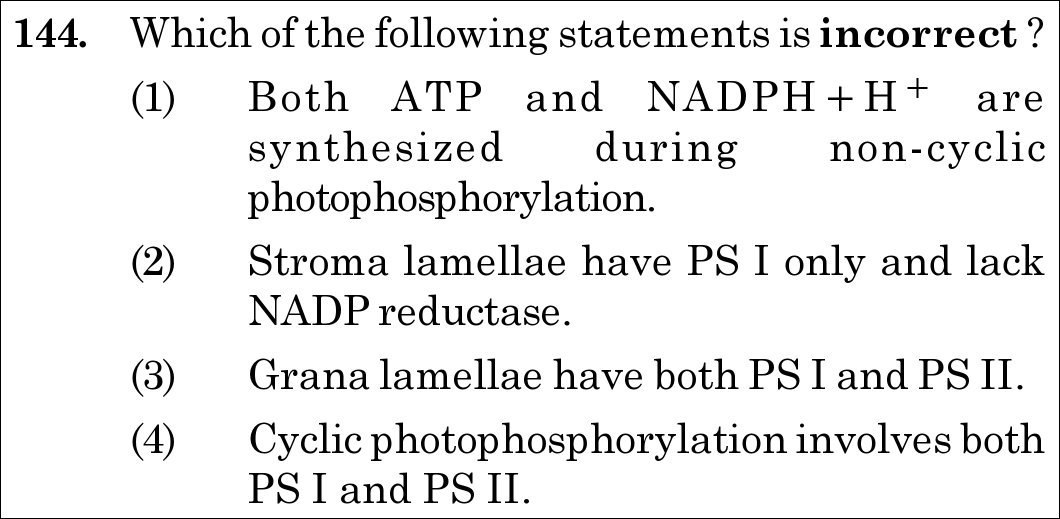
NEET 2021 Botany Question 144: Cyclic vs Non-Cyclic Photophosphorylation and Thylakoid Organization

Question

Which of the following statements is incorrect?

  1. (1)Both ATP and NADPH+H+ are synthesized during non-cyclic photophosphorylation.
  2. (2)Stroma lamellae have PS I only and lack NADP reductase.
  3. (3)Grana lamellae have both PS I and PS II.
  4. (4)Cyclic photophosphorylation involves both PS I and PS II.
✓
Verified Against NTA Final Answer Key
Option (4) : Cyclic photophosphorylation involves both PS I and PS II.
📚 Photosynthesis in Higher Plants Easy
📋 Given Parameters & Problem Setup
Process Light reaction of photosynthesis
Target Identify the statement that is INCORRECT
⚡

The 30-Second Exam Hall Shortcut: ⚡ Cyclic Photophosphorylation Involves ONLY PS I, Never PS II!

⏱️ Save ~20 seconds

Non-cyclic photophosphorylation (Z-scheme) involves BOTH PS II and PS I. Cyclic photophosphorylation occurs when only PS I is functional (e.g., in stroma lamellae which lack PS II and NADP reductase). Claiming cyclic photophosphorylation involves both PS I and PS II is factually wrong! Match Option (4)!

1 Check Statement (1): Non-cyclic photophosphorylation produces both ATP and NADPH + H+   ⟹  \implies TRUE.
2 Check Statement (2): Stroma lamellae possess PS I only and lack PS II and NADP reductase   ⟹  \implies TRUE.
3 Check Statement (3): Grana lamellae appressed membranes possess both PS I and PS II   ⟹  \implies TRUE.
4 Check Statement (4): Cyclic photophosphorylation involves both PS I and PS II   ⟹  \implies FALSE (it operates solely with PS I).
5 Match Option (4).
🛡️
Why You Can 100% Trust This Shortcut: Canonical NCERT Photosynthesis in Higher Plants on Cyclic Photophosphorylation.
📐

Step-by-Step Rigorous Workflow & Mathematical Proof

Step 1

Mechanism of Cyclic Photophosphorylation

When light of wavelength beyond 680 nm680\text{ nm} is available, or when stroma lamellae lack PS II and NADP reductase, only Photosystem I (P700P_{700}) operates in a closed cycle:

PS I (P700)→hνe−→Primary AcceptorCytochrome b6f complex→PlastocyaninPS I (P700)+ATP\text{PS I } (P_{700}) \xrightarrow{h\nu} e^- \xrightarrow{\text{Primary Acceptor}} \text{Cytochrome } b_6f \text{ complex} \xrightarrow{\text{Plastocyanin}} \text{PS I } (P_{700}) + \mathbf{\text{ATP}}
Step 2

Contrast with Non-Cyclic Photophosphorylation

- Non-cyclic photophosphorylation (Z-scheme): Involves both Photosystems II (P680P_{680}) and I (P700P_{700}) operating in series, generating both ATP and NADPH+H+NADPH + H^+, with photolysis of water. - Cyclic photophosphorylation: Involves only PS I. Electrons cycle back to the reaction center, synthesizing solely ATP without NADPHNADPH production or water splitting.

Step 3

Evaluation of Statement (4)

Statement (4) asserts that "cyclic photophosphorylation involves both PS I and PS II". This is incorrect because PS II does not participate in cyclic electron flow.

⭐

360° Option Elimination Engine Key Feature

Diagnose every choice: Know exactly why the right option works and why distractors fail.

4-Option Deep Scan
1 1
✗ Incorrect
Verdict & Scientific Reason:

This statement is TRUE. The non-cyclic Z-scheme generates both assimilatory powers (ATP and NADPH).

⚠️
Student Fallacy (Why candidates pick this trap): Selecting a true statement instead of the incorrect claim.
2 2
✗ Incorrect
Verdict & Scientific Reason:

This statement is TRUE. Stroma thylakoids lack PS II and NADP reductase, performing only cyclic photophosphorylation.

⚠️
Student Fallacy (Why candidates pick this trap): Thinking stroma lamellae contain both photosystems.
3 3
✗ Incorrect
Verdict & Scientific Reason:

This statement is TRUE. Granal thylakoid membranes contain both PS I and PS II.

⚠️
Student Fallacy (Why candidates pick this trap): Thinking grana lamellae are restricted to PS II.
4 4
✓ 100% Correct
Verdict & Scientific Reason:

This statement is FALSE (and hence the correct answer). Cyclic photophosphorylation involves ONLY PS I.

💡
Why this is airtight: None. Clean recognition of the photosystem requirement.
⚠️

NTA Trap Alert: Cyclic vs Non-Cyclic Photosystem Inversion Trap

Non-cyclic = BOTH PS I and PS II; Cyclic = PS I ONLY. Memorize this exact dichotomy.

🛡️ How to avoid the -1 mark: Cycle = 1 loop   ⟹  \implies PS I only.
📖

Core NEET Syllabus Standard

NEET / NCERT Biology · Photosynthesis in Higher Plants Standard Benchmark
Core Scientific Principle Tested:

"When only PS I is functional, the electron is circulated within the photosystem and the phosphorylation occurs due to cyclic flow of electrons. The stroma lamellae membranes lack PS II as well as NADP reductase enzyme."

Syllabus Focus: The Light Reaction: Cyclic and Non-cyclic Photophosphorylation
✓ Core NEET UG Syllabus Anchor Syllabus & Academic Standards ↗

Ready to attempt under real exam pressure?

Test your speed and accuracy in the authentic 200-minute timed NTA simulator.

Launch NEET 2021 CBT Test →

Spotted a mistake in this solution? Report an error (support@mycompetitiveexams.com)

⚖️ Legal & Fair Dealing Notice: Sourced from publicly released NEET 2021 question papers and NEET answer keys for private study, research, and non-commercial educational practice under Fair Dealing (Section 52(1)(a) of the Indian Copyright Act, 1957). Not affiliated with or endorsed by NTA or NMC.

Solve 4 NEET Questions a Day — One per Subject

Cover all 1,140 official NEET questions in 285 days at your own pace. Progress is saved on your device. No login needed.